|
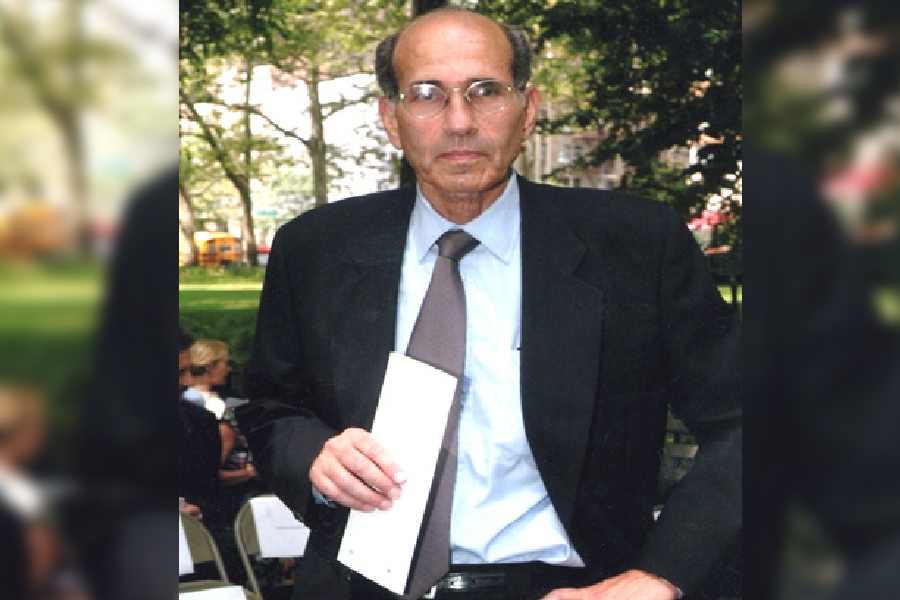
| Aseem Sinha at his Mumbai office. Telegraph picture |
A little girl plays hopscotch within the shadows of prison bars. Her leaps leave her in giggles.
There is poignancy behind the laughter, as the girl, whose mother is serving a sentence in Birsa Munda Central Jail, Hotwar, on Ranchi’s outskirts, has turned six. It means that the time to leave her mother has come.
In 2006, the Supreme Court laid down uniform guidelines for all Indian prisons, which said that female prisoners were allowed to keep their children with them in jail until they reached age six. If the mother wants, the child will be handed over to a surrogate or put in an institution in the same city as the prison. The child must be allowed to meet the mother at least once a week.
This child doesn’t yet know that. When she does, her heart will break at being separated from her mother. At the same time, the rule wants to ensure that the child of a jailed mother can pick the pieces of his or her life and move ahead with dignity.
But either way, it is an experience that leaves a scar. And this is the subject of a film, “But, who killed my childhood?”
Directed by Bollywood film editor Aseem Sinha, originally from Ranchi, the 52-minute documentary made for Prasar Bharati explores the world of children residing in Birsa Munda jail with their mothers. It will be shown on Doordarshan shortly.
For Sinha, it is a story of a mother-daughter bonding, separation and sufferings. At present, there are 18 children at Birsa Munda jail, innocent victims of their mothers’ actions.
Before embarking on this project, Sinha researched intensively inside the jail. “I believe strongly in the subject and I did not want any compromise,” said the editor who has been a staple in Shyam Benegal’s films from Mammo, Sardari Begum, Zubeidaa, Welcome to Sajjanpur and others.
“Through this documentary, I wanted to show the love between a mother and child inside prison and then their separation. The innocent world of children in prison has always interested me. I wanted to probe the children’s psychology, aspirations and dreams within the grim and limited resources of the jail,” Sinha told The Telegraph from Mumbai.
He added other angles to what was undeniably a human drama.
“The children also bond with jail staffers and other inmates. After their release, they venture into the real world. Many don’t know why they had been staying in prison. They understand it gradually. Obviously, the first six years cast an influence over the child’s later life. These were some of the facets I wanted to explore,” he said.
Sinha, armed with a postgraduate diploma in film and television editing from FTII-Pune, has worked with a clutch of serious film-makers such as Benegal, Kundan Shah, Kalpana Lajmi, Ketan Mehta, A.K. Bir, Pankaj Parasher and others.
It perhaps explains his love for looking beyond the obvious. After all, exploring the psyche of collateral convicts — innocent children living with prisoner mothers — is quite a job.
How can society help the children of female convicts?
Tell ttkhand@abpmail.com