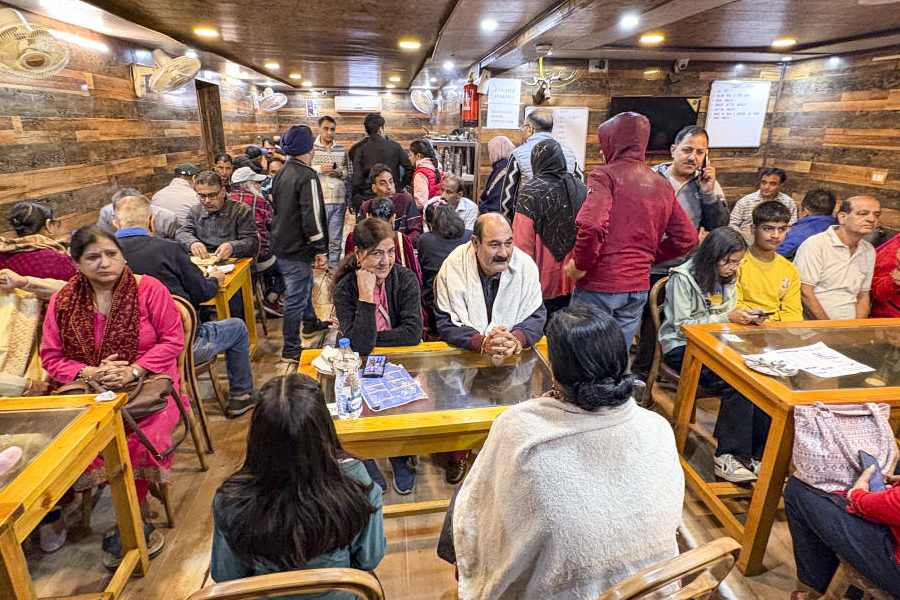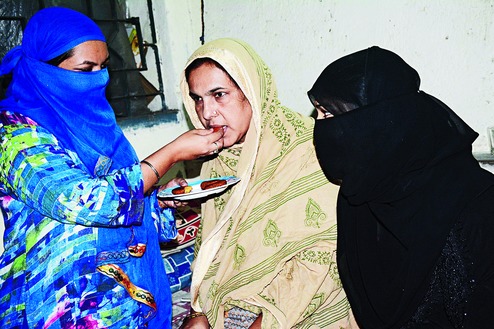

with other women in Jamshedpur on Tuesday. (Bhola Prasad)
Instant divorce for a dark complexion. Instant divorce two days after nikah.
As Muslim sisters across India rejoiced on Tuesday to hail the Supreme Court's decision to strike down instant triple talaq or talaq-e-biddat, which allowed Muslim men to dissolve marriages instantly, two women in Ranchi and Jamshedpur relived their horror and humiliation to underline why the judgment was indeed historic.
The humiliation lasts a lifetime, affirmed a middle-aged woman in Ranchi, who got instant triple talaq over three decades ago. Calling the practice "inhuman", she said her then husband, a young man in his early 20s, had given her instant triple talaq suddenly one day as he was angry over her dark complexion.
"I was still a teenager. I went into severe trauma, I was taunted by everyone while my husband remarried. I am glad the practice will stop," said the woman who refused alimony and took up private tuitions to educate her daughter into a banker.
In Jamshedpur, 24-year-old Nusrat Jahan said she was a victim of instant triple talaq two days after her nikah.
"He was having an affair with another girl. He married me on a whim and divorced me on a whim. I filed a case against him under the Dowry Protection Act but don't have much hope. I am happy what happened to me won't happen to any other Muslim girl now."
Apart from uttering the word verbally thrice, there have been instances of men divorcing their wives by pronouncing talaq three times over phone and even text messages.
In one swoop, the apex court's decision on Tuesday lifted the shroud of fear of instant divorce from millions of Indian Muslim women.
Its time had come, said Ranchi University postgraduate student of science, Afifa Shahin.
"Instant triple talaq had become a tool for fundamentalists to keep women enslaved to their whims. I practise Islam and I know my religion gives equal rights to women," she said, hailing the Supreme Court decision.
Rafia Naz, a student of Marwari College and general secretary of college students union, added the landmark decision gave them freedom.
"I know many Muslim women will not come forward to tell the media but we all are very happy. Triple talaq was never Islamic. Men used it for their vested interests. The SC decision is a celebration of women's rights and equality. We also want the court to fix punishment and do something for multiple marriages," said a 30-year-old law student whose husband has married many times.
Former VC of Ranchi University, the erudite A.A. Khan, hailed Supreme Court decision.
"It is a milestone decision to empower Muslim women. Rules on talaq are elaborately codified in the Holy Quran and the Hadis. There is no place for instant triple talaq. A talaq is supposed to be a well-considered decision taken over a specific timeframe to discourage instant, impulsive decisions," he said.
Added Shaheen Razi, a retired economics professor of Jamshedpur Women's College, "Educated Muslim men never utter words like talaq."
Chief minister Raghubar Das, BJP state minority cell president Sona Khan and JVM's media in-charge Tauhid Alam also hailed the Supreme Court decision. "Islam teaches respect for women. Instant talaq is anti-Islamic," said Alam.
A dissenting voice came from Saud Alam, the head of Imarat-e-Sharia, a religious body in Jamshedpur.
"Triple talaq never existed in Islamic law. There cannot be a verdict on a practice that never existed. Everyone has the right to follow their religion and the court need not have interfered," Alam said.