 |
With India too having caught on with Mother’s Day, slated on Sunday, it is time to say, “thank you, mom” or in case you are more sentimental, “Maa tujhe salaam”. Himanshu Sheth looks back into history and takes time off to chat with two “working mothers”, a phrase which is said to be redundant, as mothers are working all the time.
In England, Mothering Sunday is commonly called “Mother’s Day”. It falls on the fourth Sunday of Lent (exactly three weeks before Easter Sunday). It is believed to have originated from the 16th Century Christian practice of visiting one’s mother church annually, which meant that most mothers would be reunited with their children on this day.
Most historians believe that young apprentices and young women in servitude were released by their masters that weekend in order to visit their families. As a result of secularisation, it is now principally used to celebrate and give thanks to mothers, although it is still recognised in the historical sense by some churches, with attention paid to Mary the mother of Jesus as well as the traditional concept “mother church”.
In the US, Mother’s Day is copied from England by social activist Julia Ward Howe after the American Civil War with a call to unite women against war. She wrote the Mother’s Day Proclamation.
Today, some organisations are working to revive Howe’s original vision of a holiday that celebrates peacemaking by mothers and others.
In the UK, the day now simply celebrates motherhood and thanking mothers. According to the National Restaurant Association, Mother’s Day is now the most popular day of the year to dine out at a restaurant in the US.
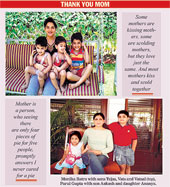
Monika Batra’s elder son Tejas is six years old and her younger twins, Vats and Vatsal, are two and half years old now. Tejas is in primary school and both Vats and Vatsal have started going to play school. Monika happens to be the joint commissioner at Central Excise and Customs in Jamshedpur.
Born in Bhopal into a conservative Sindhi family, her father was an employee with BHEL and mother, a home maker. The youngest amongst three siblings, she was a highly active child.
She pursued bachelor and then masters degree in clinical psychology and topped in the university. Right from childhood days the white car with red beacon used to fascinate her as she found them synonymous with power and respect.
Little wonder then that she appeared for UPSC 1996 and got through in the very first attempt. She was accepted into the IPS but her parents did not want their daughter to get into the police force. So she opted for Indian Revenue Service. She met Ashish Batra during her UPSC days and married him, coaxing her parents to shed their reservations.
Monika’s mantra for tackling the three fold responsibilities — home, children and office — is devotion of due time, in right doses, to all the three. Since her working hours are from 9.30 am 6 pm, she spends quality time with her children after coming home from office.
She believes in her children acquiring a sense of responsibility right from this tender age, and they are encouraged to take decisions and be supportive to the mother in small tasks like managing their school bags and setting the table for dinner.
A mother has to be role model and create a sense of awareness in her children. Children are like “tabula rasa” (a Latin word meaning clean slate) and it is a mother who shape them up to be good citizens, feels Monika.
“Every woman must take up some work outside the responsibilities of her home, whether it is a career, job or persuasion of your passion or interest. It may sound a difficult proposition initially but things settle down soon,” observes Monika.
Parul Gupta is a mother of two children — eight-year-old son Aakash and two-and-half-year-old daughter Ananya. Parul was born at Meerut and has spent her schooling days at different small and at times interior places of UP/ Uttrakhand. Parul’s father was an engineer with irrigation department and her mother, a home maker.
She pursued BSc in nutrition science and also BEd, as she was interested in teaching. In 1993 Parul was introduced to shaded painting on fabric, at a private institute at Jaipur. Painting soon became her passion and profession too.
A woman should definitely pursue a career, but not the one that is rewarding in terms money alone but one that gives her deep satisfaction. Also, she feels that one should not procrastinate for too long to take such decisions.
Something called best time will never happen in future — it is now . Do not fret and frown but go about discharging your responsibilities happily. Never leave a chance to be of help to someone in need — are her mantra for happiness in life. “What makes you happy is life,” states Parul.
Parul prefers to operate from home so that she can look after her children better. Although they may not need their mother to be with them every minute, but the feeling that mom is around, relaxes a child and gives a feel of assurance. Though, working from home is a tougher proposition for the mother, as her privacy at work can easily be broken by just about anyone.
Parul says, “God loves children. But, since He can’t be everywhere, He created mother.” Her favourite lines are from a short poem, A Mother, and she quotes them for The Telegraph readers:
Someone who will never laugh at your mistakes, /For your hurt becomes her. /Someone who stands besides you, / Never in front or behind you. /As strong as an Oak tree /Yet as gentle as a morning rainfall /and as beautiful as a sunset. /Everlasting beauty that will never perish.