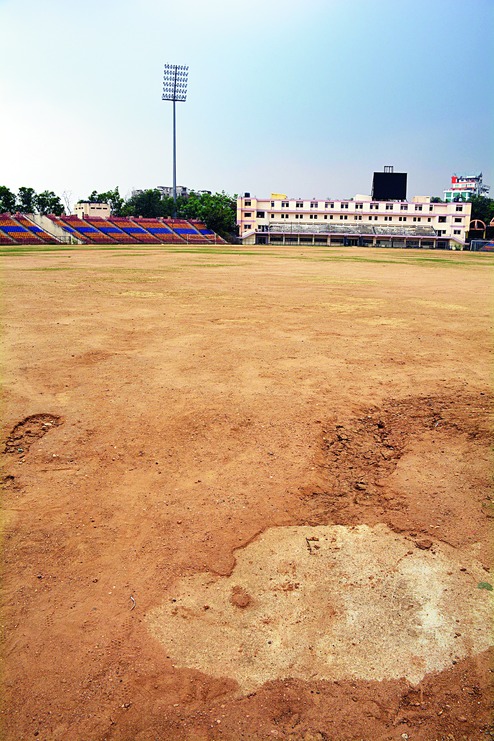

Birsa Munda Football Stadium in Morabadi, shut for a year because of the poor state of the field, is up for a makeover with the state sports department seeking expert suggestions from Jharkhand State Cricket Association (JSCA) chief curator S.B. Singh.
Singh, who visited the stadium recently, has already worked out some of the specifics for the renovation of the greens. He has also submitted his suggestions to the sports department.
"During my visit, a pit was dug out to check the previous layout of the ground profile. It was found to be in a compacted state and it will be difficult for any turf grass to germinate and survive. Also, the hard and over compacted surface, besides increasing the risk of injuries to players, would also lead to accumulation of water on the playing surface," Singh, who is pursuing PHD on cricket pitches and the outfield, told The Telegraph.
The JSCA chief curator has suggested the use of top-fine sand-dominated organic soil (fine sand mixed with compost, powdered neem and castor seeds extracts) under at least 4-5 inches of the playing surface for providing a fertile surface for turf grass. Below the top playing surface, he has suggested laying out 4-5 inches of sandy soil with high-medium to fine sand with clay percentage of up to 5-10 per cent.
"This is done to generate a perched water table in between the two surfaces that acts as a drainage sub-surface. A perched water table in-between the two layers acts as a good source of entrapped water for the turf grass roots," Singh explained, adding that since the monsoon wasn't far off, removal and replacement of the top 10-12 inches of playing surface should be accomplished by the first week of July so that the surface could be transplanted.
Based on rainfall, maximum and minimum temperature and relative humidity, Singh has recommended several varieties of turf to be transplanted, including Bermuda. Apart from the use of fumigants on the sub-surface to control termites, he has called for the installation of a pop-up sprinkler irrigation system to maintain the grass turf.
This means, the stadium would require 60,000 litre to 80,0000 litre of water daily.
Sports director Ranendra Kumar said the suggestions of the JSCA's chief curator would be looked into seriously. "It's our top priority to make the venue regain its old glory," he said.
Last year, the sports department gave around Rs 30 lakh to the district administration to overhaul the ground, which is in a dishevelled state because of prolonged non-use. However, shoddy work and lack of proper expertise yielded no good results.