
The tragedy at Jonha Falls that claimed two teenaged students on Thursday, in a stirring reminder of how unwarranted risks can snuff out young lives, has prompted state tourism mandarins to order barricading of half a dozen waterfalls on the outskirts of capital Ranchi, with groundwork beginning at the killer cascade on Friday.
Expecting heavy rush at Dassam, Jonha, Hundru, Panchghagh, Hirni and Sita falls during the upcoming extended weekend, the department also distributed additional life jackets and buoys at these places. Officials are further mulling a proposal to the home department seeking deployment of static NDRF teams and special training for paryatak mitras.
Class XII students Sameer Vishwakarma (19) of Marwari College and Divyayan Bhattacharya (18) of Surendranath Centenary School drowned at Jonha during a day trip with their girlfriends, both intermediate students of St Xavier's College on Thursday afternoon. The group had allegedly ignored warnings from paryatak mitras to venture into the deep waters without knowing how to swim.
Officials of Jharkhand Tourism Development Corporation (JTDC) inspected the mishap site, 40km from the capital, on Friday morning and recommended barricading.
Rajiv Ranjan, general manager of JTDC and also joint director of the tourism department, said the frequency of drowning - a 16-year-old student had died at Hundru Falls in June - was alarming.
"Although we have deployed paryatak mitras, visitors tend to disregard their advices. So, we have ordered immediate barricading. Five extra life jackets and as many buoys are being distributed at each waterfall," Ranjan said, adding that monsoon downpour had made these tourist spots treacherous.
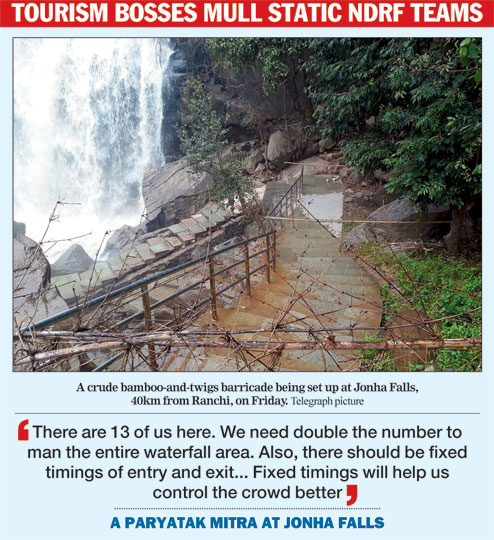
Asked how they planned to fence off the falls, he said they had identified five peril spots at Jonha on Friday, where barricading work was being started as he spoke. "We are using bamboo poles. Each point will be additionally manned by a guard who will be at liberty to use force to restrain unruly visitors and inform police if need be."
On long-term measures, the senior JTDC official said they were in talks with the home department to explore possibilities of deploying the NDRF.
"It will be very helpful if the static NDRF team plan works out. A draft is being prepared and will be forwarded to home officials soon. We further want to give professional training to at least five paryatak mitras (primarily local divers) at each place. A daylong training by NDRF for 30 paryatak mitras (five from each waterfall) will be held at Hundur tomorrow (Saturday)," Ranjan said.
Asked if the department planned to give prosecution powers to paryatak mitras so that safety offenders could be reined in, the JTDC official just said that would be a long-term process.
Currently, there are 93 paryatak mitras at the six waterfalls. But, they feel their numbers are inadequate compared to the average daily footfall of 20,000 at the six waterfalls.
"There are 13 of us here. We need double the number to man the entire waterfall area. Also, there should be fixed timings of entry and exit. The situation is such that tourists come as early as 6am and stay on till very late. We work for hours at a stretch for only Rs 246 a day. Fixed timings will help us control the crowd better," said a paryatak mitra at Jonha, unwilling to be named.