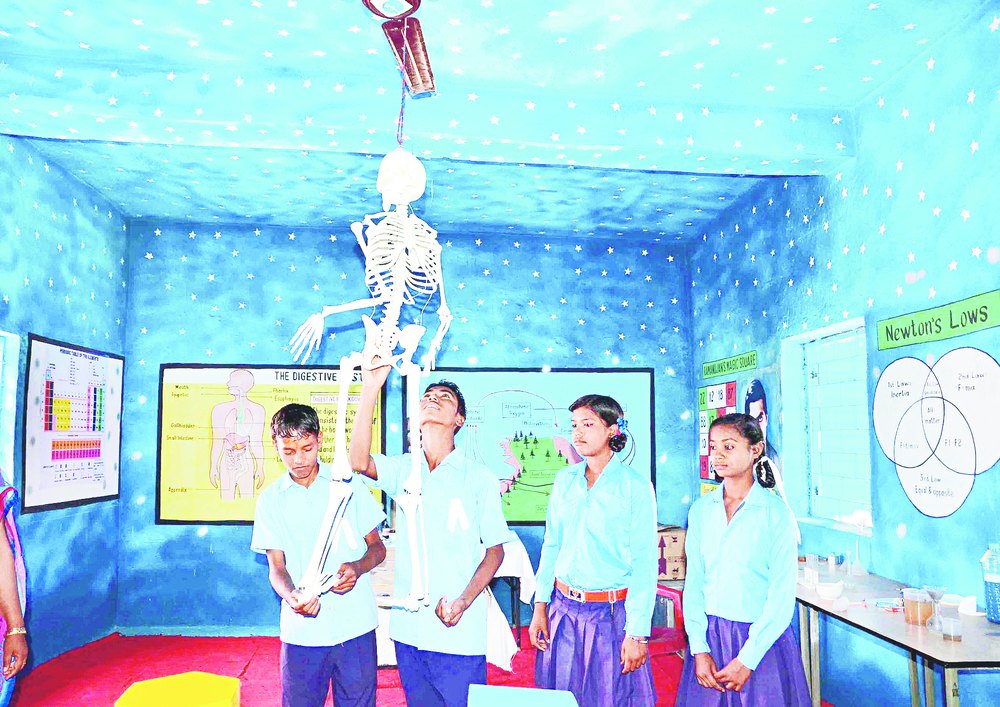

Students check out a human skeleton at the newly built science centre on their school campus in Ranchi. Picture by Prashant Mitra
To the world, they are just teachers. To their students, they are stars.
Twenty-five teachers of a government middle school in Jagannathpur, Ranchi, have become role models for not just the 1,000-odd underprivileged children they mentor, but also their own contemporaries across Jharkhand after they gave up a day's salary to launch a peerless science centre on the campus.
Aryabhatt Bal Vigyan Kendra, which aims to build up a scientific temper among students at the state-run cradle, was formally inaugurated by chief minister Raghubar Das on March 14.
'The science centre follows the motto of making learning simple and fun. A precedent has been set. All schools must try to emulate this model of teaching instead of waiting for government aid to improve infrastructure,' said HRD secretary Aradhana Patnaik who was so impressed by the idea that she too contributed a day's salary for the project.
'We always promote activity-based learning. Every day, students visit the science centre for 40 minutes to learn fundamentals of science and arithmetic,' Patnaik added.
Naseem Ahmed, a science teacher and among the 25 who played Samaritan for the 1,008 children from humble backgrounds, underscored that plain textbook knowledge was making the subject boring.
'A child's mind is impressionable. We wanted our students to learn to follow their curiosity. We wanted them to see and then believe, and never stop asking questions,' the mentor said, adding that the teachers together decided to contribute Rs 1,000 each for the science centre and the project was completed within a month.
Most good things come in small packages. And though Aryabhatt Bal Vigyan Kendra is essentially a couple of modified classrooms, walls outside and inside painted like the galaxy of stars, it is the biggest draw on the modest middle school campus.
Grabbing eyeballs are exhibits on cosmic evolution, the human body, Newton's laws of motion and Ramanujan's number theories among others. But, the centrepiece is undoubtedly a human skeleton dangling from a ceiling fan.
Anup Kesri, also a science teacher, said more needed to be done. 'We have exhibits, but we need equipment too - like microscopes and vernier callipers - to teach students better.'
Seventh grader Poonam Kumari bubbled with excitement nonetheless when asked what she liked at their Bal Vigyan Kendra. 'Oh, I know so much about the human body now... like, we have 206 bones...I have counted them all! I can also tell how our digestive system works. The science centre has clarified all my confusions that some chapters in our book had left,' beamed the girl barely into her teens.
'The skeleton is cool,' piped in Class VIII student Sunita Kumari. 'Reading about the human body in the textbook is one thing. Touching the skeleton to know what we look like on the inside is both scary and interesting,' she giggled.
Rajkumar Nayak, who is in Class VII, likes the paintings on the walls. 'Science, with all its laws and theories, has been made easy. I like visiting the centre every day.'
School principal Poonam Sahay said the science centre had increased interest among students manifold and boosted attendance too. 'Our school was established in 1956. It was recently upgraded into a model school with facilities like toilets, a boundary wall, a playground, kitchen etc. The science centre is now our crown jewel.'