
Ranchi, July 18: Endangered species are being maimed and killed. Poachers are laying traps with remarkable ease. Foresters are finding animal skin and ivory with chilling regularity. And yet, a proposed wildlife crime control cell has failed to see the light of day in Jharkhand.
The nodal outfit, on the lines of the Wildlife Crime Control Bureau under the Union government, was announced at a forest department workshop in April last year. It was supposed to spawn 32 more cells for as many territorial divisions in the 24 districts to effectively keep poachers at bay.
Although senior forest officials in Ranchi division insist that necessary infrastructure was put in place at regional levels (Jharkhand has six forest divisions), insiders say the entire exercise was half-baked and hence, incapable of yielding desired results.
"Yes, logistical support in the form of nets, dart guns, binoculars and vehicles was provided to the regional offices in Ranchi, Hazaribagh, Dumka, Palamau, Jamshedpur and Bokaro. But, the intelligence network that is mandatory to put these tools to use was conspicuous by its absence," a forest official in Ranchi said, requesting anonymity.
According to him, forest divisions were working in isolation. "The basic purpose of a crime control cell, much like the state police's special branch, is intelligence gathering by co-ordinating with other states and the bureau in Delhi, which in turn allows tracking down threats and neutralising them. The nodal cell must act as a bridge between the bureau and the territorial units to effectively crack down on wildlife crime and criminals," he said.
Central regulations say a forest conservator- or chief conservator-rank officer must be appointed the nodal officer to get a state-level cell up and running. "But, that never happened. The nodal cell was never formed because there was no one to coordinate with allied wildlife agencies," the official added.
Jharkhand falls under the central regional office of the Wildlife Crime Control Bureau in Jabalpur. Its deputy director A.R. Choudhary spoke vaguely about the nodal cell. "We were told last year that some anti-crime cell was being set up in Jharkhand... maybe, the chief wildlife warden can tell you its current status," he said.
Chief wildlife warden L.R. Singh, the key custodian of wildlife in the state, said the nodal office had been earmarked at Van Bhavan in Doranda, Ranchi, but conceded that the cell needed to be activated. "Owing to manpower and other issues, it hasn't been made functional yet. We will ensure that the nodal cell takes shape within this financial year. It is our priority," he added.
Agni Mitra, the regional deputy director of the bureau in Calcutta, was not clued in either. "Crimes in Jharkhand are usually ivory-related or involves smuggling of reptile skins. Proper figures must be available with the state forest department."
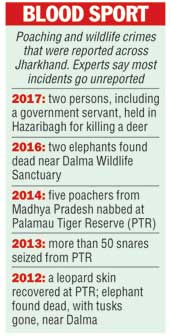
Department sources said data on wildlife crimes was never compiled or maintained, but they conceded that atrocities against animals were rampant.
According to wildlife expert D.S. Srivastava, these incidents were among the few that were reported.
"Most wildlife crimes go unreported. Be it Dalma, Palamau, Saranda or any other protected forest, poaching is routine. For instance, Dumka once had a large population of star turtles, but their numbers have plummeted drastically owing to regular smuggling to Bangladesh. Poaching of the sloth bear for its bile is common too," he said.
Srivastava agreed that the forest department was dragging its feet on intelligence and surveillance. "The department acts when a crime takes place. The job of a nodal cell is prevention. Unfortunately, that mechanism hasn't evolved in Jharkhand till date. It has in many states."