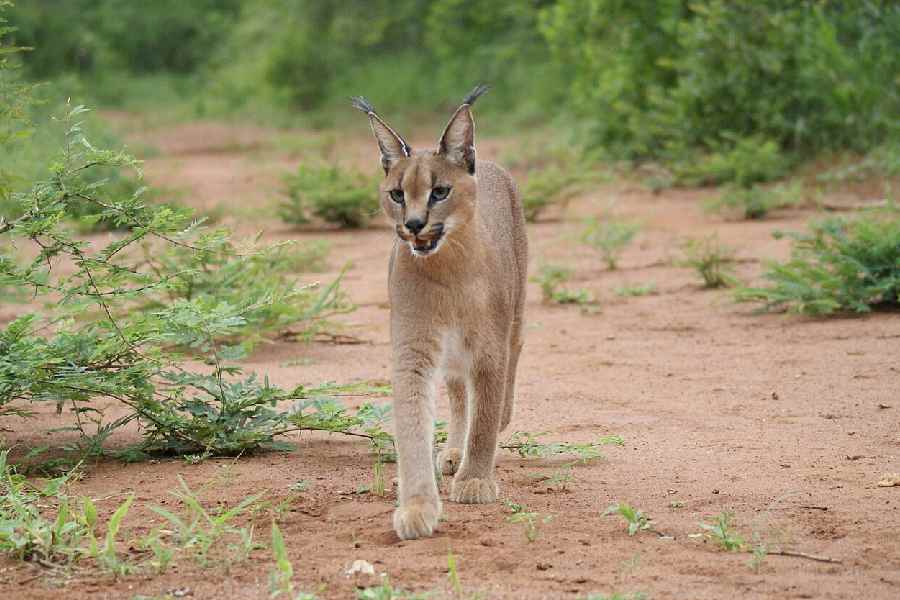
Officials have confirmed the return of the rare caracal in the Thar Desert near the India-Pakistan border, raising fresh hopes for conservation of the highly elusive, and critically endangered species.
The officials spotted two wildcats, a male and female, in the Shahgarh region of Rajasthan's Jaisalmer, with the help of camera traps and radio-collaring, taking the total recorded number of the species to three.
Locally known as 'padang', the caracal is protected under Schedule 1 of the Wildlife Conservation Act. Once widely populated in Rajasthan and Gujarat, the feline found its population decline by more than 95 per cent due to habitat loss, fragmentation, and retaliatory killings.
According to the Wildlife Institute of India (WII) surveys, only around 50 caracals remain in India.
The WII has said that it is conducting a detailed scientific study on the species' behaviour, movement patterns and ecology, while the Wildlife Trust of India has launched a pilot project to involve local communities in conservation efforts and reduce human-wildlife conflict.
Forest officials said motion-sensing camera traps installed at select locations have yielded encouraging results despite their limited number.
Another caracal has also been fitted with a radio collar to monitor its movement, habitat use and proximity to human settlements, officials added.
"Continuous monitoring through camera traps and radio-collaring is helping us better understand the species' behaviour and habitat use," Deputy Conservator of Forest, Kumar Shubham, said.
Following these findings, additional camera traps have been deployed in Ghotaru and other parts of the Thar desert to assess the species' wider habitat range. A comprehensive conservation plan will be prepared after the study is completed, officials said.
To address this, the WII has introduced a "goat bank" model under which a community-managed pool of goats is created. In case of livestock loss due to caracal predation, affected families would be compensated with a goat after verification and later return a kid to sustain the system, officials said.
An expert said the Ramgarh-Shahgarh landscape offers a suitable habitat for caracals due to dry grasslands, low human habitation and sufficient prey base, though movement of nomadic herders increases occasional human-wildlife interaction.
Regular evidence, including pugmarks recorded over the past year, suggests the region may serve as a critical refuge for one of India's last remaining caracal populations, the expert added.
Meanwhile, officials have expressed hope that scientific research, modern monitoring and community participation will aid long-term conservation of the species.