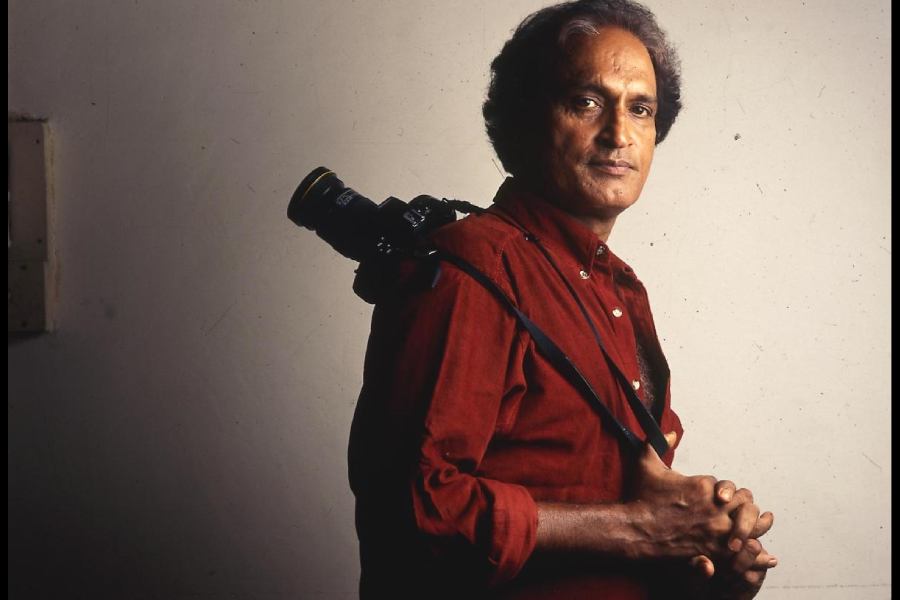
As long as art endures, as long as a semblance of sanity persists in this world, the photographs of Raghu Rai will live on.
In post-Independence India, Rai and Kishor Parekh were towering presences who shaped an entire generation of photojournalists.
Rai’s documentation of the Bhopal gas tragedy — the devastation after the Union Carbide leak — remains a master class for anyone who has ever pointed a camera at human suffering.
And yet an entirely different sensibility defined Rai’s portraits of Indira Gandhi and Mother Teresa. The range was extraordinary, the empathy constant.
Simplicity was the hallmark of his work. He was born into the film era and shot almost without pause, going through two or three rolls during an assignment without a second thought. There was an instinctive restlessness to him, a compulsion to look.
When I joined The Telegraph in 1989, I had encountered his work on its pages. But it was his book Calcutta — published that same year — that truly drew me in, compelling me to visit the Anandabazar library every other day, studying its pages with the fervour of a student who had just discovered his subject.
Six months later, the man himself arrived in the city, working then for the weekly news magazine Sunday.
What has stayed with me from that first meeting is not anything he said about photography — there was no talk of cameras, technique or the projects he had undertaken. Instead, there was warmth and genuine curiosity.
He wanted to know other people, to understand the everyday trials and tribulations of a photographer’s life, and he laced it all with a generous, easy humour. It was simply a day in the life. That was his way.
Soon after the demolition of the Babri Masjid in 1992, Rai returned to Calcutta. Though he had left Sunday by then, I was asked to take him around the city to document the aftermath.
On our way to the Metiabruz neighbourhood, he had a stream of questions for me — some personal, others probing: Why had I taken up photography in the first place?
At Metiabruz, we found the media was being turned away. Despite persistent efforts, we could not get in.
But Raghu Rai always found a photograph. He suddenly asked the driver to stop as we were crossing the Kidderpore-Garden Reach bascule bridge. Below, a group of men had gathered for namaz.
He stepped out of the car like a man possessed and began shooting. When he climbed back in, his eyes were bright — “Mil gaya, mil gaya”. He said it almost to himself, as though he had caught something rare and living.
Relieved, we drove to Balwant Singh’s dhaba for tea, and our friendship deepened over the hours that followed. He spoke of Calcutta with genuine affection.
“You are lucky to be working here,” he told me. “It’s a marvellous city, full of potential.”
Later, he asked where one could find good “machli-bhaat”. He eventually got the meal he was hoping for, along with a fair measure of whisky on the side.
What struck me throughout those conversations was how spiritually minded he was — and how deeply he cared for fellow photographers.
Our next meeting was in Delhi, in the pre-mobile era. After a quick call on the landline, I made my way to his flat in Rabindra Nagar. There, laid out for an upcoming exhibition, were some of his finest printed photographs. He was also preparing a National Geographic project on wildlife in India.
It was on that visit that I met his son Nitin, now an acclaimed photographer in his own right. We shared a meal of tadka-roti. And still, not a word about equipment, or what goes into the making of great photographs.
That period marked a turning point for me professionally. I was growing increasingly drawn to the work of Raghubir Singh and, later, of the Czech-French photographer Josef Koudelka. But my regard for Raghu Rai never dimmed, and our conversations remained personal — his love of plants, his interest in gardening, the life behind the lens.
It was shortly after that I received a Unesco photography award — presented to me by Raghu Rai himself. There was a particular grace in that moment I have never forgotten.
When he heard I had joined The Statesman, he lit up, recalling his own early years in photojournalism there and speaking with affection about the legendary Desmond Doig.
Many generations of photojournalists have grown up in the long light cast by his work. That will be his lasting gift to those who come after.