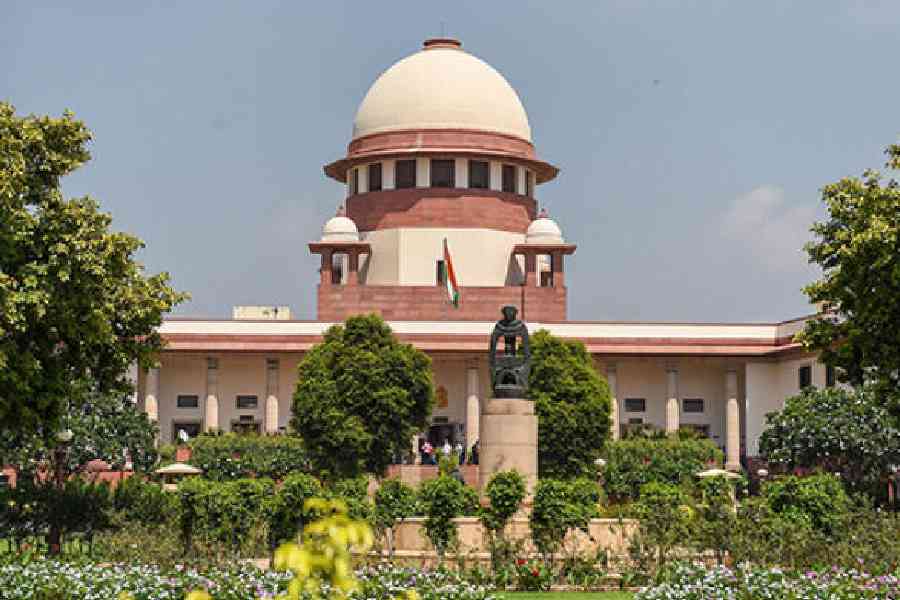
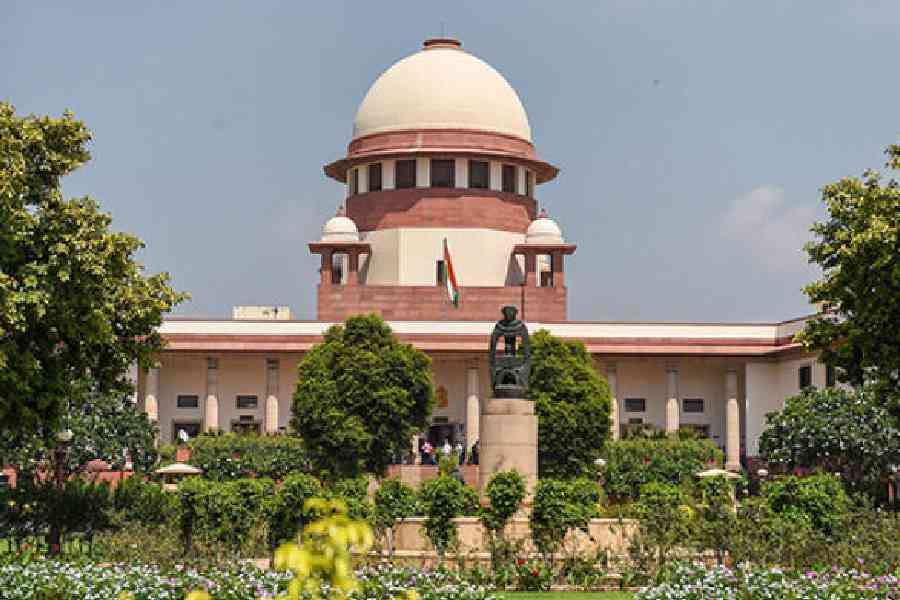
A nine-judge constitution bench of the Supreme Court dealing with appeals seeking reimposition of the ban on women of childbearing age from entering the Sabarimala temple in Kerala has orally observed that it cannot hollow out religion in the name of carrying out “social welfare and reforms”.
The court said certain traditions should be based on the beliefs of millions of devotees practising a particular religion.
“In the name of social welfare and reform, you cannot hollow the religion,” Justice B.V. Nagarathna, the lone woman judge on the bench, told senior advocate Abhishek Manu Singhvi appearing for the Travancore Devaswom Board.
During the daylong hearing, Singhvi submitted that Articles 25 and 26 should be read harmoniously so that the essential religious practice and certain traditional rituals and conventions followed by religious denominations should not be interfered with by courts.
While Article 25 relates to freedom of religion, conscience, practice and propagation, Article 26 gives every religious denomination or any section thereof the right to establish and manage its own religious affairs, subject to public order and morality.
Singhvi told the bench that the court has to be sensitive to the beliefs of millions of people and it was “not a case of dealing with a toy shop” or a “restaurant”.
“Your Lordships are dealing with a deity who is an eternal brahmachari and eschews all forms of grihastha dharma (householder),” Singhvi said.
He justified the temple management’s decision to restrict the entry of women devotees in the 10-50 age group as it was antithetical to the presiding deity at the Ayyappa temple, who is a naishtika brahmachari (eternal celibate).
“It is assumed that women in this age group would be antithetical to the very manifestation and identity of the deity. But those women can certainly visit Lord Ayyappa in many other temples. If they are so concerned, why should they want to visit this one temple which is unique in its form?” Singhvi asked.
He said such an exclusion was permissible under the Constitution and cannot be challenged on grounds of violation of Article 14 (equality) and 15 (non-discrimination).
Singhvi submitted that the Ayyappa temple at Sabarimala is revered by millions only because of the deity having the form of a naishtika brahmacharya, who has “adopted penance of a very high order, which includes celibacy and self-denial to an extreme position”.
Justice M.M. Sundresh, one of the judges on the bench, wondered whether courts can interfere in such purely religious beliefs of millions of devotees without hearing their representatives, merely based on a PIL filed by some interlopers.
CJI Surya Kant was of the view that it would be a difficult task for courts to adjudicate such matters and say that “faith of millions of devotees are wrong”. The arguments will continue on Thursday.
The nine-judge bench comprising Chief Justice Surya Kant, Justices B.V. Nagarathna, M.M. Sundresh, Ahsanuddin Amanullah, Aravind Kumar, Augustine George Masih, Prasanna B. Varale, R. Mahadevan and Joymalya Bagchi is dealing with a batch of petitions and cross-petitions seeking recall of and defending the September 2018 judgment of a five-judge bench that had by a 4:1 majority ruled as “unconstitutional” the centuries-old ban on the entry of women of childbearing age to the Sabarimala temple.
The bench will also be dealing with other issues relating to restrictions on the entry of Muslim women into mosques and dargahs; female genital mutilation among the Dawoodi Bohra community and the ban on the entry of Parsi women to the fire temples if they marry into non-Parsi communities.