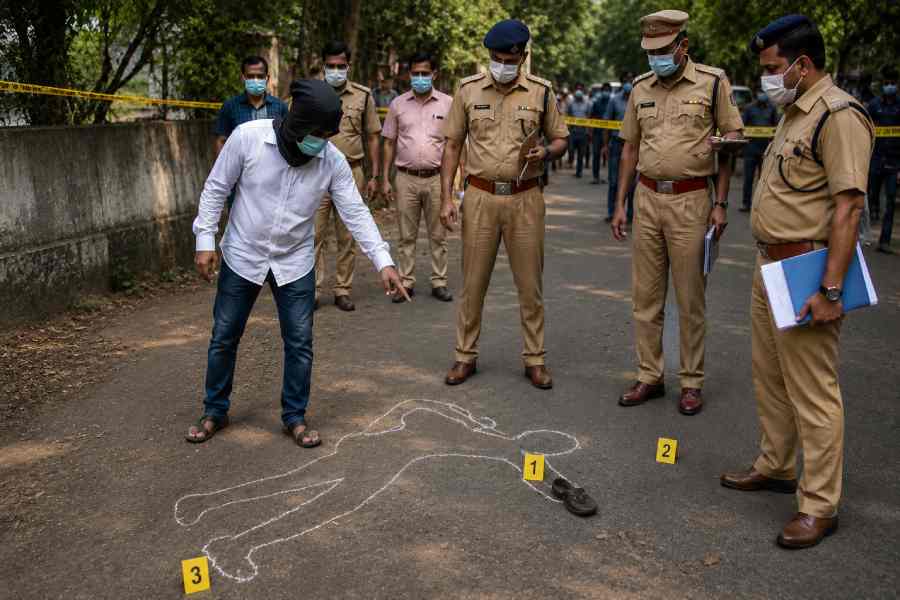
The Supreme Court has reversed the acquittal of five people convicted of a doctor’s murder, as it ruled that asking the accused to re-enact the crime scene was legally permissible and it would be “dangerous” to discard such “potent” scientific evidence.
“The re-enactment or demonstration of an occurrence by an accused is often based on eyewitness accounts of the offence or on the basis of CCTV footage extracted from nearby cameras installed in public spaces. Nevertheless, it cannot be held as a general proposition that every re-enactment or demonstration of a crime scene per se amounts to personal testimony of the accused,” a bench of Justices M.M. Sundresh and Satish Chandra Sharma said in a judgment.
The bench said that if the re-enactment was merely based on a direction to walk, act a certain way or imitate a visual sequence, it did not necessarily involve any physical manifestation or disclosure of the personal knowledge of the accused. “In that sense, it does not amount to any personal testimony,” the top court said. “Therefore, it would be dangerous to lay down a general rule against the admissibility of evidence based on re-enactment or demonstration of the occurrence, as it would effectively kill a potent and scientific investigative technique.”
The apex court passed the judgment while reversing the acquittal of seven accused, whose life sentence by a Chennai sessions court for the murder of Dr Subbiah was set aside by Madras High Court on the ground that the re-enactment of the crime scene was not permitted under law, as it amounted to self-incrimination. Reversing the acquittal, the top court imposed life sentences on five of the convicts while allowing the remaining two to seek remission of their sentence from the governor under Article 161 in view of their advanced age.
Earlier, the high court had said that compelling an accused to re-enact or demonstrate a scene of occurrence amounted to compelling him to reveal personal knowledge and to be a witness against himself within the meaning of Article 20(3).
Further, re-enactment of a crime scene would amount to giving a confession to the police in police custody, which was inadmissible in evidence, the high court had held.
The high court had cited Article 20(3) of the Constitution, which declared that no accused could be compelled to be a “witness against himself”.
It means that an accused cannot be compelled to incriminate himself. The statutory manifestation of this concept is found in Sections 25 and 26 of the Evidence Act, which render a confession made by an accused in police custody inadmissible as it is deemed involuntary or under
compulsion.
However, writing the judgment, Justice Sharma said: “In the present case, the police conducted an exercise of reenactment or demonstration of the crime scene by involving the accused persons. A crime scene reenactment is a technique which is gaining prominence in the investigation of heinous offences. On its own, a re-enactment exercise does not constitute any direct form of evidence of the offence, as it is essentially in the nature of recreated evidence.”
The top court said re-enacting the crime scene served the limited purpose of explaining the physical attributes of the occurrence, such as the place and lighting conditions, to help visualise the manner of commission of the offence.
“It may not directly assist the court in reaching any conclusion, but may help in the appreciation of the... visual evidence of the events.... We are of the view that the high court has committed an error in holding that reenactment by the accused persons amounted to their personal testimonies within Article 20(3) of the Constitution,” the bench said.