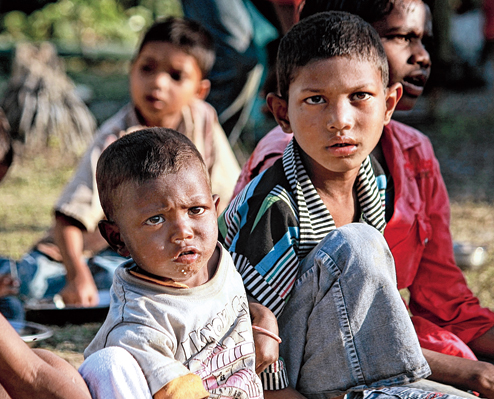

Adivasi children having lunch at a camp in Sonitpur district. Pictures by Nishit Dholabhai
Tezpur, Dec. 29: From a forest rivulet that sustained a village, Jia Gabhru has turned ethnic fault-line.
Twenty-eight years ago, Jakhari Murmu and fellow Adivasis had travelled west from Lakhimpur in search of land and livelihood and settled down on the Gabhru's banks in Sonitpur district.
So had Leelakanta Boro and his clan, migrating eastwards from the Bodo heartland along the north bank of the Brahmaputra.
'We cleared the forests together to start cultivating land at Dayalpur village,' said Jakhari, 67, at the Missamara relief camp today.
Both groups lived in peace in the village, located near Dhekiajuli town, some 40km west of Sonitpur district headquarters Tezpur.

Jakhari Murmu at a relief
camp near Missamari in
Sonitpur district
But when the villagers fled in panic a day after the National Democratic Front of Bodoland (Songbijit) butchered 64 Adivasis in Kokrajhar and Sonitpur districts, the two groups fled in opposite directions - the Bodos to the west of the Gabhru and the Adivasis to the east.
The massacre, followed by sporadic Adivasi reprisals on Bodos, had suddenly given a rebel attack the look of an ethnic strife.
'The river became the dividing line. We came here, the Bodos went in the other direction beyond the Jia Gabhru,' said Renuka Murmu.
On the Brahmaputra's north bank, Bodos and Adivasis have sizeable populations in five districts that form a contiguous strip along Assam's borders with Bhutan and Arunachal Pradesh.
Kokrajhar, Chirang, Baksa and Udalguri are part of the autonomous Bodoland Territorial Areas District while Sonitpur, the fifth district, has parts of its areas claimed by the Bodo militants.
The Adivasis, brought from central and eastern India by the British as indentured tea labour a century and a half ago, want redemption through Scheduled Tribe status. The 'indigenous' Bodos, the state's second largest ethnic group, want a Bodoland state.
The two groups clashed several times in the 1990s but not much since then. Other local communities too have been caught up in ethnic tensions, such as the Bengali-speaking Muslims during the 2012 conflict with Bodos.

Basumatary, a Bodo villager
whose shop was burnt down
by Adivasis, at Ghaghra-Kachari
village in the same district
Over the past three decades, however, Adivasi and Bodo had lived together without much friction in Dayalpur, sharing land and resources and even inter-marrying.
'Leelakanta and Indro (both Bodos) were my best friends, but they passed away sometime ago,' Jakhari reminisced at the Missamari camp, about 65km from Tezpur by road.
His Bodo neighbours are at a camp almost 100km to the west, at Jugibeel, 16km from Rangapara tea and railway township.
'All we need is peace. Just stop this madness,' said Narod Daimary, one of the 500-odd inmates at the Jugibeel camp.
Some 1.6 lakh people have fled to 90-odd relief camps since last Tuesday's massacre, about one lakh of them Adivasis.
Distrust is festering. Many Adivasi camps have mostly women and children while the men are guarding their land back home with sickles, bows and arrows.
As the Bodoland Territorial Council braces for elections early next year and the state for Assembly polls in 2016, the distrust could become political fodder.
Peace message
One ray of hope are the student leaders. 'We want neither Bodoland nor any rights at the cost of blood,' All Bodo Students Union (Absu) president Pramod Boro told this correspondent on the day of the killings.
Edmund Andrew Sawra, the All Adivasi Students Association of Assam (Aasaa) working president, sounded a warning to political parties. 'Finish the terrorists and then think of your political future,' he said.
Boro and Aasaa president Raphael Kujur are in the Gossaigaon area of Kokrajhar, visiting camps to urge people to keep calm.
Kujur said that whatever the terrorists may have done, young people have made up their minds that the rift cannot be allowed to widen. A joint team of Adivasi and Bodo students is touring both the Bodo heartland and Sonitpur.
When it comes to talking peace, the Bodos, as though by an unspoken pact, are keeping quiet while the Adivasi leaders are stepping forward to pledge there would be no more retaliation to the terrorist violence.