The Supreme Court on Monday stayed its own November 20 order that had relaxed mining norms for the Aravalli Range, which stretches across Delhi, Haryana, Rajasthan and Gujarat, amid concerns over ecological imbalance and depleting green space.
A three-judge bench headed by Chief Justice of India Surya Kant, which stayed last month’s order by another three-judge bench, however, threw its weight behind an interim order that the earlier bench had issued in May last year.
It directed “unequivocally” and “as a matter of abundant caution” that, “as set out in the order dated 09.05.2024 (interim order), that until further orders, no permission shall be granted for mining, whether it is for new mining leases or renewal of old mining leases, in the ‘Aravalli Hills and Ranges’”.
The bench, which included Justice J.K. Maheshwari and Justice George Augustine Masih, had earlier taken suo motu cognisance of the matter, although several interlocutory applications had been moved against the November 20 order passed by the bench of then Chief Justice B.R. Gavai, Justice K. Vinod Chandran and Justice N.V. Anjaria.
The earlier bench had accepted an expert committee’s recommendations that, among others, said that only hills with an elevation of 100 metres or more from their local relief shall be deemed as Aravalli Hills.
It said the term “Aravalli Range” would apply only to collections of two or more such hills that are within 500 metres of one another.
Mining restrictions were to apply only to hills that satisfied these stipulations, according to the November 20 order, leaving other areas that were normally considered a part of the ecologically fragile Aravallis free to be mined.
This had provoked an avalanche of protests from environmental activists and civil society, culminating in Monday’s order.
“While we have no scientific reasons justifying any ex-facie acceptance of the same, nor any cogent evidence or expert testimony to substantiate these individual contentions, nevertheless, it seems prima facie that both the Committee’s Report and the judgment of this Court have omitted to expressly clarify certain critical issues,” the apex court said.
“Furthermore, there has been a significant outcry among environmentalists, who have expressed profound concern about the potential for misinterpretation and improper implementation of the newly adopted definition and this Court’s directions.
“This public dissent and criticism appear to stem from the perceived ambiguity and lack of clarity in certain terms and directives issued by this Court. Consequently, there is a dire need to further probe and clarify to prevent any regulatory gaps that might undermine the ecological integrity of the Aravalli region.
“We therefore deem it appropriate that prior to the implementation of the Committee’s Report, or the execution of the directions (in the November 20 judgment)… a fair, impartial, independent expert opinion must be obtained and considered, after associating all requisite stakeholders.”
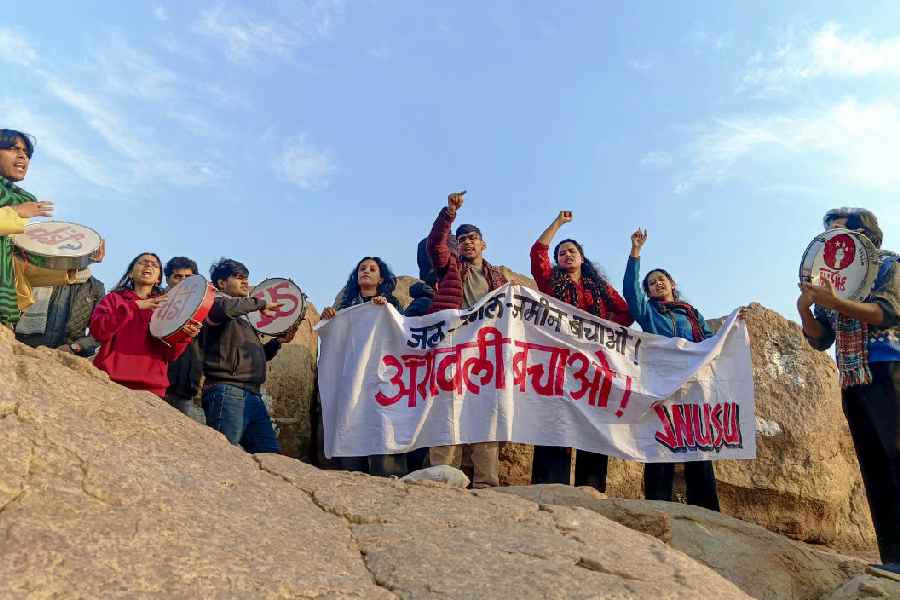
JNU students demand the protection of the Aravalli Hills on Saturday. PTI
The order outlined the need for “definitive guidance” on issues such as:
- Whether the definition of “Aravalli Hills and Ranges”, restricted to 500m stretches between two or more Aravalli Hills, significantly narrows the geographical scope of protected territory.
- Whether this broadens the scope of “non-Aravalli” areas, facilitating the continuation of unregulated mining and other disruptive activities in terrain that is ecologically contiguous but technically excluded by this definition.
- Whether the Aravalli Hills, characterised by an elevation of 100m and above, constitute a contiguous ecological formation even when the intervening distance exceeds the stipulated 500m threshold.
- Whether regulated mining would be permissible in these gaps. If so, what precise spatial parameters or lateral width would be used to define the extent of the Aravalli Range to ensure that ecological continuity is not compromised?
- Whether the widely publicised criticism that only 1,048 hills out of the 12,081 in Rajasthan meet the 100m elevation threshold is scientifically accurate.
- If yes, whether an exhaustive scientific and geological investigation, involving the precise measurement of all hills and hillocks, is necessary for a more nuanced and “measured” assessment.
“In the interim, to subserve the ends of complete justice and in the broader public interest, we deem it necessary to direct that the recommendations submitted by the Committee, together with the findings and directions stipulated by this Court in its judgment dated 20.11.2025, be kept in abeyance,” the court said.
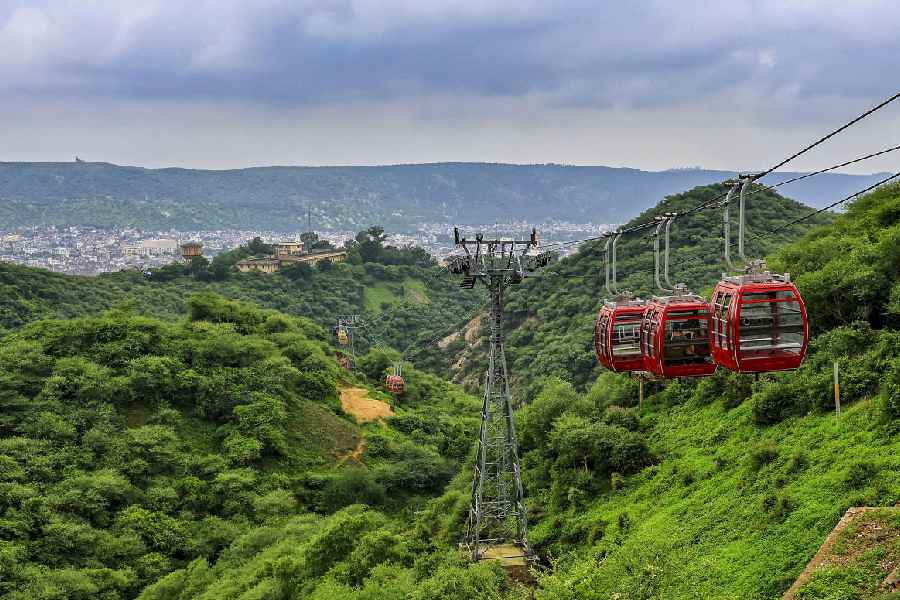
The Aravallis, often called the “green lungs” of northwestern India, have for centuries hosted diverse ecosystems and provided livelihoods to many communities. These mountains separate the arid northwestern desert from the fertile northern plains, and are home to some of the country’s most significant mineral deposits.
However, decades of unchecked urbanisation, systematic deforestation and intensive resource extraction are said to have put an immense strain on this fragile
ecosystem.