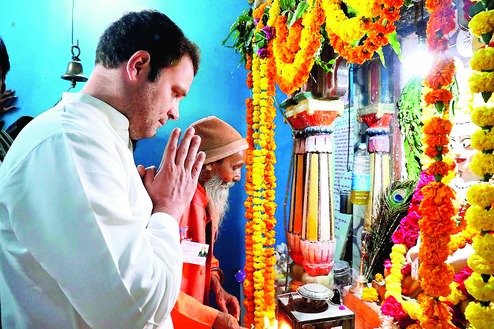

and (below) at the Swaminarayan Akshardham Temple in Gandhinagar

Paresh Gajera, president of the Shree Khodaldham Trust (SKT), the most important religious body of Gujarat's Leuva Patel community, says he gets goosebumps whenever he talks about the gathering of devotees at the inauguration of the Khodiyar Temple in Bhavnagar in January this year.
Leuva Patel is one of the sub-castes - the other being Kadwa Patel - constituting the powerful Patidar community of the state. The Patidars make up 15 per cent of Gujarat's population and are known for their economic and political clout. Just this week, the young Patidar challenger, Hardik Patel, signed up an election deal with the Congress on the promise that the community will be granted reservation. Whether that agreement can tilt the balance of power in Gujarat is yet moot, but the wooing of the Patidars is one of the stories of the campaign that's unfolding.
"Around 75 lakh people visited the temple in a week. It was perhaps the greatest ever show of strength on the soil of Gujarat," says Gajera, adding, "Khodiyar Ma is the kuladevi (community deity) of the Leuva Patels and Khodaldham is the only place where all members of our community come to worship. How can anybody ignore us?"
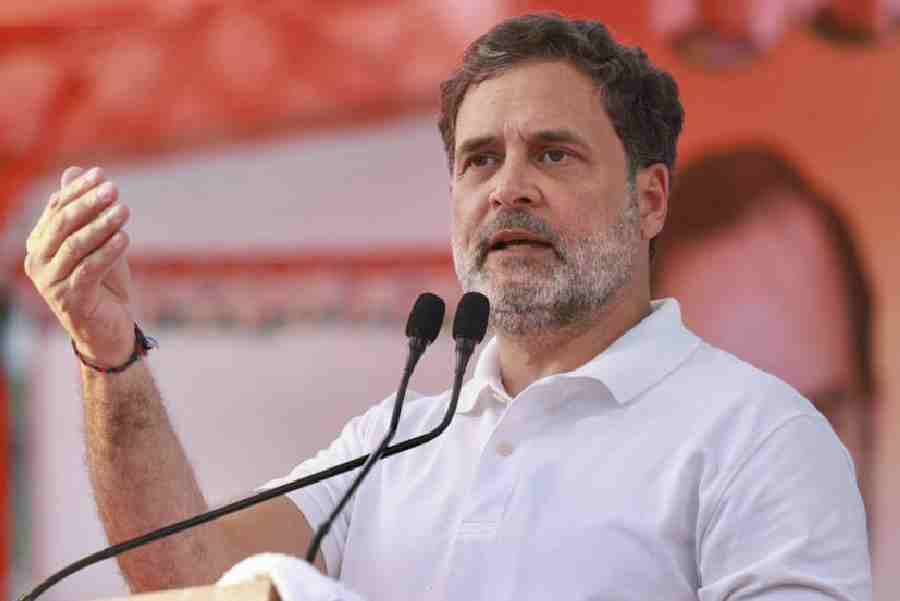
Indeed, nobody can, and somebody didn't. In September, when Congress vice-president Rahul Gandhi visited the Saurashtra region, he visited Khodiyar.
The Congress in Gujarat has been ignored by the Leuva Patels since the 1980s. They had shifted allegiance to the BJP. The Congress, for its part, focussed on the KHAM - Kshatriya, Harijan, Adivasi and Muslim - votebank.
But now, finding a chink in the Gujarat BJP armour in the form of the Leuva Patels' displeasure with the incumbent state government over reservations in government jobs, Rahul Gandhi approached Khodiyar Ma, opportunely.
Only two days prior to that Gandhi had climbed 600-plus stairs of the Chotila Hill to reach the Chamunda Mata Temple. Chamunda is the reigning goddess of seve-ral communities, including the Kolis - a Kshatriya caste - who dominate quite a few Assembly constituencies. "The Congress is trying to appease all sections of the society without knowing as to what it will gain in the end," says Gaurang Jani, sociologist.
Gandhi also visited the Dwarkadhish Temple, Dwarka; Jalaram Bapa Temple, Virpur; Dasi Jivan Temple near Jasdan, Kalika Mata Temple in Pavagadh, Dakor Temple in Kheda and so on and so forth.
Visiting temples is nothing new. Indira Gandhi was a regular visitor to the Ambaji Temple in Banaskantha district and Dwarkadhish. "Even Sonia Gandhi started her Gujarat campaign in 2003 with a visit to Ambaji," points out Vidyut Joshi, an Ahmedabad-based political analyst. But just one well-publicised visit to a temple doesn't cut with the people these days, he believes. Ambaji was one of Gandhi's many stops last year - during the latest leg of his party's Navsarjan Yatra in the state.
Assertion of caste and sub-caste has been on the rise in Gujarat. And according to political analyst and social activist Achyut Yagnik, many of these have chosen to align themselves along their kulas or castes/sub-castes/community. Joshi gives the example of how youth in Gujarat wear their caste on their bikes and cars. "They simply have a sticker of their kuladevi. You see the sticker and you know their caste."
With communities thus cobbling themselves around kuladevis or patron deities to assert their identities, analysts say Gandhi's temple run was an inspired political strategy. "Some have called it soft-Hindutva, but I would say it is hard-nosed politics," says Yagnik.
One of Gandhi's many stops was the Umiya Ma Temple in Kunjha late last year. Umiya is the reigning deity of the Kadva Patels, and the Patidar Anmat Andolan Samiti (PAAS) leader Hardik Patel is a Kadva Patel.
When PAAS first started organising demonstrations, the Gujarat government largely saw it as a group of agitated youngsters. It was only after prominent images of Umiya started app-earing on posters and banners that the pro-tests were perceived as having the support of the community.
Understanding full well the traction of the kuladevis, Hardik has also been making it a point, to invoke deities such as Umiya, Khodiyar and Amba at large gatherings. He has also been asking followers not to "betray" them by siding with the ruling party.
To come back to Gandhi's temple visits, the BJP is not a little irked by what they have dubbed as "publicity events". Bharatbhai Pandya of the state BJP says, "He has every right to go to any number of temples he wants to visit. It is being done not out of devotion but with votes in mind. People of Gujarat are smart enough to understand that and the Congress will be rejected."
The state Congress has to say that the media is deliberately focussed on Gandhi's visits to Hindu temples, whereas he visited Jain, Sikh and Muslim places of worship, too. Says state Congress leader Shaktisingh Gohil, "Ours is a secular party and we respect all religions. The BJP, for many years, has been spreading lies about the Congress. It is important for a leader like Rahul ji to show that Congress is for everybody to co-exist without any discrimination."
Gujarat has been a stronghold of the Sangh Parivar for more than two decades now and some claim that Gandhi had to do something different to appeal to those who see the Congress as being anti-Hindu. Warns Joshi, "He may want to change that perception, but it is a slippery slope. He may now be expected to visit every small temple as it is associated with some influential group or the other."
Rahul’s Temple Rundown
And the communities each is associated with
♦ Shree Khodaldham Temple, Rajkot
Patidars
♦ Bahucharaji Temple, Mehsana
Charans, a nomadic tribe
♦ Vir Meghmaya Temple, Patan
Meghwal community of Dalits
♦ Dakor Temple, Kheda
Vaishnavs and some Brahmin sub-castes
♦ Bathiji Temple, Phagvel
Kshatriyas
♦ Chamunda Mata Temple, Chotila
Kolis, a Kshatriya sub-caste
♦ Umiya Ma Temple, Kunjha
Kadva Patels, a sub-caste
♦ Dwarkadhish Temple, Dwarka
Vaishnavs
♦ Jalaram Bapa Temple, Virpur
Lohanas
♦ Dasi Jivan Temple, near Jasdan
Dalits and Buddhists
♦ Akshardham Temple, Gandhinagar
Vaishnavs
♦ Ambaji Temple, Vanaskantha
Several castes and communities