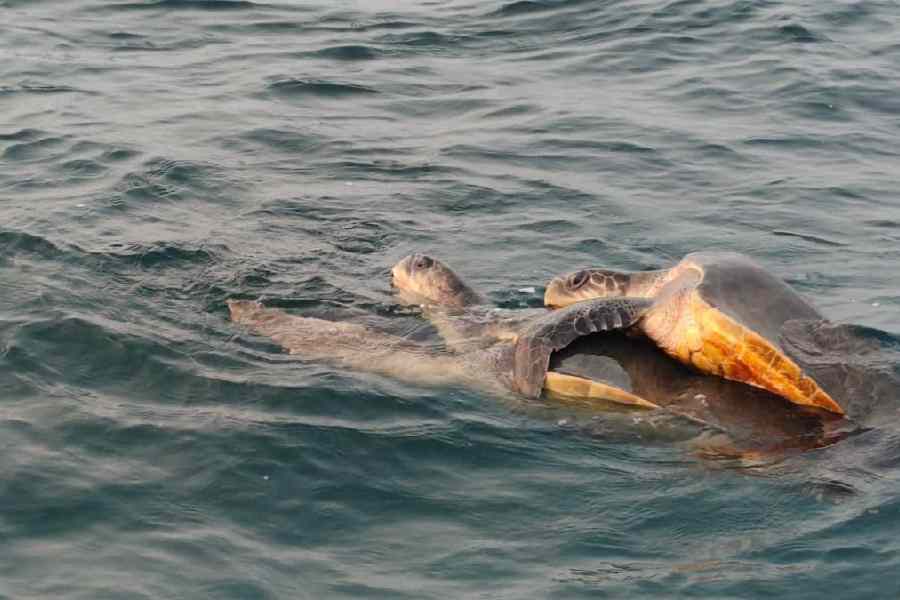
The annual mating phase of endangered olive ridley turtles has commenced along the Odisha coast, with key congregation sites reporting increased activity.
Thousands of turtles have been sighted off the coast of Ganjam in southern Odisha and at the Gahirmatha Marine Sanctuary in Kendrapara district.
“The weather is conducive for mating. The mass mating has begun at the Rushikulya river mouth in Ganjam. There was sporadic mating last month. Once the mating is over, the egg-laying process will begin,” said Rabindranath Sahu, secretary of the Rushikulya Turtle Sea Protection Committee.
According to Sahu, lakhs of olive ridley turtles migrate from the Sri Lankan coast, taking nearly 27 days to reach Ganjam. “The mating and mass nesting season will continue till the end of April. Mating goes on till the end of January. After mating, the female turtles remain in the sea at a distance of three to four kilometres in a floating condition. Once temperatures rise with the receding winter, the turtles come ashore to lay eggs,” he said.
After laying eggs, the turtles return to the sea, while hatchlings emerge after 45 to 60 days, Sahu added. “After laying eggs, most turtles head back towards the Sri Lankan coast. We have evidence of this from the government’s tele-marking study. This time, eight turtles have already been fitted with transmitters to track their journey.”
In December 2025, the Odisha government, in collaboration with the Wildlife Institute of India, fitted satellite transmitters — known as Platform Transmitter Terminals — on six turtles at the Gahirmatha Marine Sanctuary and two at the Rushikulya river mouth.
Assistant conservator of forest (ACF) at Gahirmatha Marine Sanctuary, Manas Das, said a large number of turtles are being observed in the area. “We are quite hopeful about the outcome. Last year, around six lakh turtles visited Gahirmatha for mass nesting,” he said.
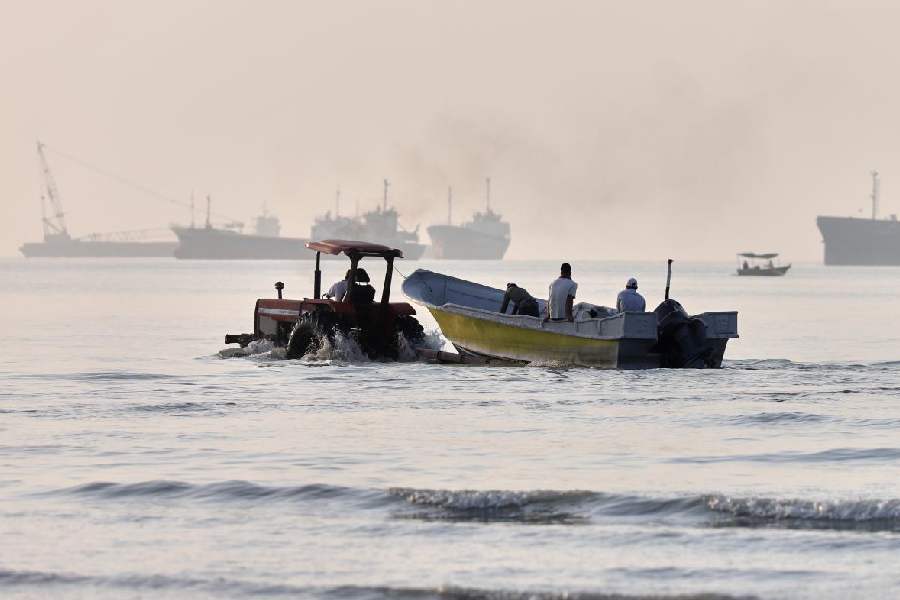
To protect the turtles during the breeding season, Odisha has imposed a seven-month ban on fishing at three major river mouths, which will remain in force till May 31, 2026. The restricted areas include the Rushikulya river mouth in Ganjam district (from south of Prayagi to north of Aryapalli), the Devi river mouth covering parts of Jagatsingpur and Puri districts, and the Dhamra river mouth in Bhadrak district (from Scott’s Island to Udabali North). These locations are known olive ridley nesting sites.
Nearly 11 lakh olive ridley turtles visit these sites annually to lay eggs, while more than 15 lakh were reported during last year’s mass nesting. The phenomenon is known as “arribada”, a Spanish term used to describe the mass nesting of these eco-sensitive marine creatures.
Under the ban, fishing by motorised vessels, trawlers and mechanised fishing boats is prohibited within 20 kilometres of the designated turtle congregation areas and their buffer zones. The restriction has been imposed under the provisions of the Orissa Marine Fishing Regulation Act, 1982, and the Wildlife Protection Act, 1972.
To ensure strict enforcement, the state government has set up 61 onshore camps and five offshore camps across the three river mouth areas.