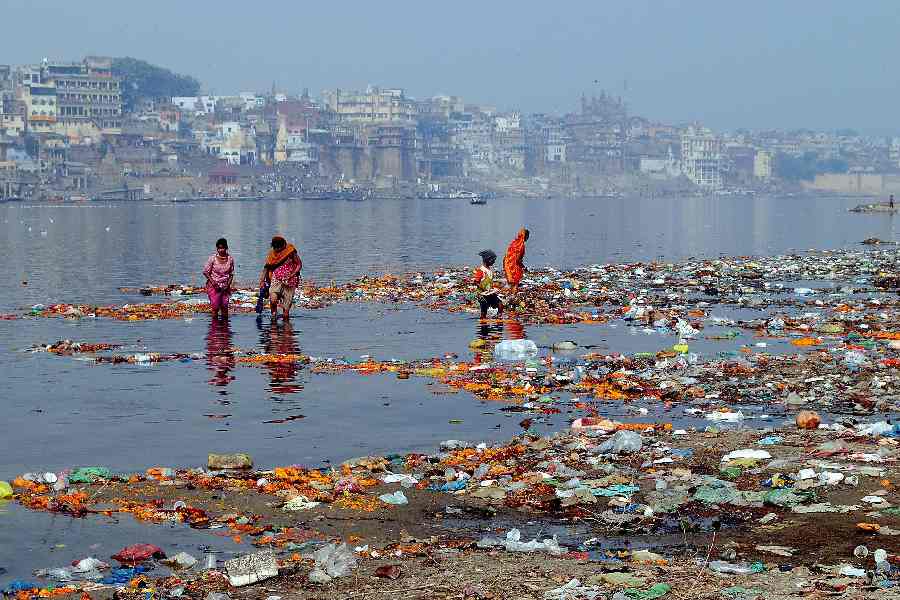
A report by the Comptroller and Auditor General (CAG) has said that the Centre's 'Namami Gange' programme has failed to deliver the desired results in Uttarakhand due to the failure of the state's implementing agencies.
It said that under the flagship programme, launched over a decade ago to clean Ganga river, the Centre had provided Rs 1,000 crore between 2018 and 2023 (the auditing period) for the effective implementation of the project in the state.
However, the report, presented during the ongoing state's budget session, notes several irregularities found in this project, including defective designs of sewage treatment plants (STPs), poor maintenance of infrastructure, failure to tap drains discharging into the Ganga, and the dumping of waste near rivers and smaller streams.
The CAG observed that the detailed project report (DPR) for Forestry Interventions for the Ganga (FIG) included a budgetary provision of Rs 885.91 crore and a plantation target of 54,855.43 hectares.
However, contrary to this, only Rs 144.27 crore-amounting to just 16 per cent of the allocated funds - was actually utilised. Consequently, physical progress remained sluggish, and the scheme failed to achieve the specific objectives related to the rejuvenation of the Ganga.
Of the 44 STPs inspected by the CAG in 2023, only three to five were found to be compliant with the norms set by the National Green Tribunal (NGT), while merely six to twelve were found to be in compliance with the standards of the Ministry of Environment, Forest and Climate Change (MoEF) and other relevant criteria.
The report states that this reveals widespread non-compliance and a substandard level of sewage treatment.
Of these 44 STPs, the majority demonstrated gross non-compliance with the norms of both the MoEF and the NGT across all three quarters of 2023, with levels of Biochemical Oxygen Demand (BOD), Total Suspended Solids (TSS), and Faecal Coliform far exceeding the permissible limits.
The report also notes that in Chamoli, Rudraprayag, Tehri, and Uttarkashi districts, cremation ghats were constructed at 11 locations without assessing local needs or cultural practices; consequently, these facilities are neither being utilised nor maintained, while funeral pyres continue to be lit along the riverbanks.
According to the report, in 2011, the then State River Conservation Authority set a target to prevent untreated urban wastewater and industrial effluents from entering the Ganga by 2020; yet, state government officials have failed to formulate a plan even 13 years later.
The report further states that District Ganga Plans were not formulated in any of the districts within the Ganga basin, resulting in the poor management of sewage-related issues and a failure to achieve the 2020 target.
According to the report, one of the key objectives of the 'Namami Ganga' was to involve local communities in the planning of sustainable infrastructure. However, an audit revealed that state government officials and implementing agencies failed to engage local residents, leading to improper utilisation (or complete non-utilisation) of the sewage infrastructure.
The report observes that, despite bearing the responsibility for sanitation in the towns situated along the banks of the Ganga, the state government did not allocate funds from its own resources toward the sewage infrastructure in these areas.
The state neither constructed STPs nor provided sewer connections to households. Furthermore, initiatives such as those funded by the German Development Bank (KfW) remained limited solely to Haridwar and Rishikesh.
According to the report, not a single household was connected to any of the 21 STPs constructed across seven riparian cities along the Ganges (two in Nandprayag, five in Karnaprayag, six in Rudraprayag, two in Kirtinagar, one in Chamoli, three each in Srinagar and Shrikot, and two in Joshimath).
The report states that during the audit, only partial sewage connectivity was observed in households; specifically, in Haridwar (69 per cent), Rishikesh (29 per cent), Srinagar (12 per cent), Uttarkashi (9 per cent), and Chamoli (6 per cent). The primary reasons cited for this were a shortage of sewer lines and inadequate treatment capacity.
Additionally, the STPs in Haridwar and Rishikesh are grappling with the problem of overloading-that is, receiving sewage volumes exceeding their designed capacity.
Conversely, the STPs in Devprayag and Joshimath are operating significantly below their capacity due to insufficient sewage inflow. As a result of these issues, the intended objective of the STPs has been undermined.
During the audit, it was also observed that 12 STPs-located in Dhallwala (Rishikesh), Kirtinagar, Rudraprayag, Shrikot, Gopeshwar, and Karnaprayag-are discharging untreated sewage directly into the Ganges.
The audit also revealed that among the 44 STPs, eight have been operating for over four years without valid consent or authorisation from the Pollution Control Board; this not only violates legal provisions but also poses significant environmental risks, says the report.
Even several years after their construction, 18 STPs have yet to be handed over by the construction agency-the Uttarakhand Peyjal Nigam-to the designated maintenance agency, the Uttarakhand Jal Sansthan.
The report notes that, due to the failure to conduct mandatory safety audits as stipulated by regulations, a 75-kilolitre capacity STP located in Rudraprayag was destroyed by a landslide in 2021, resulting in a financial loss of Rs 88 lakh.
Furthermore, a severe accident at the Chamoli STP in 2023 resulted in 28 people suffering electric shocks, 16 of whom lost their lives.