
New Delhi, April 29: The Union cabinet has approved a proposal to drop an anti-corruption clause that was blamed for a "policy paralysis" and was invoked by a court to summon former Prime Minister Manmohan Singh in a coal allocation case.
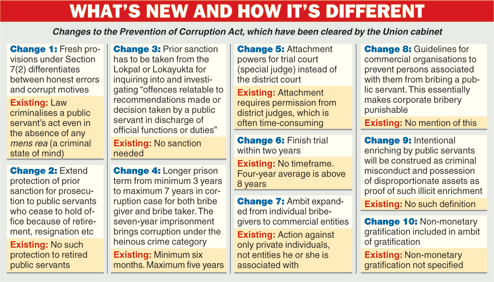
Most of the amendments to the Prevention of Corruption Act, which were approved by the cabinet today, are intended at making the law more stringent and bringing the scourge under the heinous crime category.
But it was decided to do away with Section 13 (1) (d) of the act, which makes public servants culpable even in the absence of any mens rea (a criminal state of mind).
According to sources, the government has inserted a fresh provision under Section 7 (2) to remove the ambiguity between an honest error and decisions taken with mala fide intention. The new provision redefines certain phrases such as "corrupt means", "pecuniary advantages" and "public interest" to ensure that an act of corruption was not confused with an "honest error".
The amendments also offer some sort of protection to both serving and retired officials in line with the government's assurance that bureaucrats would not be hounded for taking decisions.
If and when the amended bill is passed in Parliament, an investigating agency will require the prior sanction of the Lokpal or its counterparts in the states to probe alleged offences against a serving public servant. The Supreme Court had earlier said such sanction was not needed.
"Section 13 (1) (d) of the act was a draconian provision which can be used to question any decision taken by public servants and bureaucrats. The definition of certain phrases in the act is too vague and ambiguous and that's why it needed amendment to protect honest public servants," said a senior official.
The latest amendment, he said, is based on the UK Bribery Act 2010 and aims to clarify that every wrong decision is not an intended wrong-doing.
At a CBI event on Monday, finance minister Arun Jaitley had advocated amending the Prevention of Corruption Act because "departments and civil servants are reluctant to take decisions" fearing future prosecution.
In August 2013, the UPA-II had introduced an amendment bill but it could not be passed in the Rajya Sabha. The Manmohan government had also decided to revoke Section 13 (1) (d) of the act. The latest amendment includes some portions of the earlier bill prepared by the UPA-II.