The Narendra Modi government on Wednesday deferred the passage of the contentious FCRA Bill in the Lok Sabha, a move seen to be driven by concerns over a potential backlash from the electorally significant Christian community in poll-bound Kerala.
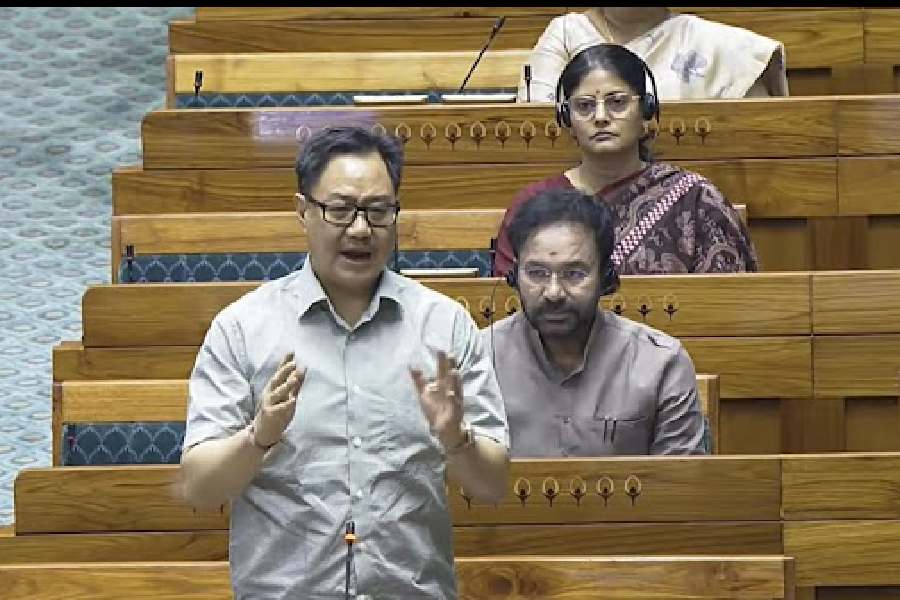
The Foreign Contribution (Amendment) Regulation Bill, introduced last week, was listed for discussion and passage in the Lok Sabha on Wednesday. However, amid Opposition protests, parliamentary affairs minister Kiren Rijiju informed the House that it would not be taken up, while accusing rival parties of spreading a “false narrative” in Kerala. The current session of Parliament concludes on Thursday.
“I had informed senior Congress leaders yesterday (Tuesday) and again today that the FCRA Bill listed for consideration will not be taken up,” Rijiju said during Question Hour as Opposition members raised slogans against the proposed amendments.
He maintained that misinformation was being circulated about the bill in Kerala. “The amendments are aimed at regulation and proper use of foreign funds, keeping in mind national security and national interest. It is not against any religion or targeted at any organisation,” he said, accusing the Congress and the CPM of misleading people.
CPM Rajya Sabha member John Brittas accused the government of denying information related to organisations losing licence under the Foreign Contribution (Regulation) Act.
“Apparently, even seeking elementary information from the Government on how many organisations have lost FCRA licences, the reasons for cancellation or non-renewal of FCRA licences, the state-wise distribution of such actions, and the curtailment of public access to NGO-wise data on the FCRA portal, has, for the past couple of years, been treated as a matter of national secrecy,” he wrote on X.
“From 2024 onwards, I have submitted eight rounds of questions in the Rajya Sabha seeking basic transparency on FCRA suspensions, cancellations, non-renewals, fresh registrations and the accessibility of the FCRA dashboard. Yet, none of those questions elicited any response. All those questions relating to cancellation of FCRA licences were disallowed.”
In Kerala, state BJP president Rajeev Chandrasekhar sought to allay concerns, stating that the legislation would be taken up only after wider consultations with stakeholders. The Centre’s decision comes amid strong opposition from the Catholic Church and Kerala’s two principal political formations — the ruling Left Democratic Front and the Congress-led Opposition UDF.
“The bill will not be passed in haste. Before it is brought to Parliament, stakeholders will be consulted and their concerns addressed,” Chandrasekhar told reporters at the state party office.
He added that he had spoken to Prime Minister Narendra Modi and Union home minister Amit Shah on Tuesday, following pressure from Church groups and political parties, and conveyed the state unit’s apprehensions. The BJP has been attempting to woo Kerala’s Christian community to get a foothold in the state, scheduled to vote on April 9.
The government’s decision to defer the bill despite earlier asserting its necessity in “national interest” suggested it had stepped back, fearing electoral damage. The bill was introduced, brushing aside Opposition objections that described the provisions as “draconian” and “dangerous”.
The proposed changes seek to tighten the regulatory framework governing foreign contributions, including the creation of a designated authority to take control of assets of NGOs whose licences are cancelled. The provisions include both provisional and permanent vesting of such assets under government control.
Reacting to the development, Robinson Rodrigues of the Catholic Bishops’ Conference of India, said the postponement did not amount to a withdrawal of the bill. “Our struggle and protest will continue,” he said.