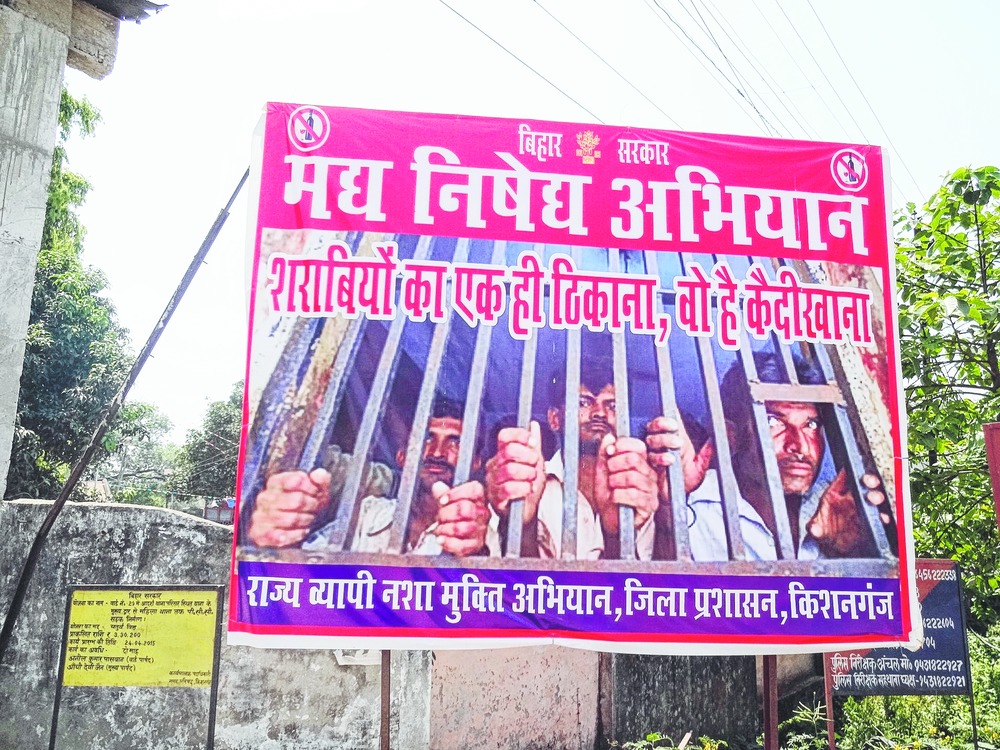


Kishanganj, April 13: "Sharaabiyon ka ek hi thikana, Woh hai qaidikhana (Alcoholics have only one address - that is jail)." A billboard with this message greets visitors right at the gate of the district-town police station in Kishanganj, around 327km east of Patna.
There are posters reading "Madh Nished Abhiyan (Mission prohibition)" barely 2km north at Farimgola check post where Bihar ends and Bengal begins on National Highway (NH) 31. An assistant police sub-inspector, Arvind Kumar, is keeping watch on passersby.
"We are here to catch criminals carrying liquor bottles from Bengal," he says. "We treat tipplers as criminals and send them to jail."
There are groups of policemen - rifles slung across their backs - patrolling the streets between the Kishanganj police station and Farimgola which is next to Panjipada, part of North Dinajpur district of Bengal, where liquor shops, restaurants and dhabas serving alcohol are ubiquitous.
Barely a kilometre south of Kishanganj on the same NH-31 is Gupta Line Hotel, with a restaurant and licensed bar, in Bengal. Sandwiched between two areas of Bengal in north and south on the busy highway is Kishanganj, microcosm of a "police state".
The police particularly keep watch on youngsters on motorbikes. If one wobbles or loses balance, he is caught and sent to jail.
"We caught a peon after we suspected he was drunk and sent him to jail yesterday. He was stripped of his job," says P.K. Gupta, station house officer of Kishanganj police station, with a sense of pride.
He refuses to name the peon: "That rascal has paid for his sin. Why do you want to publish his name?"
The sub-divisional police officer of Kishanganj, Kamini Bala, says: "Every day we catch hold of three to four drunkards and send them to jail. We have no mercy for them."
The reality, however, is completely different from what the cops are trying to portray. The tipplers have simply changed their style and place of drinking.
Kishanganj is part of the Seemanchal region (also comprising Araria, Katihar and Purnea) that shares borders with Nepal and Bengal where alcohol flows unhindered.
The India-Nepal border at Jogbani in Araria district is next to Viratnagar - home to numerous eateries and bars selling everything from high-end whisky to raksi, the Nepali equivalent of desi liquor in Bihar. Right across the Jogbani border you can find scores of Biharis drinking liquor and eating at such eateries.
"These policemen are fools. How can they stop us from drinking when we live so near Nepal or Bengal," asks Mukesh Yadav (24), a resident of Jogbani.
They can't walk drunk on Bihar streets under the new law; so won't they be caught once they cross the border? "Are we fools to go back drunk," retorts Mukesh. "We will stay for the night in these dhabas and go back the next morning. We will come back in the evening. Simple."
Thus, residents from Jogbani, Kharaiya Basti, Gauri Chak, Bahadurganj and hundreds of other villages in the vicinity travel to the India-Nepal border on cycles and bikes. They park at their contacts' places on the Bihar side and walk to Nepal to "enjoy life" and the freedom to drink.
"I let them drink when they come to my restaurant. But I also take care of them. I don't let them go drunk to Kishanganj. After all, they are my valued customers; they are not criminals," says Umashankar Gupta, owner of Gupta Line Hotel in Bengal, a kilometre south of Kishanganj.
It's a sentiment common among the Bengal dhaba owners.
"Our customers are like our brothers. We ask them not to return immediately after drinking to Kishanganj or any part of Bihar which is full of brutal policemen these days," says S.K. Alam, owner of Sher-e-Punjab dhaba in Bengal - barely 100metres from Farimgola in Bihar where the cops have set up a check post.
Many restaurant operators in Kishanganj, Araria and Jogbani towns and also several policemen under the cover of anonymity reveal that the "smart" tipplers had stored "stock" for two to three months and are drinking inside their homes and posh hotels where the policemen don't raid.
"We are catching only the fools, the naïve and poor people who don't know the tricks to operate in such situations," says a sub-inspector at Kishanganj police station. "We have many senior officials among us - professionals, contractors and businessmen - drinking in the confines of their homes and hotels. You simply can't stop it. Nowhere in the world it has been stopped. It can't be sustained. As of now, the policemen are on their toes. But you can't keep the people under the fear of gun all the time."
While chief minister Nitish Kumar is "boasting" in Patna of his prohibition success, the losers are his state's small-time vendors, dhaba owners, and roadside snack sellers.
"I am losing business worth Rs 2,000 per day. I was selling eatables worth Rs 8,000 per day. Now I shut shop at 7pm as the youths travel to Nepal and Bengal to drink. The water and soda bottles are lying unsold at my shop ever since April 1 when prohibition was clamped," says Sanjay Karak, owner of a small dhaba in Bahadurganj.
Rizwan, who used to sell fried eggs, water-soaked gram and batter-fried onions on his cart at Gowri Chowk in Kishanganj, has no customers.
"I have no way out other than resorting to begging," he rues.
Mohammad Aslam, a provision shop owner at Mastan Chowk near Kochadhaman, says: "The youths are shifting to ganja and bhang which are available easily. Nitish babu first issued licences in 2006 allowing setting up of liquor shops in the villages overnight. Now, he has clamped prohibition all of a sudden. He should have neither suddenly opened thousands of liqor shops in Bihar villages nor should have ordered them shut all of a sudden."