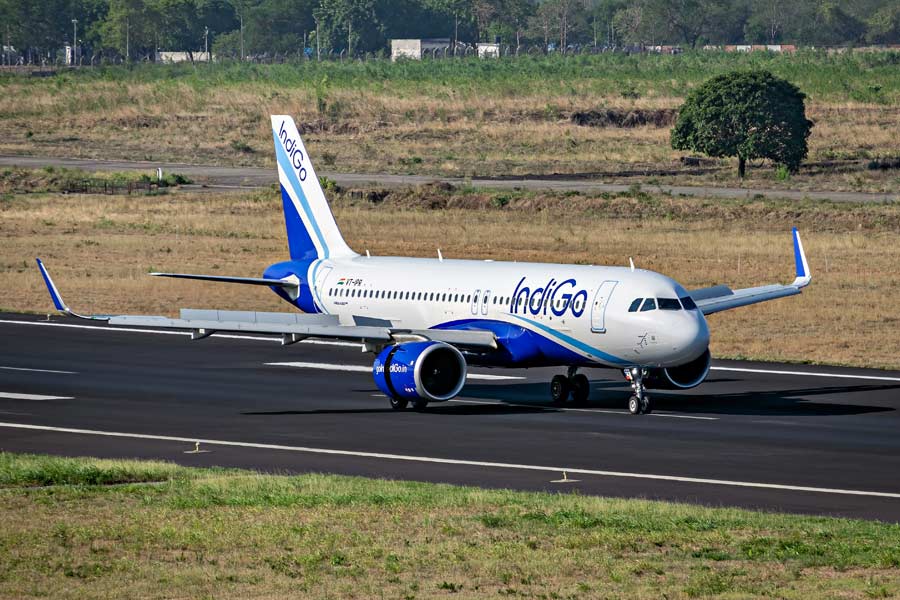
India’s largest airline, IndiGo, plunged deeper into operational turmoil Thursday with over 180 flights from three major airports cancelled as stringent government regulations on crew safety caps further disrupted roster planning.
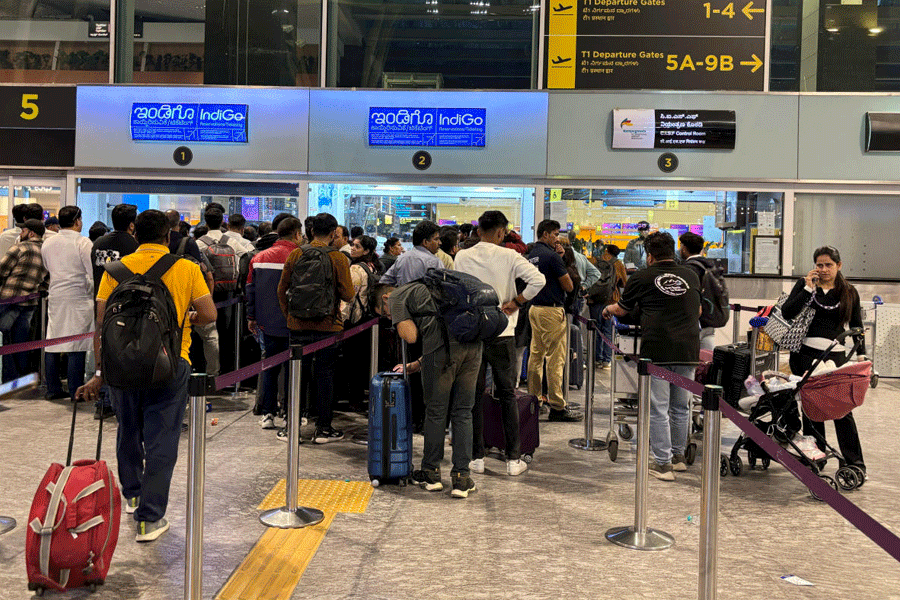
The cascading breakdown, now in its third day, has stranded thousands of passengers across major airports, turning terminals into scenes of anger, confusion and long queues.
IndiGo, which commands more than 60 per cent of the domestic market, cancelled at least 150 flights Wednesday and the numbers surged again Thursday as the airline struggled to stabilise its schedule.
Bengaluru alone saw 73 cancellations Thursday, the airport spokesperson confirmed to news agencies. Delhi lost around 30 flights, while Hyderabad recorded 68 cancellations, according to airport officials.
According to a Ministry of Civil Aviation notification issued Wednesday, IndiGo shared a summary of its recent operational performance, reporting that 1,232 flights were cancelled during the period.
The airline said a significant portion of these cancellations stemmed from crew and FDTL compliance issues, as well as airport, airspace and ATC-related factors, many of which were beyond its direct control. IndiGo’s overall on-time performance for November dropped sharply to 67.70 per cent, compared to 84.1 per cent in October.
Shares of IndiGo, which has built its reputation on punctuality, fell 3.4 per cent on Thursday and are now down 6 per cent for the week.
The Federation of Indian Pilots blamed IndiGo for failing to prepare adequately. It said the carrier "was not able to make timely roster adjustments and plan its schedule properly" ahead of the November 1 rollout of revised norms that increased mandatory rest hours and restricted night operations.
The crisis marks one of the most severe operational setbacks for the airline in its nearly two-decade existence. IndiGo, once celebrated for its trademark punctuality and the slogan "IndiGo Standard Time," is now battling a reputational storm.
On Wednesday, the airline said it was making "calibrated adjustments" to its schedules for the next two days to regain stability.
Meanwhile, disruptions rippled across the country. Delhi, Mumbai, Bengaluru and Hyderabad reported around 200 cancellations on Wednesday alone. Mumbai registered 33 cancellations (17 departures and 16 arrivals). Delhi saw at least 38 cancellations, with some estimates reaching 67 between Tuesday midnight and Wednesday evening due to rolling delays. Ahmedabad reported 23 cancellations and over 50 delays, and Nagpur saw at least six IndiGo flights cancelled.
Hyderabad emerged as a major flashpoint. As many as 33 outbound flights and 35 incoming flights were expected to be cancelled on Thursday. The airport confirmed that 19 flights had been cancelled on Wednesday. Passengers vented their frustration online.
"We have been at Hyderabad Airport from yesterday at 6:00 PM until today at 9:00 AM — over 12 hours — with no action taken by IndiGo regarding the Pune flight. This situation has caused significant inconvenience," one user posted on X.
"Total chaos at Hyderabad airport today — flights delayed 12+ hours. To not give accommodation, they kept pushing it by 'just 2 more hours' every single time for 12 hours. Same excuse: crew is coming soon. Unacceptable," another flyer wrote.
The Rajiv Gandhi International Airport issued a statement saying IndiGo flights were impacted due to "airline-related technology and operational issues", leading to delays and cancellations. While operations at the airport remained normal, it advised passengers to follow up directly with the airline for updates.
A Reuters photographer said she was stuck inside her IndiGo plane for three hours when it landed in the western city of Pune on Wednesday night, with the pilot citing operational issues and the lack of permission to dock the plane until other planes had flown.
The pilot had told passengers that the situation was unprecedented, the photographer added.
Ram Shankar Yadav, who was travelling with family to attend his younger brother's wedding celebrations, told Reuters that his flight had been delayed for six hours.
"We don't have enough chairs. People are taking newspapers to sit on floor," Yadav told Reuters by telephone from the airport in Pune.
"People are angry. There's nobody to manage; their helplines are not working," he added
As cancellations piled up nationwide, the Directorate General of Civil Aviation (DGCA) summoned the airline, demanding an explanation for the widespread failure. The regulator sought clarity on compliance with FDTL norms and contingency planning as passenger dissatisfaction soared.
In a detailed statement on Wednesday, IndiGo acknowledged the depth of the crisis: "We acknowledge that IndiGo's operations have been significantly disrupted across the network for the past two days, and we sincerely apologize to our customers for the inconvenience caused. A multitude of unforeseen operational challenges including minor technology glitches, schedule changes linked to the winter season, adverse weather conditions, increased congestion in the aviation system and the implementation of updated crew rostering rules (Flight Duty Time Limitations) had a negative compounding impact on our operations in a way that was not feasible to be anticipated."
The airline added: "To contain the disruption and restore stability, we have initiated calibrated adjustments to our schedules. These measures will remain in place for the next 48 hours and will allow us to normalise our operations and progressively recover our punctuality across the network. Our teams are working around the clock to ease customer discomfort and ensure operations stabilise as quickly as possible. Furthermore, the affected customers are being offered alternate travel arrangements to reach their destinations or refunds, as applicable."
IndiGo urged passengers to check their flight status before heading to the airport: "We request customers to check the latest flight status … before heading to the airport. We deeply regret the inconvenience caused and remain fully committed to minimising disruption and supporting our customers through this period."