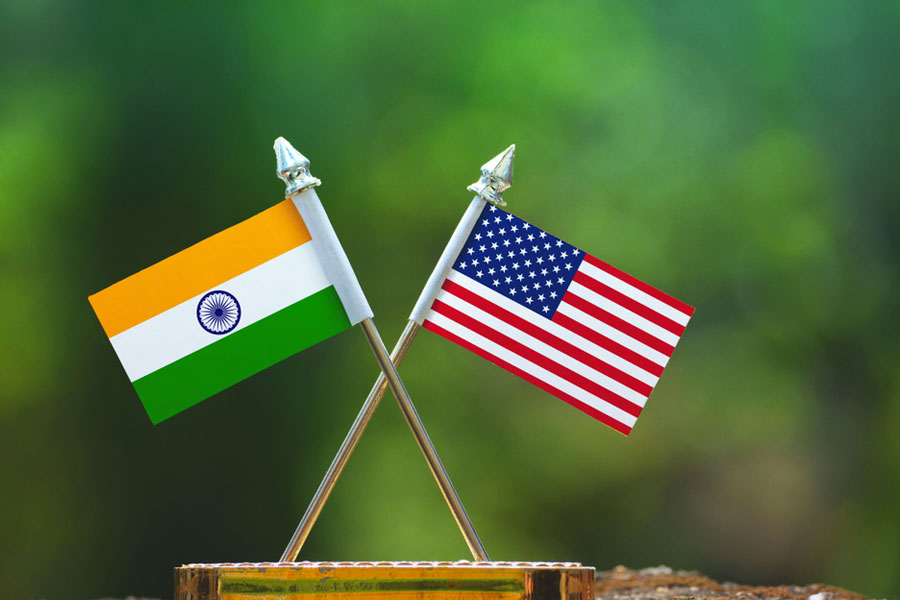
The United States and India are "very, very close" to finalising a historic bilateral trade agreement, a senior US official said, as top negotiators from both countries held high-level talks in New Delhi to conclude an interim pact before key tariff deadlines next month.
Addressing an event at Capitol Hill organised by the Foundation for India and Indian Diaspora Studies (FIIDS) on Tuesday, US Deputy Assistant Secretary of State Bethany Poulos Morrison said Prime Minister Narendra Modi and US President Donald Trump were steering the relationship with a focus on tangible outcomes.
“We're not measuring (the relationship) by meeting. We're measuring it by results,” she said, referring to the trade negotiations launched following the understanding reached between Trump and Modi earlier this year.
Highlighting progress in the talks, Morrison said, "When we looked at trade in February 2026, we announced the intention to finally conclude the historic trade deal. We are very, very close."
She said the proposed agreement would open India's 1.4 billion-strong market to American goods on terms that are reciprocal and mutually beneficial.
“The administration is driving toward the goal of Mission 500 -- the goal of achieving US 500 billion in trade by 2030 -- with a real sense of urgency,” the official said.
Morrison's remarks came as US Trade Representative Jamieson Greer is in India for discussions with Commerce and Industry Minister Piyush Goyal on the proposed trade pact.
She also pointed to growing economic engagement between the two countries, noting a surge in Indian investments in the United States.
At the recent SelectUSA Investment Summit, "we saw USD 20 billion in new investment" commitments from India, including USD 1.1 billion in immediate investment, Morrison said, adding that it was the "largest announcement in SelectUSA's history".
The US was India's second-largest trading partner in 2025-26. India's exports to the US rose 0.92 per cent to USD 87.3 billion during the fiscal year despite higher tariffs, while imports increased 15.95 per cent to USD 52.9 billion. India's trade surplus with the US narrowed to USD 34.4 billion from USD 40.89 billion in the previous fiscal year.
Morrison also underscored the rapid expansion of bilateral energy ties.
“We are exchanging goods in American oil, gas, and coal, and both sides are exploring expanding civil nuclear cooperation under the newly enacted Shanti Act.
"The US-India hydrocarbon trade has expanded significantly since 2025, reaching USD 14.4 billion to date," she said.
She further noted that more than 330,000 Indian students are enrolled in US educational institutions, contributing over USD 14 billion to the American economy and supporting more than 50,000 jobs.
Meanwhile, Goyal and Greer held crucial trade discussions in New Delhi on Tuesday aimed at recalibrating the proposed bilateral trade agreement after changes in US tariff policy disrupted the framework negotiated earlier this year.
Both sides are seeking to conclude an interim trade pact before July 24, when Washington's temporary 10 per cent tariff on imports from trading partners is scheduled to expire.
Greer's two-day visit follows the first meeting in over a year between Modi and Trump on the sidelines of the G7 summit in France on June 17, a development that has injected fresh momentum into negotiations viewed as vital for deepening economic ties.
The talks also build on chief negotiator-level discussions held in New Delhi from June 2 to 4.
Securing preferential tariff treatment has emerged as a key priority for India after shifts in US tariff policy reduced the advantage New Delhi had expected over regional competitors such as Vietnam and other ASEAN economies.
Under the February framework, the US had agreed to reduce tariffs on Indian goods to 18 per cent, lower than those imposed on several competing exporters. However, subsequent policy changes and a court ruling led Washington to impose a temporary 10 per cent tariff on imports from all countries, forcing both sides to revisit core elements of the agreement.
Earlier on June 5, Goyal said India and the US were moving towards resolving all outstanding issues in the interim agreement and were likely to execute the "very, very vibrant" first phase of the Bilateral Trade Agreement (BTA) by the middle of next month.
India and the US formally launched BTA negotiations on February 13, 2025. Under the proposed framework, India offered to eliminate or reduce tariffs on a broad range of US industrial, food and agricultural products, while also expressing its intention to purchase USD 500 billion worth of American energy products, aircraft and aircraft parts, precious metals, technology products and coking coal over the next five years.
With the tariff landscape changing in the US, both countries are now re-examining the agreement's framework while working to preserve momentum toward a landmark trade deal.