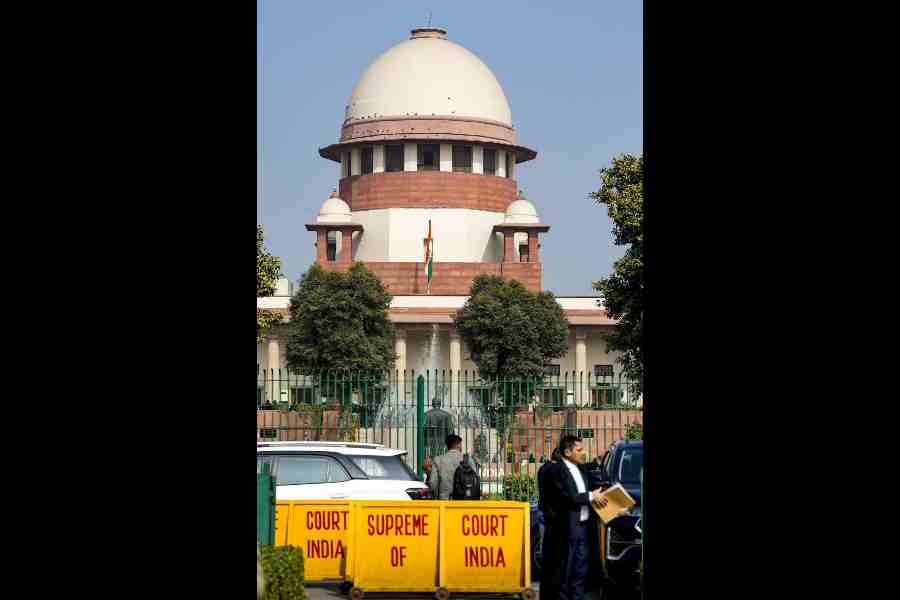
The Supreme Court on Monday said if an offence takes place inside the privacy of a house, there will be a corresponding burden on the inmates of the house to give a cogent explanation as to how the victim succumbed.
A bench of Justices Prashant Kumar Mishra and K V Viswanathan upheld the conviction and life sentence of Gour Acharjee for killing his wife Soma Acharjee under Section 302 of IPC and subjecting her to cruelty under Section 498A of IPC, saying he could not discharge the burden to explain the injuries on the deceased by offering a plausible explanation.
"It is well settled that if an offence takes place inside the privacy of a house, though the initial burden to establish the case would be on the prosecution, there will be a corresponding burden on the inmates of the house to give a cogent explanation as to how the victim succumbed," the bench said.
Terming the case an eye-opener for many, the bench posed questions, "Could the life of young Soma Acharjee have been saved? Did the fear of societal opprobrium result in Soma being thrown to the wolves? These questions will remain hypothetical." It noted that within a few days after her marriage, the deceased, Soma, was subjected to immense torture on account of the demand for dowry and she repeatedly made entreaties to her parents to save her and even came to her parental home and stayed with them for a few days.
The bench said every time she raised the issue, efforts were made only to effect a patch-up and send her back to the matrimonial home.
It said village elders were involved and even resolutions were passed after effecting a purported compromise.
"Soma's near and dear naively believed that somehow, the situation would turn for the better. A false sense of optimism engulfed them.
"Their hopes were betrayed when Soma met with a tragic end at her matrimonial home. Hopefully, the story of her life will be an eye-opener for many," the bench said.
Examining the evidence, the bench said as far as Gour Acharjee is concerned, both the trial court and the high court were categorical that it was he who was in the dwelling unit with the deceased when she was found dead.
"The medical opinion clearly points to simulated hanging or homicidal hanging. It was the bounden duty of A-1 to put forward a reasonable and probable cause of her death and also to explain the injuries which the deceased sustained before her death," the top court said.
It added that the doctor's evidence and the post-mortem report have been rightly accepted by the courts below to conclude the homicidal nature of the death.
It noted that the trial court acquitted the father of the accused as nothing emerged in evidence and the high court had acquitted his mother and brother for the offence under Section 302 of the IPC as they were not sharing the same dwelling hut though they were in the same compound.
Referring to the testimony of the prosecution witness, the bench said the presence of the accused was established when the body of the deceased was found hanging.
"In any event, that fact is not denied by him because it was the appellant who informed PW-7, though he told PW-7 that the deceased had committed suicide. When confronted with the circumstances under Section 313, CrPC, the appellant did not choose to offer any explanation. The appellant did not endeavour to discharge the burden and to explain the injuries to the deceased by offering a plausible explanation.
"His defence that it was a case of suicide has been belied by the overwhelming medical evidence. Even if we discount the aspect of discovery of the hammer that does not carry the case of the appellant any further," the top court said.
The top court, which dismissed the appeal of Gaur Acharjee, directed the DGP of Tripura to immediately constitute a team to trace the husband who has been absconding and take him into custody immediately.
Except for the headline, this story has not been edited by The Telegraph Online staff and has been published from a syndicated feed.