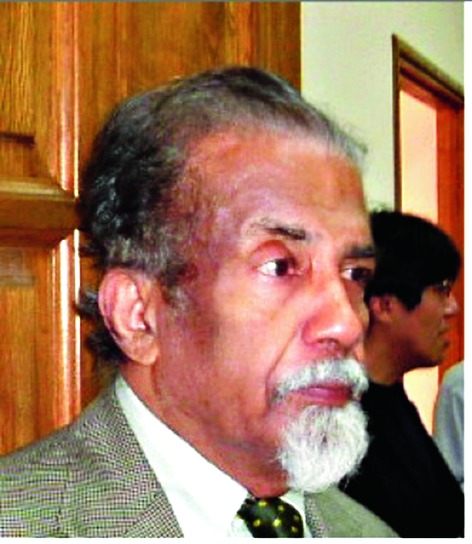

New Delhi: E.C.G. Sudarshan, an India-born physicist in the US who had proposed the idea of "faster-than-light" particles, was viewed by some fellow physicists as having been overlooked for a well-deserved Nobel Prize and was described as a "genius creator", died on Monday. He was 86.
He is survived by his wife Bhamati and two sons. Another son had died several years ago, a physicist and friend of the family said.
For more than three decades, Sudarshan, an emeritus professor at the University of Texas, Austin, which he had joined in 1969 after studies and research in India and the US, had sought insights into the realm of subatomic particles and the laws that govern them.
Physicists familiar with his work have described him as "enormously prolific", as they say is evident from the 400-plus scientific papers he authored and the diversity of research topics he pursued. He would, at times, after pioneering work on one idea, quickly switch to another.
"He didn't like to restrict himself; he was mentally inventive and often moved from one research topic to another," said Narasimhaiengar Mukunda, a senior theoretical physicist in Bangalore who has co-authored papers and books with Sudarshan.
Many fellow physicists view Sudarshan's work in 1957 on what they call "V-A interaction" as among his greatest contributions to physics. "This work was a major step towards the subsequent development of the theory of the electroweak interactions by other physicists," Mukunda said.
Two Harvard University physicists - Sheldon Glashow and Steven Weinberg - and Pakistani physicist Abdus Salam had shared the Nobel Prize for physics in 1979 for the theory of electroweak interactions that unified two of the four fundamental forces of nature.
Sudarshan, in the early 1960s, had made what many consider path-breaking contributions to the field of quantum optics. When two Americans - Roy Glauber and John Hall - and German Theodor Hansch won the 2005 Nobel Prize in physics for quantum optics, some suggested Sudarshan too should have been awarded that honour.
The Harvard Crimson reported in 2005 that a petition submitted to the Royal Swedish Academy of Sciences that year by a group of scientists read: "It is difficult to understand how the work for which Glauber is cited could be honoured in isolation from Sudarshan's published discoveries and formulations...."
"Some of us do think that a Nobel for Sudarshan would have been well-deserved," Mukunda said.
But it's Sudarshan's work proposing the idea of tachyons - hypothetical particles that can travel faster than light - that captivated public imagination and, somewhat misleadingly, prompted some to even suggest that Sudarshan had disproved Albert Einstein who had proposed nothing could travel faster than light.
Physicist Samir Bose of the University of Notre Dame in the US had in a 2009 paper explained that what Sudarshan and his collaborators O.M. Bilaniuk and V.K. Deshpande had done was to conclude that Einstein's theory of relativity "does not rule out" tachyons.
Bose had also highlighted that Sudarshan had, while collaborating with Indian astronomer Jayant Narlikar in 1976, concluded that any primordial tachyons that may have been created in the beginning were unlikely to have survived in the present era.
Sudarshan was born in Pallam and studied at the Madras Christian College, Tambaram, before joining the Tata Institute of Fundamental Research, Mumbai, for three years. He then moved to the University of Rochester in the US for a doctorate degree.
He joined the University of Texas in 1969 after academic stints at the University of Rochester and Syracuse University.
At various times, he also held academic positions at the Indian Institute of Science, Bangalore, and the Institute of Mathematical Sciences, Chennai.