
Calcutta, Aug. 7: Calcutta takes some things for granted when it wakes up every morning. Howrah Bridge, Victoria Memorial, Writers' Buildings, Tata Centre, the Kidderpore bridge....
Hit the brakes! What on earth happened to the Kidderpore bridge?
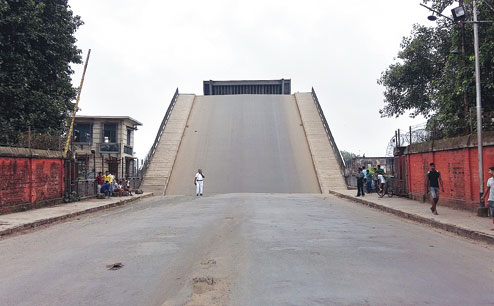
Early birds on Monday would have seen a dreary stairway to nowhere instead of the familiar flat bridge over a channel of the Hooghly.
The bascule bridge on the Hooghly that splits into two and folds upwards to allow ships to pass under it got stuck with its arms pointing skywards.
For nearly seven hours, the bridge remained in a state of suspended animation - a rare show of defiance by a familiar fixture that has been around for more than half a century.
Engineers of the Calcutta Port Trust finally succeeded in bringing the two leaves of the bridge down at 9.50am and traffic on the bridge resumed at 10am. Till then, traffic was thrown out of gear and diverted.

Here's the low-down on the bridge that refused to behave and why it did so:
• The Kidderpore bridge is only one of three bascule bridges in the country. The others are at the Mumbai port (single leaf or span, not double-leaf like Kidderpore bridge) and in Tamil Nadu.
• The world over, the most famous of the lot is the Tower Bridge in London, a combination of a bascule and a suspension bridge built over the Thames between 1886 and 1894.
• The Kidderpore bridge became operational on November 15, 1966. It was built by Waagen Biro Bridge System AG of Austria.
• An electro-hydraulic mechanism lifts the two spans of the double-leaf bascule bridge. Two motors at each end of the bridge operate two gears. When the gears move forward, they push the arms up and vessels can pass below the bridge. When the gears move in the reverse direction, the arms of the bridge come down to allow surface transport. No pulleys or cables are involved.
• Each side of the bridge rises to form an angle of 66 degrees with the horizontal, taking seven to eight minutes to do so. The descent takes another seven to eight minutes.
• The bridge splits for ships to pass between 2am and 3am five days a week, except Saturdays and Wednesdays.

What went wrong?
One of the electrical panels developed a glitch, according to an official of the Calcutta Port Trust. "There are circuits with lots of electrical cables controlling the motors. It was like finding a needle in a haystack. It took our engineers around six hours to identify the electrical panel that had developed the glitch, after which repairs were carried out," the official said.
According to a CPT official, there have been no significant renovations or repairs since 1966 although the traffic load has increased manifold.
The CPT is in touch with the Austrian firm for an overhaul, estimated to cost Rs 25 crore.
Was it happy hour for ships for seven hours?
No. The spans had got stuck after they started the descent at 3am. So, there was not enough clearance for ships to pass. In any case, ships are given the time of passage in advance and none could have been scheduled after 3am.
The bridge is expected to be out of bounds for the passage of ships under it for the next 48 hours as it undergoes more repairs. Once the overhaul starts, ships will not be allowed to pass for three months. An alternative route is available.