|
 |
| Karunanidhi, Jayalalithaa |
Chennai, Nov. 13: A panel appointed by the DMK government has recommended the abolition of the common entrance test (CET) for admission to Tamil Nadu’s engineering and medical colleges from 2007-08, official sources said.
Two such attempts by the Jayalalithaa-led ADMK regime had been struck down by Madras High Court in a move that left thousands of students in confusion.
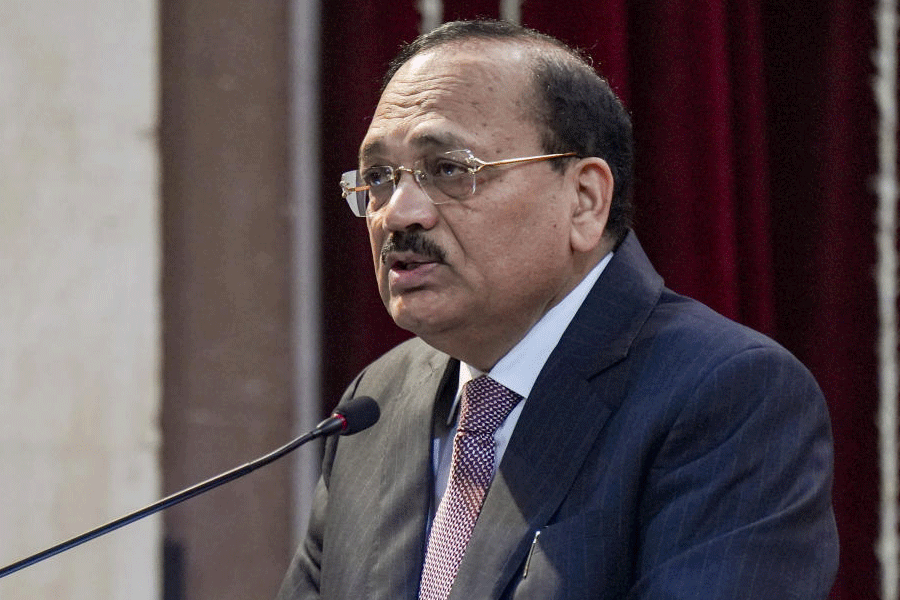
The committee was headed by M. Anandakrishnan, former vice-chancellor of Anna University, the nodal agency for the exam in which about 1.5 lakh appear each year.
The panel made the recommendation in its report submitted to chief minister M. Karunanidhi today. However, it left it to the state cabinet to “deliberate further on the steps to be taken to implement this decision”. A bill to give the decision a statutory footing is planned in the winter session of the Assembly, sources said.
Anandakrishnan declined to give details, but said the panel was “not asked to go into the merits of continuing with CET per se, or otherwise”. The Supreme Court has ruled that some form of CET is inevitable as students come from different boards, including the Central Board of Secondary Education.
“What we have done is to recommend measures that should be taken if CET is abolished from the coming academic year so that it does not cause the kind of problems that occurred in the past,” Anandakrishnan said.
In a sense, the committee had its hands tied. The DMK and its allies — notably the OBC Vanniyar-dominated PMK — had made “abolition of the CET” a key election plank in the Assembly polls in May.
They said the move would help poor rural students who have no access to the “urban teaching shops that charge huge fees to prepare candidates for CET”.
After assuming office, the DMK government had declared its intention — in the governor’s maiden address to the new Assembly — to ensure a “level-playing field” for stu- dents from rural and urban families.
The government said CET had become “highly expen-sive and a source of unnecessary hardship” for students. Incidentally, Tamil Nadu has more than 225 private engineering colleges, among the country’s highest.
In June 2005, the Jayalalithaa regime abolished CET, saying admissions to professional courses would be based purely on “Plus Two exam marks”.
At the same time, its executive order had retained the 69 per cent reservation for backward communities, Dalits and tribals. However, the high court later struck down the fiat as “unconstitutional” and made the test mandatory.
In the run-up to the Assembly elections, the Jayalalithaa government came up with a modified proposal and passed a legislation in January to put itself on stronger legal ground.
That law did away with CET for students from the Tamil Nadu board, but made it compulsory for those from other boards.
The high court spiked this legislation, calling it “discriminatory”. Admissions to professional courses this year were made through CET. But the confusion persisted.
The DMK government’s move to scrap CET could also be fraught with legal difficulties, some lawyers say.