
Bhubaneswar, May 28: The Archaeological Survey of India (ASI) has discovered remains of human civilisation dating back to Chalcolithic or Copper Age on the banks of Prachi, considered to be one of the oldest rivers of India.
The site - known as Bharati Huda - is located four kilometres east of Niali township in Cuttack, about 40 km from here. The Prachi river runs its course between undivided Cuttack and Puri districts.
Superintendent archaeologist D.B Garnaik of excavation branch IV of ASI Bhubaneswar circle said: "Prachi valley was known for archaeological remains in form of temples and sculptures starting from early historic to medieval period. For the first time the ASI has identified remains dating back to the Chalcolithic period that pushes back the antiquity of Prachi valley to pre-historic times."
The Chalcolithic age precedes the Bronze Age and is characterised by use of copper and stone tools. It lasted roughly from 3,500 to 2,300 BC.
Garnaik said: "We have found a pre-historic mound in the Prachi valley during the course of exploration. The mound is located in between Prachi river in the south and Tanla river in the north."
Describing the mound, he said: "It is huge and spread over 12 acres. The mound has a height of about five metres."
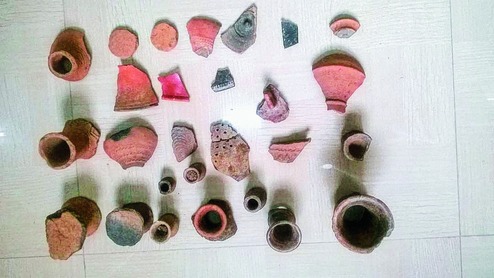
Garnaik said the survey of the mound revealed ceramic assemblages from the Chalcolithic period and early historic period. Polished fern tools and fauna remains were also found during excavation, he said.
The Chalcolithic potteries retrieved from the site consist of red ware, red slipped ware, chocolate slipped ware, black-and-red ware, perforated ware, miniature pots, ring based pots and bowl-on-stand.
A slip is a liquid mixture of clay and other materials suspended in water. It continues to be used in the production of pottery, and other ceramic ware. In pottery, slip is used to create the basic shape by slip casting with moulds, and also for decoration.

Asked how they pegged the discovery to the Copper Age, Garnaik said the potteries had great resemblance to those found at Odisha's other Chalcolithic sites such as Golabadi Sasan and Suabarie in undivided Puri. He added that the presence of painted pottery was also a hallmark of the Chalcolithic period.
"Early historic potteries such as knobbed ware and grey ware were found during excavations at Sisupalgarh and Narisho in the state," he said.
An ASI official said that knobbed ware potteries are marked by bends or angles. They are never straight or aligned, he said.
While the Prachi river valley is known for its archaeological richness, several Odia scholars claim that the tributary of the Mahanadi river system is older than the Ganga. People in Odisha also believe it to be a reincarnation of river Saraswati that according to mythology had gone underground and disappeared.
"This is the only river whose name is found in a majority of Odisha's religious scriptures. A large number of old and dilapidated Shiva and Vishnu temples are found on its banks. Vaishnavite and Shaivaite cultures also merged on its banks," said Prafulla Tripathy, an eminent scholar and historian.
Former director, State Archaeology, Debraj Pradhan said that the Prachi river valley had witnessed blending of various religious cults, which included Jainism, Buddhism, Tantrism, Shaivism, Saura and Vaishnavism. Several Jain images were also found at Kakatpur, which is part of the Prachi river valley.
The name Prachi is derived from the word 'prachina' meaning ancient. Scholars say reference to Prachi is found in Puranic literature such as Markandeya Purana, Kapilasamhita, Prachi Mahatmya and the Odia Mahabaharat.
The fate of the river, however, changed with the times. A vibrant river till the early 1940s, Prachi began choking after its banks were criss-crossed by the national highway system between Cuttack and Bhubaneswar near Phulnakhara. The release of water into Prachi from the Mahanadi river system was reduced to a trickle following construction of embankments on its two sides.
Prachi can now only be noticed as a rivulet originating from a roadside gorge (Ganda ) near Phulnakhara from where it travels for nearly 90 km before flowing into the Bay of Bengal.
Only recently, the state government has initiated efforts to revive the river at the initiative of former deputy chairperson of the planning board Surendra Nath Nayak, who has been a lone campaigner for restoration of the ancient river.