Monday, 06 July 2026
Monday, 06 July 2026
Monday, 06 July 2026
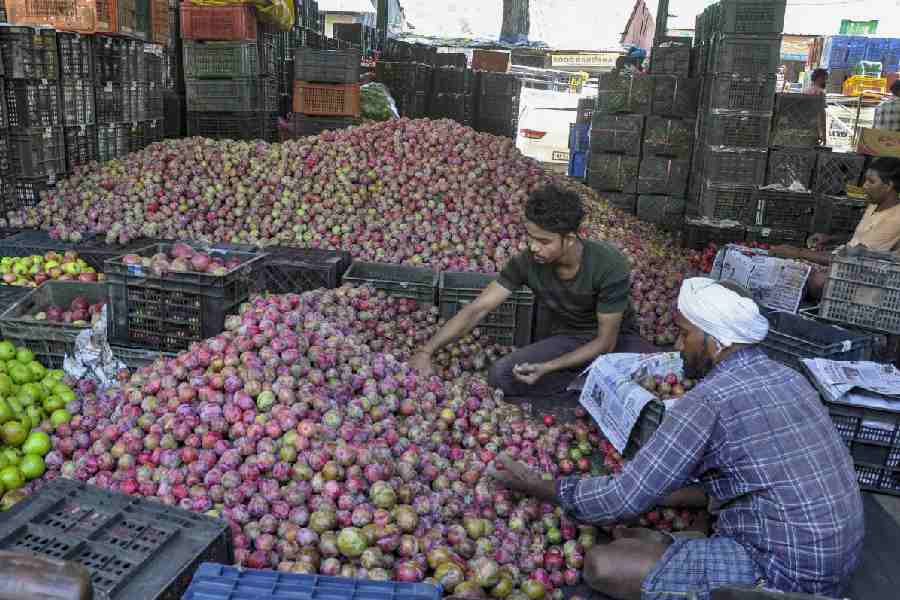
Himachal Pradesh's Rs 5,000-crore apple economy is facing a severe, unprecedented climate crisis amid unseasonal rains and rising hailstorms, with statewide output estimated to drop by around 40 per cent from last year's 6.99 lakh Metric tonnes in 2025.
Vagaries of weather, such as insufficient winter snowfall, unseasonal spring rains, hailstorms, and erratic temperature fluctuations, is likely to hit apple production, the mainstay of the farm economy in eight districts of the state, officials said on Monday.
The state's apple production was at 6.99 lakh Metric tonnes in 2025, which is estimated to be around 4.36 MT in 2026 (about 2.15 crore boxes), a huge drop of 2.63 MT, they added.
"The area under apple cultivation is about 1.16 lakh acres (about 49 per cent of the total area under fruit crops, which is 2.37 lakh hectares) and production was 6.99 lakh MT in 2025, which is estimated to drop to 4.36 lakh MT during 2026," said Director Horticulture, Satish Kumar.
About 2.5 lakh families are involved in apple farming. Orchardists are worried because, in addition to weather-related uncertainties causing huge losses, production costs have also increased due to higher prices for inputs such as medicines and machinery. Stone fruit crops also suffered heavy losses due to inclement weather.
"The apple production this year has declined due to unfavourable weather conditions as neither snow nor rains came on time," said apple orchardist Balwant Justa. "Due to a lack of irrigation facilities, we are dependent on the weather", he added.
Growers have urged the government to provide irrigation facilities to every orchardist and make them aware about the crop insurance scheme so that the losses could be recovered to some extent.
The state's apple economy was about Rs 5,000 crore, but this year it is likely to be proportionately less, Kumar said, adding that the stone fruit production was also on decline due to global warming and climate change, rising temperatures (1 to 1.5 degree Celsius), but the growers are fetching good returns.
According to data from the horticulture department, in terms of boxes, the apple production was 3.49 crore in 2025-26, 2.51 crore in 2024-25, 2.11 crore in 2023-24, 3.36 crore in 2022-23, 3.05 crore in 2021-22 and 2.40 crore in 2020-21, flagging startling variations and gaps in production.
The area under apple production has expanded phenomenally from 400 hectares in 1950-51 to 1,16,338 hectares in the 2024-25 fiscal year, while 27,386 hectares are dedicated to stone fruits.
Regarding stone fruits, which mainly include apricot, cherry, peach and plum, the area under cultivation is 17,306 hectares, and production is expected to decrease slightly from 24,622 last year to about 23,000 this year.
Temperatures are high with inadequate chilling hours; additionally, hailstorms have damaged the apple crop, input costs have increased, and production is going down, said an apple grower, Virender Singh.
Desired cooling (chilling) hours (1200 to 1600 below 7 degrees C) are required for traditional varieties of apple and 600 hours for early varieties, according to the President of the Fruit Vegetable Flower Growers Association, Harish Chauhan.
Raghubeer Singh Chauhan, another orchardist, said that "income is going down and it is becoming difficult to sustain on farming as we are dependent on the weather, and there is a dire need to strengthen irrigation facilities. We are also not aware of the crop insurance schemes".