|
 |
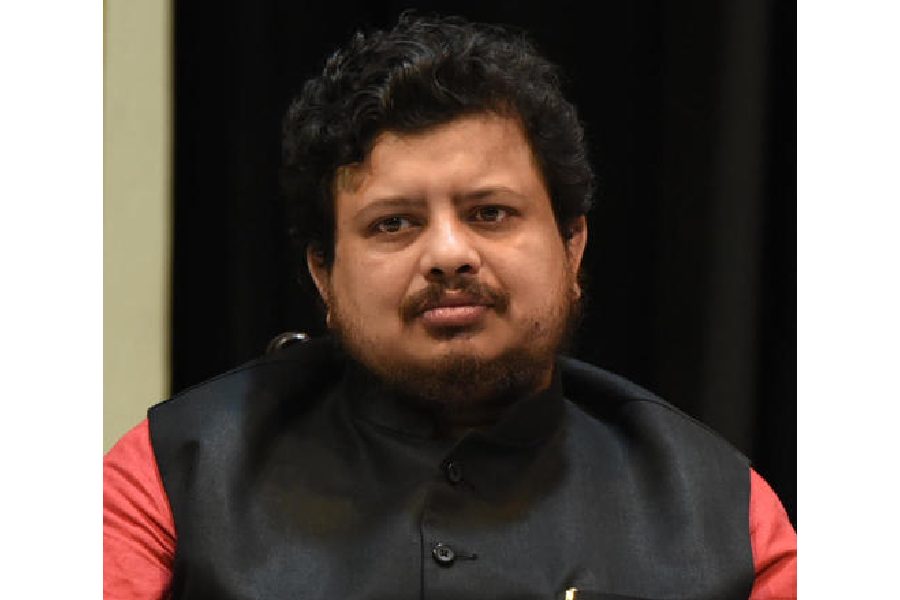
| (From top) Sandip Ray and Anjan Dutt in the former’s study at 1/1 Bishop Lefroy Road; Sandip takes Anjan around Satyajit Ray’s study room. Pictures by Bishwarup Dutta |
“An adda on Feluda and Bomkesh? Yes, that would be hugely interesting!” said Sandip Ray and Anjan Dutt when we approached the two thriller-makers. On a Friday evening, Sandip played host to Anjan and t2 at his 1/1 Bishop Lefroy Road home — over tea, cakes and sandwiches — for a free-wheeling chat on their craft, fave sleuths, filmmaking influences and, of course, Satyajit Ray...
You have given us the two best-loved Bengali sleuths on screen. How did you get into making films on Feluda and Bomkesh Bakshi?
Anjan: I grew up with the tradition of watching Hollywood cinema of the ’50s and ’60s from my school days and obviously a lot of thrillers. Billy Wilder’s Double Indemnity or John Huston’s The Maltese Falcon are films I love immensely. Every filmmaker, after a certain point of time, has the desire to make a thriller. Thrillers and detective stories are a test of one’s craft in cinema. I, with my bit of experience, also wanted to join the bandwagon. I started looking at alternatives. Kiriti Roy was too outlandish. That hat-coat-clad detective didn’t work for me. I needed someone more Bangali.
Sandip: And Hemen Roy was probably too childish...
Anjan: Yes, so I thought of taking up Saradindubabu (Bandopadhyay) and bought the rights to five of his stories.... Feluda obviously is a travelogue whodunnit, it is not just a detective story. I have tried to recreate Bomkesh a little differently. But if you look at it very closely, I keep referring to Sukumar Ray or drawing from Joi Baba Felunath’s wit.
Sandip: My beginning was very much like Anjan’s. I’ve grown up on American thrillers although more than films, detective thrillers were mostly on television.
Anjan: Apart from Humphrey Bogart, who did a few Philip Marlowe…
Sandip: It was the American B-movies that had a few Oriental detectives in a typical whodunnit format. Reading Sherlock Holmes and Bomkesh were really my beginning. When I decided to start making movies, I wanted to begin with a Feluda story — Gangtoke Gondogol. This was in the early ’80s. I realised that Joi Baba Felunath had happened in the late ’70s and Sonar Kella in the early ’70s. It would be quite tough to surpass those two films. There would be comparisons and I would be in trouble, so I chose Phatik Chand, which is one of my most favourite novels.... I had to wait for nearly 25 years to make a Feluda film! Because I just could not find a producer for the big screen.
Anjan: That’s so strange!
Sandip: Nobody was interested! The other thing was we would need to create a fresh team. The first team had become very popular but they had aged. So we decided to experiment and take a low-cost risk on television to test whether people would accept it. Baksha Rahasya proved quite popular but even then no one was interested. Ironically, the one who finally showed interest was a non-Bengali producer, Ramoji Rao.
But the classic noir films you grew up watching have not influenced your Feluda and Bomkesh films...
Sandip: Not really. Dark, serious, gritty reality was a wonderful thing in black-and-white films but I’m yet to try that.
Anjan: Our references maybe of noir films like Sunset Boulevard or The Third Man but when we’re making a film, we’re not making a noir film.
Sandip: You have to be deeply rooted or else you wouldn’t be able to handle these two characters [Feluda and Bomkesh Bakshi].
What do you think are Feluda and Bomkesh’s unique strengths as super sleuths?
Sandip: Anjan had said something very interesting once [to t2] — Feluda can be taken everywhere, from Hong Kong to London, to solve a case. There is an educative aspect to him. He always provides a lot of real information and we get to learn a lot from him. Bomkesh to me is a bit more adult. Most of his tales involve women, romance and interesting adult crimes — something that Baba (Satyajit Ray) could not do with Feluda because it was published in Sandesh and Desh.
Anjan: I think cinematically, Feluda is a lone knight who is an intelligent, well-educated Bengali of good taste, which is so missing in Bengali cinema. Many years ago when I had come to this house and met Satyajit Ray, he had told me, ‘Good cinema is primarily about good taste. What good taste is you’ll have to decide and find out....’ Feluda is someone who can stand and talk from an international level and that is the USP of the character.
Sandip: Bomkesh, you have to keep him within a certain period of time.
Anjan: Yes, or else it will be a bad mimic of Feluda. It won’t work. Bomkesh is the moral, intelligent, ethical Bengali who can stand up against power and corruption. Bangaliana and the period in which the tales are based are Bomkesh’s USP and that is what differentiates him from Feluda.
Sandip: Bomkesh was always popular but now there is a renewed interest among youngsters. It’s not easy for this generation to read Bomkesh because it is written in sadhu bhasha. If youngsters start reading Bomkesh novels again because of Anjan, then there’s nothing like it.
How do Feluda and Bomkesh compare with the foreign detectives?
Sandip: Both are so Bangali that it’s difficult to draw parallels. Their mentality, attitude and the manner of detection are so Bangali that the first one I made in Hindi for the national network didn’t seem like Feluda to me at all. I think my first proper Feluda got started only with Sabyasachi (Chakrabarty).
Anjan: Both of them are so uniquely Bangali that you can’t compare them to Philip Marlowe or Sam Spade or Hercule Poirot. This British legacy is somewhere hidden in their plotlines but that’s about it.
Sandip: It’s a very light influence. Maybe you can compare a Topshe and Ajit with a Watson, but Bomkesh is a married man. Feluda has a character like Lalmohan.
Anjan: Yes, both Lalmohan and Satyabati are unique characters that add to a trio and which you won’t find in any foreign story.
What is most challenging about making a Feluda or a Bomkesh film?
Sandip: There is so much of information in a Feluda story that it becomes extremely difficult to decide what to keep and what not to while writing the screenplay.
Anjan: I don’t find any flaws. There might be flaws in the depiction of months and seasons but those errors you find in an Arthur Conan Doyle work too. One can bypass those things and move forward without having to change the plot.
Sandip: Nowadays I find that whodunnits are finding repeat viewing. Had there been spoiler alerts, it would have crashed. That is also a reason why I have also gone back to that format with my last film. People are enjoying the suspense and watching it a second time.
Anjan: And irrespective of the fact that Maganlal Meghraj is the culprit, there are so many interesting things happening that give it an inherent strength. I think good thrillers are not just about who the killer is.
What is your take on the legacy of thrillers in Bengali films…
Anjan: I don’t find a legacy of thrillers in Indian films altogether, except for Satyajit Ray’s Feluda and later on Sandip Ray’s Feluda. I’m greatly in love with Satyajit Ray’s middle films. Chiriakhana was there but it did not affect me so much, although it was an important film. If I look back, there was Premendra Mitra’s Hanabari or some of Naresh Mitra’s films.
Sandip: There was a Kuheli or a few Kakababu attempts but very sporadic... once in five years.
Anjan: I realised that noir cinema in our reality is difficult. So the only thing I fell back on was Feluda.... I tried Rudra Sener Diary on television…
Sandip: That was very effective. Why don’t you bring it to the big screen? It’s so different.
Anjan: There are so many interesting Bengali characters that have been left unexplored. Now because of the sheer popularity of Feluda and success of Bomkesh, people are rethinking this genre and that is a good sign.
Sandip: True. Very little work has happened in this genre despite the fact that so many interesting thrillers have been written. I wouldn’t mind adapting one some day.
Anjan: Also, there are very few ghost and horror films in Bengali cinema.
Sandip: There is a difference between a ghost film and a horror film. I’m thinking of doing a ghost story next, so let’s see. I’m just glad that both Feluda and Bomkesh have found a space on the big screen. This should continue. Anjan has been lucky to find Abir (Chatterjee). I will have to bid goodbye to my Feluda, so I’m in trouble!
Anjan: You are in trouble with Lalmohan too...
Sandip: Absolutely! Even if I repeat Sabyasachi for another Feluda film, I need to find a Lalmohan [Bibhu Bhattacharya passed away just before the release of Royal Bengal Rahasya.]
Anjan, who according to you would be the best fit as Feluda after Sabyasachi?
Anjan: I’m in love with Feluda and also in love with that man who plays Feluda, and even though I’ve gone through this exercise in my head I haven’t been able to come up with an alternative. One thing is, Sabyasachi, after a long time and after Soumitra Chattopadhyay, became a sharp, intelligent, thinking hero in Bengali films. There’s also a certain dadagiri, an upper hand in Feluda, which Sabyasachi has in him.
Sandip, what do you think of Abir as Bomkesh?
Sandip: Khub bhalo! He is improving and you will see that in the Feluda films too. Since we [he and Sabyasachi] had done the television series together, we had that chemistry.
Anjan: Also, Sabyasachi was a finished actor. Similarly, the way Saswata (Chatterjee) as Ajit goes about things is smoother than Bomkesh at times but he (Abir) is growing, responding and I hope he gets better and better.
Anjan, which is your favourite Feluda film by Sandip Ray?
Anjan: I liked the first one Bombaiyer Bombete and the last one Royal Bengal Rahasya the most. Not that I didn’t like Tintorettor Jishu. I liked the Hong Kong portions and the court cases, it was fun. What I liked about Royal Bengal Rahasya was that he went back to the whodunnit format.
Sandip: It was a story without a specific culprit. It was based on a lie, so I had no choice but to follow the whodunnit but it worked.
Sandip, which of Anjan Dutt’s Bomkesh Bakshi films did you like better?
Sandip: I think the second one works better because of the chemistry between Bomkesh, Ajit and Satyabati. Prothomtatey mone hochhilo ‘eki Bomkesh-ke Ajit tekka mere jachhe!’
Anjan: Also, the first one was shoddy. We couldn’t capture the period or the riot scenes too well.
In future, would you like to try an edgy version of Feluda or Bomkesh Bakshi like they are doing with Sherlock Holmes in the West?
Sandip: No, I don’t see myself doing that. There’s too strong a classical essence in both Feluda and Bomkesh which wouldn’t be right to break. Also, my present fan following would be hugely disappointed. Even youngsters aren’t too keen that I give Feluda a mobile phone.
Anjan: I believe that if I am following somebody else’s text, I must adhere to it. Deconstruction is a part of cinema and literature but if I were to do Hamlet I cannot go out of context. The writer is the last word. I cannot move away and turn Bomkesh into an edgy, gun-toting sleuth. Another thing is, Sherlock Holmes has been remade over years and years, so it makes sense when Guy Ritchie thinks of giving it a twist today. We don’t have that tradition with Feluda or Bomkesh. We haven’t reached that stage yet. In fact, I still prefer Sherlock Holmes playing the violin and riding around in a carriage.
Sandip: Yes, the fog-bound London, steam engines and horse carriages were far more dramatic and intriguing.
What would your advice be to each other for the next Feluda and Bomkesh films?
Sandip: Bomkesh’s casting is impeccable. The three main characters shouldn’t be touched. I am the one in trouble! Big trouble! (Laughs.)
Anjan: Can’t you repeat the present Feluda just one more time?
Sandip: I’m not sure. Since we’re giving it a two-year gap, it’s a bit of trouble.
Anjan: I think I can accept Sabyasachi in one or two more Feluda films. Feluda has already achieved its status, its branding and I don’t think we should tamper with the format of sometimes being told as a whodunnit and sometimes as a travelogue.
Sandip: Same with Bomkesh. The theme music should also continue as a connecting element. Instead of carpeting the entire film with music, we should use proper SFX and use music only when required.
Anjan: Yes, it’s time background music is developed as a separate craft.
All-time fave thrillers...
Sandip: Rear Window, Double Indemnity and Strangers on a Train.
Anjan: Double Indemnity, The Maltese Falcon and Se7en in cinema. In literature, it’s Darjeeling Jomjomat and Durga Rahasya.
Sandip: And my favourite Bomkesh Bakshi story would be Durga Rahasya.
Anjan: Badshahi Angti is my favourite Feluda story.