Nearly 13 years after redefining the landscape of Malayalam cinema with Drishyam, director Jeethu Joseph returns with the third instalment in the crime thriller franchise. Drishyam 3 does not merely continue Georgekutty’s story, but deepens it with emotional weight and psychological complexity.
Released on May 21 to mark Mohanlal’s birthday, the third instalment offers a sort of closure to the original case of Varun’s murder, but also keeps the door open for a fourth chapter.
What made the original Drishyam such a phenomenon in 2013 was its ability to transform an ordinary family man into one of Indian cinema’s most celebrated anti-heroes. Over the years, the franchise expanded far beyond Malayalam cinema, spawning remakes across multiple languages and turning Georgekutty into a pan-Indian cultural figure.
The first 30-odd minutes of the film also act as a meta nod to the huge legacy that Drishyam has left in Malayalam, and Indian cinema.
Drishyam 3 understands that legacy completely. Instead of attempting to outdo its predecessors through illogical twists or exaggerated drama, the film chooses a more mature and emotionally-heavy path.
In a nutshell, we have Georgekutty leading a seemingly-peaceful life with his family. The Varun murder case is now closed by the police. But the family lives in constant fear of the discovery of new evidence that could derail their existence. As they prepare for Anju’s wedding, the return of an old nemesis, seeking vengeance, puts Georgekutty on the defensive once again.
Joseph once again embraces a slow-burn narrative structure. The pacing this time is more meditative than procedural, especially in the first 100 minutes of this 160-minute long film. He carefully reconstructs Georgekutty’s world, revisiting fragments of the past and reminding viewers that the wounds inflicted by the Varun murder case never truly healed. Georgekutty may have escaped the law repeatedly, but peace has remained elusive for him and his family.
The interval marks a decisive tonal shift. What begins as an exploration of the remnants of a past trauma suddenly transforms into a gripping game of survival. There is a renewed urgency, setting up an engaging second half that steadily tightens its grip.
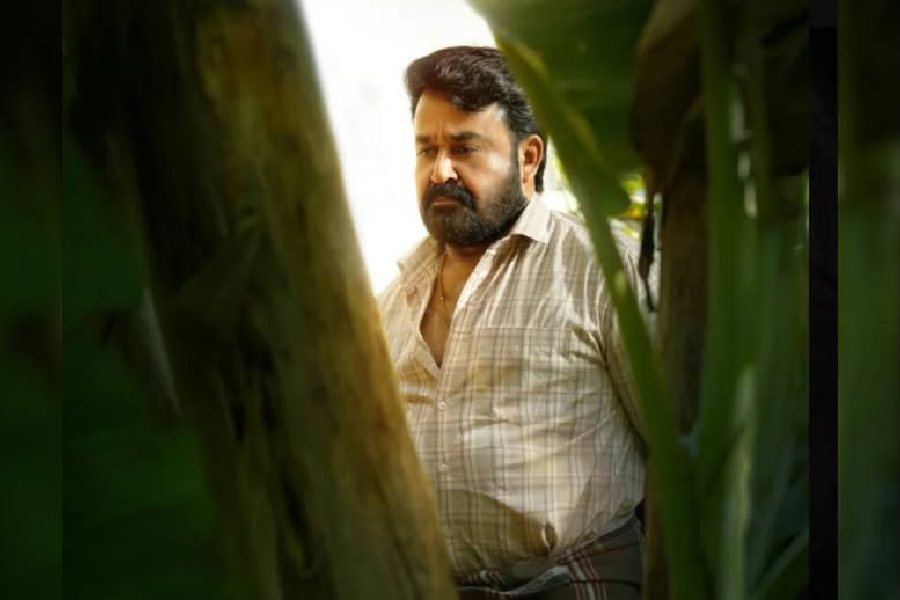
At the centre of it all is Mohanlal, who slips back into Georgekutty’s shoes with ease. But this is not the same man audiences encountered in the earlier films. Age, fear and exhaustion now weigh heavily on him. Earlier, Georgekutty knew who his enemies were. In Drishyam 3, the threat is invisible. He lives with the constant paranoia that someone could be watching him, that one mistake could unravel the carefully constructed life he built for his family.
Mohanlal captures this anxiety with remarkable control. He communicates Georgekutty’s mental state through subtle body language, restrained dialogue delivery and his expressive eyes.
Supporting performances from Meena, Ansiba Hassan and Esther Anil remain convincing throughout. Together, they portray a family permanently haunted by fear, and a hope for survival.
And then comes the climax.
Joseph delivers a final act that is masterfully written and executed, combining emotional catharsis with the intelligent twist that we expect from Georgekutty: he is always one step ahead. The ending serves as a powerful reminder of why the Drishyam franchise remains one of Indian cinema’s smartest thriller sagas.
More importantly, Drishyam 3 works because it understands that Georgekutty’s greatest battle was never with the police but with the burden of guilt of what he did to protect his family.
Whether this truly marks the end of the franchise remains uncertain, despite Jeethu Joseph previously suggesting that a fourth instalment is unlikely. But if this is indeed the farewell to Georgekutty, it is a fitting one. However, if the mid-credits scene is anything to go by, a fourth instalment may very well be in the making. And we can’t wait to see how Georgekutty protects his family this time.