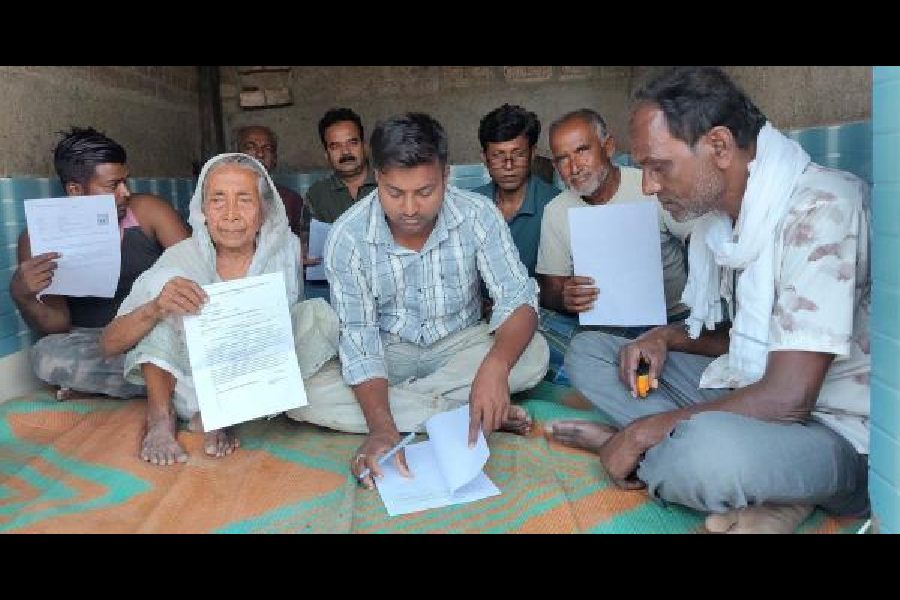
A predominantly Muslim Nadia village whose literacy rate is as high as 96 per cent and which boasts several doctors, engineers and civil servants has seen 821 residents struck off the electoral rolls after the SIR.
Beneath a bamboo shed beside a tea stall at a market in Chandanpur village, 60-year-old Nayeb Mallick sat in stunned silence, unable to wrap his head around a “bureaucratic anomaly” that has stripped his five children of their voting rights.
During the SIR drive, Mallick had been erroneously recorded in the Election Commission’s database as the father of six children. “But I have five children — three sons and two daughters. I don't know who this sixth person is,” he said.
The mistake created a tangle that led to the deletion of all five of his children following adjudication of “logical discrepancies”. Many in Bengal with more than five children have alleged being enmeshed in the quagmire of “logical discrepancies” and ejected from the electoral rolls.
A similar fate has befallen 57-year-old Ujir Seikh, whose four children have lost their voting rights after the EC’s system flagged him as the father of six. “We are being punished for something we don’t even understand,” he said.
The tentacles have reached into hundreds of homes in Chandanpur village under Billwagram panchayat in Nakashipara block of Nadia. At least 821 residents have been removed from the poll rolls, largely because of what locals have described as technical anomalies ranging from minor surname variations to mismatches in parental linkage.
With the Supreme Court earlier this week refusing to lift the freeze on the electoral rolls for the April 23 and 29 polls in Bengal, over 27 lakh people deleted after adjudication can no longer vote in this election.
Many residents of Chandanpur, 5km from Bethuadahari, said that during hearings, they produced citizenship documents tracing theirlineage back over a century, including British-period land deeds and electoral records as far into the past as 1952, but to no avail.
“Our exclusion from the voters’ list was completely unexpected. There were discrepancies, but most of us submitted sufficient proof. Yet those were not enough to convince officials to retain our names on the poll rolls,” said Kauser Ali Sk, a booth-level officer of polling station 165 under the Nakashipara Assembly seat, whose own name has been struck off the rolls.
He explained that his name appeared as “Kauser Sk” in the 2002 rolls and was later updated to “Kauser Ali Sk”, a change that appears to have triggered the mismatch.
“Despite submitting evidence in support of my claim that both refer to the same person, my name was deleted,” he told The Telegraph.
The scale of deletions is stark. Chandanpur, with a population of around 8,000, falls under four polling parts. In Part 70, 166 of the 198 voters under adjudication have been deleted and 32 cases approved.
In Part 71, 162 names have been excluded and 10 approved. In Part 72, 165 names have been struck off and 20 approved, while in Part 73, 328 names have been deleted and only 15 approved.
What has shocked many is that such large-scale exclusions have been done in a village known for its educational achievements, having among its residents at least 17doctors, nearly a dozen civil engineers, numerous schoolteachers, army and BSF personnel and several hundred government employees. Chandanpur’s literacy rate of 96 per cent is far above Bengal’s 77.08 per cent.
Md Jerman Seikh, a schoolteacher whose name has been deleted from the rolls, attributed the crisis to a mix of systemic rigidity and lack of awareness among residents.
“Most deletions have occurred because of surname mismatches, discrepancies between EPIC numbers of 2002 and 2024, a large number of children linked to one parent, and inconsistencies in parent-child age records,” he said.
At the same time, he acknowledged certain lapses within the community.
“In some cases, people modified their surnames by adding prefixes or suffixes without affidavits. These changes, made casually, have now come back to haunt them,” Jerman said.
The local mosque committee is advising residents against making such alterations in the future without proper documentation. But for now, the damage is irreversible for those removed from the rolls.
Dozens of affected residents had rushed to file petitions before the appellate tribunals, both online and offline, hoping to be reinstated ahead of the April 29 polls in Naida. That hope now lies shattered with the Supreme Court’s seal on the freezing of the rolls.
“I don’t know how to get their names back on the voters’ list. Having seven children seems to be my only fault,” said 68-year-old Doyajan Mullick, who passed the Madhyamik exams in 1975 and has seen all his children excluded from the voter list.
“I don’t know how to prove that all seven are my children and that they are not bogus voters,” he told this newspaper.
Miadad Hossain, a private tutor in the village, pointed to demographic realities.
“Having a large number of children was common in our community a few decades ago, though that has changed now. But this cannot be a ground for deletion,” he said.
An official from the Nadia district election cell defended the process, saying:
“The Election Commission is being extra cautious. If one person is linked as a parent to a large number of children, the system flags it as suspicious as many fake and duplicate voters had entered the rolls in the past under a parent’s name. It is not a rule against large families, but a stricter verification mechanism requiring additional documents.”
However, the political ramifications of the episode are already surfacing.
Local Trinamool Congress MLA and party candidate Kallol Seikh alleged targeted exclusions. “The large-scale deletion of voters in Chandanpur is clearly targeted at a particular community. This exposes the divisive intent of the Election Commission, which has become a tool of the BJP,” he said.