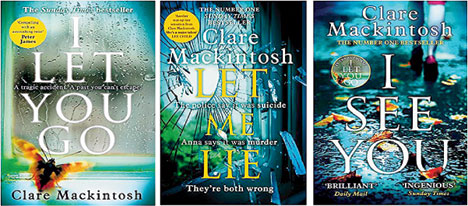

Clare Mackintosh’s novels I Let You Go, I See You and Let Me Lie are lucidly written swift-paced thrillers with a twist on every page. A former policewoman, Mackintosh’s debut novel, I Let You Go (Hachette India, Rs 399), became a Sunday Times bestseller, and it is easy to see why. The story revolves around the mysterious Jenna Gray, whose life abruptly descends into nightmare after a horrific accident. Jenna chooses to walk away from her old life to begin anew, but her past catches up with her, threatening everything she loves. The heart-rending story deals with subjects as difficult and diverse as murder, domestic abuse and the loss of one’s child, weaving all of them into a plot of suspense.
I See You (Hachette India, Rs 399) is about Zoe, a woman who spots her own picture in the classified section of a newspaper, thus uncovering a vast conspiracy designed to target vulnerable women via a terrifying breach of privacy. The book looks closely at ambition, jealousy and betrayal, and ends like I Let You Go, on a cliffhanger.
Let Me Lie (Hachette India, Rs 399) takes up the tension a notch higher, with a story about a suicide that is suspected to be a murder but becomes something else entirely by the end of the book. Anna Johnson, whose parents both committed suicide within less than a year of each other in an identical manner, has to confront the idea that all was not what it seemed — something she had already suspected for a long time. Having just given birth to a child, she must try to protect both her daughter and herself from the invisible enemy she can feel closing in on her. The story’s emotional punch lies in its exploration of generational trauma, and how much of our childhood is shaped by being sheltered from witnessing the worst of our near and dear ones.
All three books have open endings, creating the possibility of a series featuring these characters, although the characters and plots of the novels do not overlap. Mackintosh handles the details of investigations that are hidden from the public eye, turf wars between the various agencies of the police and politics within the office with the confidence of one who has experienced it all up close. She goes further and adds a human touch to it all — the tiresome hours, the endless paperwork and the heartbreak of working on an investigation only to hit dead ends, or not being able to save a potential victim. She thus portrays both sides of an investigation — the victim as well as the police officers looking into the crime — and often even the perpetrators’ perspectives, giving a close look at the way the minds of many kinds of criminals, both deliberate and accidental, work.