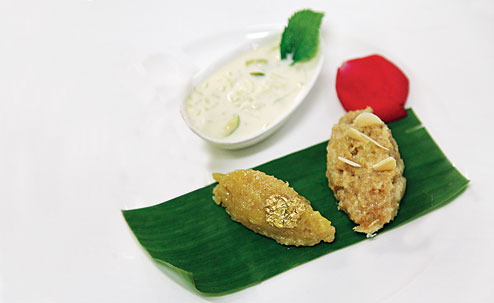

If you are tired of London, you are tired of life, said the wise man. I have come up with an addendum — if you are tired of nimish, you are tired of desserts.
To my mind, no dessert is as good as Hyderabad’s nimish — known in the north as daulat ki chaat. If you’ve not eaten this, you have not eaten the best of Indian sweets. It looks wonderful, tastes delicious and has some exotic stories linked to it.

The dessert is prepared with the foam of milk, which is gathered gently at night. Legend has it that this is best done on a full moon night, for that’s when you get the perfect consistency of the milk foam. The peaks of foam are left to cool, placed on a sal leaf and served. And you devour this wonderful delicacy with brown sugar sprinkled on top.
If you are in Hyderabad in winter, you should go in search of nimish. Food writer Pratibha Karan calls it a “heavenly dish” which “can truly be described as the food of the gods” in her book A Royal Legacy-Hyderabadi Cuisine. The dish, she explains, moved to Hyderabad from the north, as did many other desserts. But chefs who specialise in Hyderabadi cuisine see these desserts as their own — and are rightfully proud of them.
“The dishes are from Hyderabad,” asserts chef Arun Sundararaj, the new executive chef of the Taj Mahal Hotel
in Delhi, who was earlier with the Taj Falaknuma Palace in Hyderabad. “The food of Hyderabad is influenced by the north because of the city’s deep roots with the Mughals,” he adds.

Indeed, the links are clear when we talk about desserts. A dish like the southern city’s double ka meetha — fried bread in sugar syrup cream — is like the north’s shahi tukda. But what interests me is that there’s more to
Hyderabadi desserts than the better known double ka meetha and khu-mani ka meetha, prepared with dried apricots and cream. Among the dishes that the city takes pride in, for instance, is gil-e-firdaus, a rich dessert prepared with thickened milk and pumpkin. Then there’s pineapple halwa, as well as khuuba, another apricot dessert.
Desserts, by definition, are heavy. I mean, if you want to have a low-cal sweet dish, you’d rather stick to yoghurt, right? But I find that Hyderabadi dessert is especially rich. You have a whole host of desserts in the East and elsewhere, where magic is woven mainly with milk and sugar. Hyderabadi desserts have all that, and almonds, cashew nuts and pistachios, a few strands of saffron, cream, dollops of ghee and so on.

Chef Mandaar Sukhtankar, the executive chef of The Park in Hyderabad, agrees that most of Hyderabadi desserts are deliciously rich. “You will find a lot of badam and cream in them. The sugar content is also very high,” he says. Badam ki jaali, or Ashrafi, he says, is a case in point. The sweets are like almond marzipans, with a net
or lattice-like appearance, or with a coin pressed over the sweet for shape and design.
Milk is one of the main ingredients of Indian sweets, but is used only in some Hyderabadi desserts, such as in urusa, a beetroot halwa. “Milk is also used in the form of reductions as in khoya and for boiling fruits, etc.,” chef Arun says.

Hyderabad’s sheer khurma is another milk-based dessert. To serve five, the chef recommends the use of 1.5 litre of milk, 120g superfine seviyan, 125ml ghee, 100g sugar, 50g almonds, 25g green pistachio nuts, 20g dried dates, 15g charoli (chironji), 15g cashew nuts, a few strands of saffron, 2g green cardamom powder and 5ml rose water. Blanch, peel and sliver the nuts. Roast the almonds and charoli in ghee. Strain the ghee. Heat the seviyan till golden brown. Heat the milk and add chopped dates to it. Once the dates are soft and the milk has been reduced by a quarter, add the sugar and stir to dissolve. Now add the seviyan and cook till soft (don’t overcook it). Remove from the flame, add cardamom, saffron, rosewater and nuts. Serve hot.
But despite the somewhat limited range of Hyderabadi desserts, the sweets are memorable — and the Hyderabadi loves them. Karan recalls that the founder of Hyderabad, Sultan Mohammed Kuli Qutub Shah, had such a sweet tooth that in his poetry, he compared his saki, or the bearer of wines, to dates and sheer khurma. And if that’s not sweet, I don’t know what is!
Courtesy: Taj Mahal Hotel, Delhi