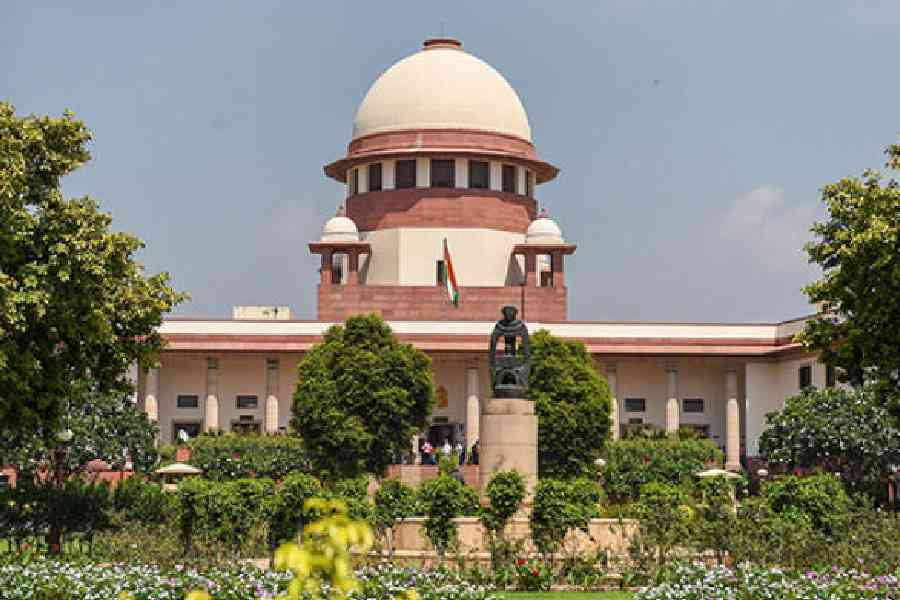
The Supreme Court has ruled that the government cannot impose one-sided contractual terms on private parties, observing that “notions of justice and fair play would be rendered a mockery” if such a position were accepted.
“Liability cannot be decided by the respondent administration, which is itself the party alleging the breach. The interpretation canvassed by the respondent, if accepted, would militate against the fundamental principle of the rule of law that no party shall be a judge in its own cause. Notions of justice and fair play would be rendered a mockery if such an interpretation is countenanced,” a bench of Justice J.B. Pardiwala and Justice K.V. Viswanathan said in its judgment.
The bench delivered the ruling while setting aside a Calcutta High Court judgment in an appeal filed by M/s ABS Marine Services. The case arose from a contractual dispute with the Andaman and Nicobar Administration concerning the maintenance and manning of shipping vessels on the high seas.
On December 26, 2008, a “Manning Agreement” was executed between the appellant and the administration for manning 17 vessels. Subsequently, on September 25, 2014, the Andaman and Nicobar Administration unilaterally recovered ₹2,87,84,305 as a penalty for damage and grounding of the vessel M.V. Long Island at Campbell Bay, deducting the amount from the appellant’s pending bills.
The dispute was referred to arbitration before a tribunal headed by former Supreme Court judge Justice S.S. Nijjar.
The arbitrator held that Clause 3.20 of the agreement was void, as it contravened Section 28 of the Indian Contract Act, 1872 by imposing a total restraint on challenging decisions in a court of law. The clause also barred the parties from invoking arbitration, thereby violating the same provision.
The arbitrator directed the administration to refund ₹2,87,84,305 to the appellant, along with interest at 9 per cent per annum from the date of recovery until the date of the award. However, the Calcutta High Court later set aside the arbitral award, prompting the marine company to approach the Supreme Court.
Writing the judgment, Justice K.V. Viswanathan observed that once the appellant disputed any wilful action or negligence leading to financial loss, the issue of liability had to be adjudicated by an independent forum.
The Court further noted that Clause 3.20, which declared the administration’s decision as final, could only apply in cases where wilful action or negligence was undisputed — something that was not the case here, as the appellant had contested its liability.
“What is even more glaring,” the Court observed, “is that Clause 3.20 states that the administration’s decision would be final and that neither a court of law nor an arbitrator could examine its correctness. If the respondent’s contention is accepted, such an interpretation would strike at the very heart of the fundamental legal maxim ‘Ubi jus ibi remedium’—there is no wrong without a remedy,” Justice Viswanathan said.