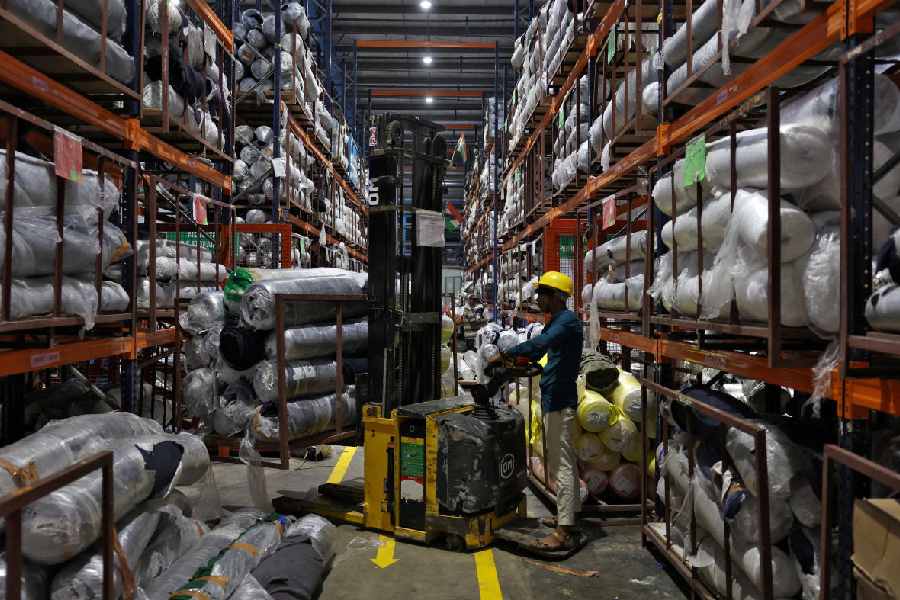
Garment worker Raj Pal often sleeps on the roof of his one-room home near India's capital to try to escape the sweltering heat, but even so headaches and exhaustion mean he sometimes misses work and can lose as much as a quarter of his £200-a-month pay.
Researchers said relying on the resilience of garment workers to endure the withering effects of climate change was likely to undermine India's drive to become a global force in garment manufacturing and boost the sector's exports from the current $40 billion to $100 billion by 2030.
India's garment industry employs around 45 million people and accounts for about 12 per cent of its exports.
"It feels like my hands will fall off from the shoulder," Pal said, describing how he feels at the end of a typical 15-hour working day.
New York University's Stern Center for Business and Human Rights said in a report on India's garment sector last month that extreme heat led to greater absenteeism, lower productivity, more product defects and more frequent disruptions caused by power failures and overheating equipment.
Managers estimated productivity fell by between 3 per cent to 10 per cent during peak summer months, while workers said they suffered health problems and wage losses, the report said.
"The key lesson is that heat can no longer be viewed solely as a worker safety issue," said Lucy Siers, co-author of the report. "It is increasingly an operational, productivity and supply chain resilience issue."
Workers bear the brunt
Research by the non-profit Heatwatch India and the Mumbai-based Tata Institute of Social Sciences said workers often paid for extreme heat with poor health, longer hours and lost income.
"Workers are currently absorbing the largest share of the climate adaptation burden," said Apekshita Varshney, founder of HeatWatch India.
"We have not come across instances where brands or buyers adjusted production schedules or reduced targets due to extreme heat," she said.
Workers often have little choice but to continue working despite poor health because missing targets could affect wages and job security, Varshney said. In many cases, factories attempt to make up for declining productivity by having longer shifts, overtime and additional working days.
Adaptation measures remain uneven, Varshney said. Larger factories have been able to install cooling systems and monitor temperatures, while many smaller ones struggle to provide basic amenities and lack the resources to retrofit their facilities.
Threat to competitiveness
The consequences extend beyond the factory floor. Anant Sudarshan, an associate professor of economics at Britain's University of Warwick who has examined heat and manufacturing in India, said there was strong evidence that worker performance declined as temperatures rose.
"Extreme heat is very likely to be a meaningful challenge for India in manufacturing growth," Sudarshan said.
"There is a very large body of evidence from all over the world, including my research in India, which shows that labour productivity declines rapidly as temperatures cross 30-35 degrees Celsius (86 to 95 degrees Fahrenheit)," he said.
Cooling factories alone cannot eliminate the problem as workers and their families are also exposed to heat outside the workplace, which contributes to illness and absenteeism, Sudarshan said.
Sudarshan said North India was becoming "increasingly unattractive from the labour point of view", reducing one of India's biggest competitive advantages, its abundant supply of relatively low-cost labour.
The challenge extends beyond India.
A 2023 study by Cornell University's ILR Global Labor Institute estimated that failure to address heat and flooding could cost the apparel industries of Bangladesh, Cambodia, Pakistan and Vietnam nearly $65 billion in earnings and about one million jobs by 2030.
Adapting to heat
"Extreme heat is a real threat to India's manufacturing ambitions if it is ignored, but if addressed well it should not be an inevitable barrier to growth," Siers of New York University said.
As heat is predictable, businesses can prepare for it through better factory design, heat monitoring, cooling systems and work-rest practices, she said.
"In a warming world, the manufacturers that adapt to heat will be more productive, more resilient, and ultimately more competitive," Siers said.
Garment worker Pal does piecework until late at night, but said it was still not enough to support his family.
"Summers were always hot, but nights were cooler and we could sleep," he said. "Now the heat does not leave us, day or night."