The European Union, overcoming deep dissension among its members, gave the green light on Friday to a sweeping trade pact with four South American countries (known as Mercosur) that would create one of the largest free-trade zones in the world, connecting markets with more than 700 million people.
The agreement offers a stark contrast to the amped-up aggression on display this week from the Trump administration. As Europe worked to extend an era of economic collaboration, the United States, its once-close ally, demonstrated that it preferred coercion over cooperation.
In Brussels, European leaders negotiated and revised rules to win agreement. Across the Atlantic, President Donald Trump authorised military raids to oust Venezuela’s president and capture two tankers, as part of a plan to seize billions of dollars worth of Venezuelan oil. He then doubled down on threats to Colombia, Cuba and Greenland, a semiautonomous Danish territory.
To some degree, Trump’s confrontational approach and embrace of trade wars helped seal a deal between the 27-member EU and four South American nations (Argentina, Brazil, Paraguay and Uruguay) that had languished for a quarter-century.
Indeed, countries across the world have stepped up efforts in the past year to sign trade partnerships that do not include the United States. Trump’s policies were helping “to create a world without America,” said Robert Z. Lawrence, a professor of international trade and investment at Harvard University. And “it’s not only in trade,” he added. “In the short run, Trump is able to impose his will,” Lawrence said, “but is he building a lasting basis on which America can interact with the rest of the world?”
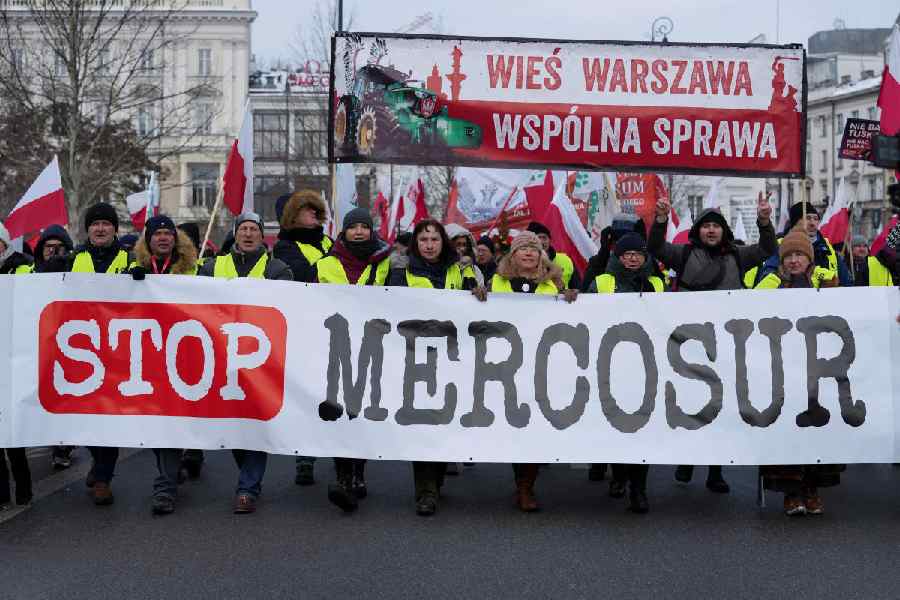
The EU’s agreement with Brazil, the largest economy in Latin America, as well as Argentina, Paraguay and Uruguay, was long opposed by agricultural interests and environmentalists in Europe. Farmers, particularly chicken and beef producers, have been worried that cheap imports would undercut their livelihoods.
On Thursday, French farmers driving tractors forced their way through police barricades and blocked roads around the Eiffel Tower and Arc de Triomphe in Paris to protest the Mercosur agreement, while Polish farmers protested in Warsaw on Friday.
New York Times News Service