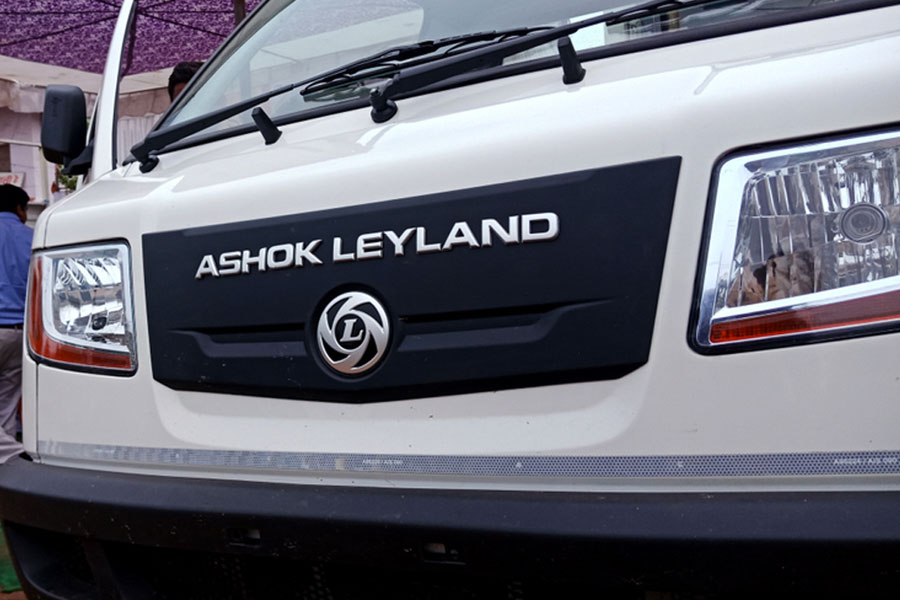
Ashok Leyland on Thursday said demand across Gulf markets remains resilient despite short-term supply-chain disruptions affecting output at its UAE facility, as the company also rolled out twin-fuel light commercial vehicles to widen its portfolio.
Addressing concerns over the impact of geopolitical tensions in West Asia on FY27 performance, Ashok Leyland President-LCV, IO, Defence & Power Solutions, Amandeep Singh, said, "It's too early" to assess the situation, while noting that India’s economic momentum continues to be strong.
He added that there may be temporary disruption due to 'shortage and logistics' issues linked to the West Asia situation, but expressed confidence that conditions would "bounce back" quickly.
"We have earlier seen this, we can bounce back pretty quickly, but it is very difficult right now to hazard any guesses, or forecast on the growth percentage. All we have to keep an eye on is the GST collections, on the e-Way bills, which are very important for the economy as an indicator," he said.
Ashok Leyland maintains a strong presence in the Middle East through its Ras Al Khaimah (RAK), UAE manufacturing facility, which serves as a hub for the Gulf Cooperation Council (GCC) and African markets, while also expanding its footprint with a new assembly plant in Saudi Arabia.
Singh said the company has not witnessed any "slack in the demand" across GCC markets.
"The demand in the Middle East countries are very strong, continues to hold, and we have not seen any order cancellations that have happened," said Singh.
However, he acknowledged supply-side challenges, citing "logistic issues of getting the parts and components" that led to production "come down" slightly in March.
"We are trying to make efforts for alternate routes and logistic arrangements, so that we can reach the parts there and our plant is functioning. Our manpower is there, and I think we can bounce back very shortly," he said.
On the timeline for normalisation at the RAK facility, Singh said, "It's difficult to say". He added that once the conflict subsides, operations could stabilise quickly as most components are shipped from India.
"It's not too much of a distance, and we can do it in a matter of days," he said.
The company reported a record FY26 performance, with revenue of Rs 11,534 crore, driven by strong sales in both Medium and Heavy Commercial Vehicles (MHCV) and Light Commercial Vehicles (LCV) segments.
On whether this momentum can be sustained, Singh said: "If we can get it over quickly", the current disruption may not materially impact FY27, which has just begun.
"We should also remember that last year, it was the second half which had a big increase. The first half did have a lower base. Therefore, we are still confident that in FY27, the momentum that we saw in FY26, and particularly in the second half of FY26, will continue because the economy is doing well," he said.
He also noted that the Iran war could accelerate electric vehicle adoption, positioning the company favourably.
"Our Dost and Bada Dost (of LCV range) vehicles are already available in the EV, and we are selling them in good numbers already," he said, adding, "We have a very good market share through our subsidiary Switch in the two to four tonnes category.
Separately, Ashok Leyland announced the launch of twin-fuel variants of its LCV models — DOST and DOST+ XL — enabling customers to switch between Compressed Natural Gas (CNG) and petrol.