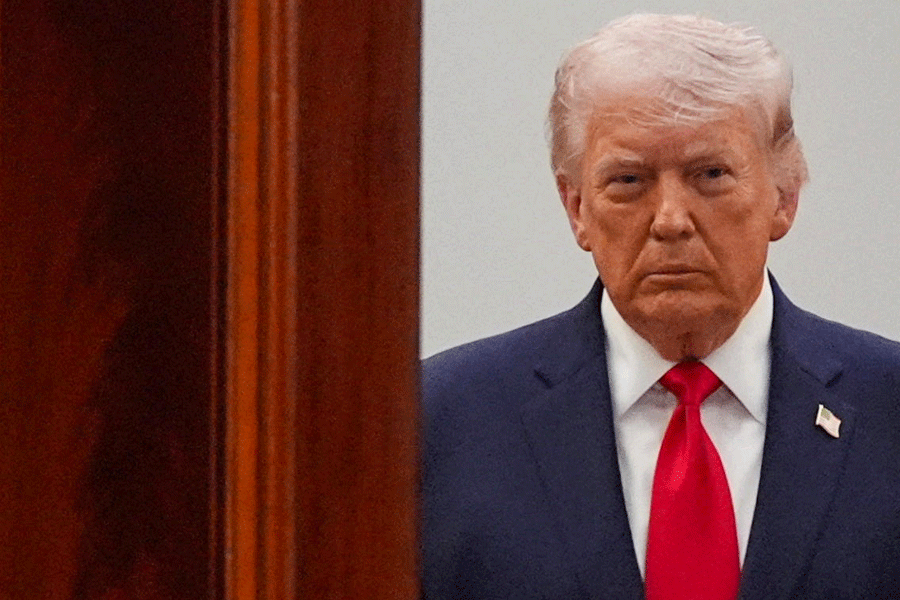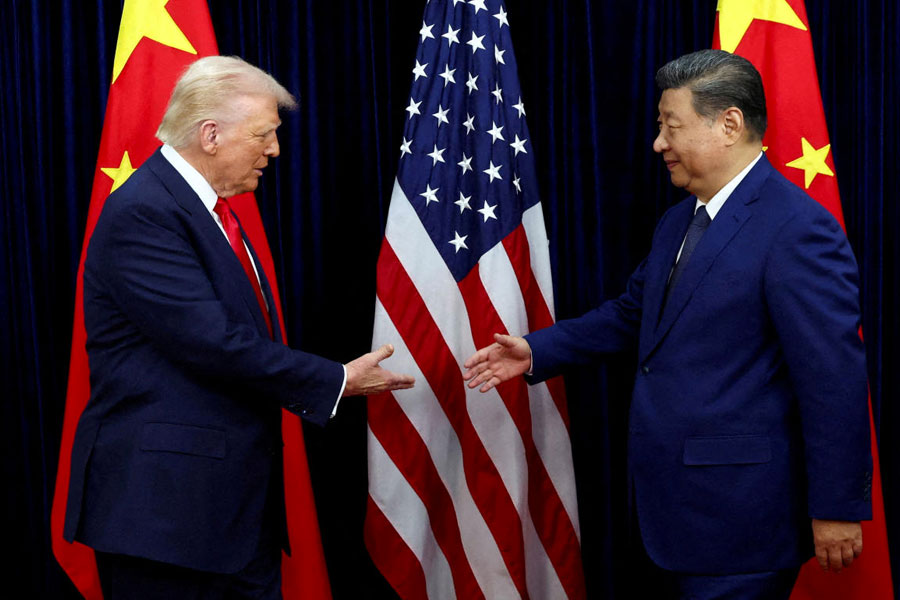
US President Donald Trump will pay an official visit to China from May 13 to 15 at the invitation of Chinese President Xi Jinping, the Chinese foreign ministry announced on Monday, setting the stage for high-stakes talks on trade, Taiwan, Iran, artificial intelligence and global security.
The visit will mark the first trip to China by a sitting US president in almost nine years and comes at a time of heightened geopolitical tensions, including the prolonged US-Israel-Iran conflict, the crisis surrounding the Strait of Hormuz blockade and growing friction between Washington and Beijing over Taiwan and trade.
On Sunday, US principal deputy press secretary Anna Kelly said Trump would arrive in Beijing on Wednesday evening for what she described as a “visit of tremendous symbolic significance”.
According to Kelly, Trump will attend a welcome ceremony and bilateral meeting with Xi on Thursday, followed by a visit to the Temple of Heaven and a state banquet. The two leaders are also scheduled to hold a bilateral tea and working lunch on Friday. Kelly added that Washington plans to host Xi for a reciprocal visit later this year.
Trade deal, rare earths truce in focus
Ahead of the summit, both countries announced that Chinese Vice-Premier He Lifeng will travel to South Korea for trade talks with US Treasury Secretary Scott Bessent on May 12 and 13, in what is expected to be the final round of negotiations before Trump’s arrival in Beijing.
The talks are expected to focus heavily on tariffs and trade disputes between the world’s two largest economies. Officials from both sides indicated that agreements could be reached on agriculture purchases, energy cooperation, investment mechanisms and Boeing aircraft deals.
The US and China are also expected to discuss extending a truce in their trade war that currently allows rare earth minerals to continue flowing from China to the United States.
"It doesn't expire yet," a US official told reporters. "I'm confident we'll announce any potential extension at the appropriate time."
A Chinese commerce ministry statement said the negotiations would be “guided by the important consensus” reached by the two leaders during their previous meeting in Busan, South Korea, as well as in subsequent phone conversations, and would address “economic and trade issues of mutual concern”.
Iran, Russia and AI expected to dominate discussions
Beyond trade, the Trump-Xi summit is expected to cover several sensitive geopolitical flashpoints, including Iran, Russia, nuclear weapons and artificial intelligence.
US officials said Trump is expected to press China over its economic and strategic ties with Iran and Russia. Beijing remains a major buyer of Iranian oil and maintains close links with Moscow.
"The president has spoken multiple times with General Secretary Xi Jinping about the topic of Iran and about the topic of Russia, to include the revenue that China provides to both those regimes, as well as dual-use goods, components and parts, not to mention the potential of weapons exports," one US official said.
"I expect that conversation to continue."
The Trump administration is also expected to raise concerns about the rapid advancement of Chinese artificial intelligence models and seek the establishment of communication mechanisms to avoid future conflicts linked to AI technologies.
"What that looks like is yet to be determined, but we want to take this opportunity with the leaders meeting to open up a conversation and to see if we should establish a channel of communication on AI matters," the official added.
Washington is additionally expected to renew efforts to engage Beijing on nuclear arms discussions, though US officials acknowledged China remains reluctant to enter formal arms control talks.
Taiwan watches summit closely
Taiwan has meanwhile expressed confidence in its relationship with Washington but said it hopes there are no “surprises” concerning the island during the Trump-Xi summit.
Speaking in Taipei on Monday, Taiwan Foreign Minister Lin Chia-lung said the government was closely monitoring the upcoming meeting.
"We have also maintained continuous communication with the United States - whether through public statements from the U.S. government or through non-public channels. We are confident in the stable development of Taiwan-U.S. relations," Lin said.
"The U.S. government has repeatedly expressed that its Taiwan policy will not change," he added.
Taking questions later in parliament, Lin said Beijing continued to raise the Taiwan issue in discussions with Washington.
"Of course we hope that the Trump-Xi summit does not produce any surprises regarding Taiwan-related issues," Lin said.
The Taiwan issue remains one of the most contentious points in US-China relations. Beijing claims Taiwan as part of its territory and has increased military pressure around the island in recent years, while the United States remains Taipei’s principal international supporter and arms supplier.
China’s defence ministry reiterated its stance over the weekend.
"'Taiwan independence' is the root cause destabilising peace in the Taiwan Strait, and we will absolutely not tolerate or condone it," Chinese defence ministry spokesperson Jiang Bin said.
Taiwan defence spending under scrutiny
The summit also comes amid growing US concern over Taiwan’s defence preparedness after Taiwan’s opposition-controlled parliament recently approved a smaller defence budget than requested by the government.
A senior US official said Washington was disappointed with the reduced spending levels.
Lin said Taiwan hoped lawmakers would take “remedial” steps to strengthen defence allocations.
"However, peace depends on strength - it requires demonstrating the defence capability for self-defence in order to deter aggression," he said.
Taiwan Premier Cho Jung-tai also warned that cuts to defence funding could damage international confidence in Taiwan’s security commitments.
"Having it fragmented in this way is a serious blow to defence and security," Cho said.