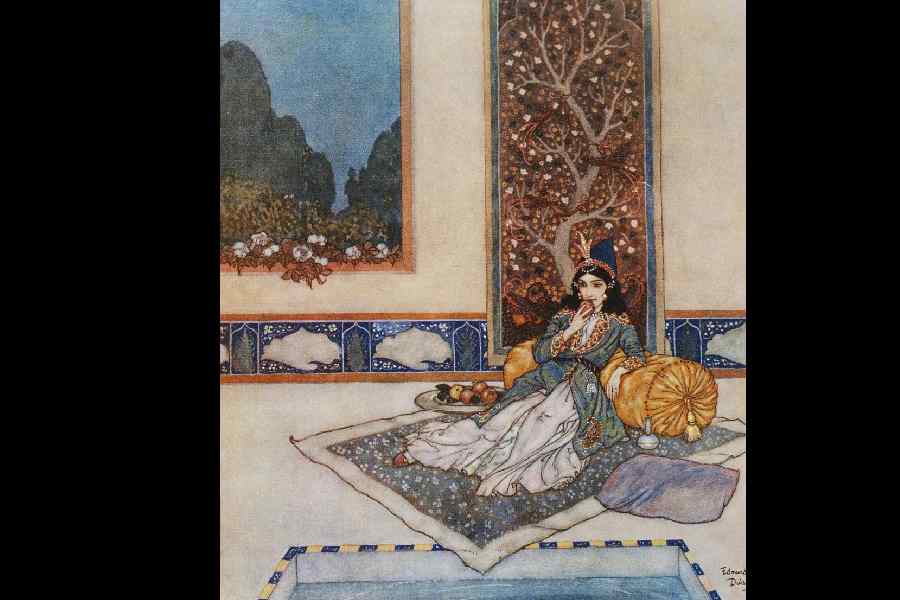
Book: ONE ALADDIN TWO LAMPS
Author: Jeanette Winterson
Published by: Jonathan Cape
Price: Rs 1299
In One Aladdin Two Lamps, Jeanette Winterson returns to a question that has shaped her writing from the beginning: what work do stories actually do in the world? This has been a question Winterson has returned to time and again, in earlier works like Oranges Are Not the Only Fruit, for instance, where the narrative carried the weight of escape, self-making and defiance. One Aladdin takes its cue from One Thousand and One Nights, though it treats that source less as a stable frame than as a canvas of possibilities. Stories are retold, interrupted and redirected. Shahrazad is recast as a figure of strategic intelligence, someone who understands that survival depends on controlling the narrative. This idea governs the structure, which unfolds as a sequence of reflections.
The narrative style reflects that design. Chapters open with compressed retellings before expanding into commentary that straddles politics, religion, technology and memory. The shifts are abrupt and intentional. Winterson favours association over transition, allowing one idea to trigger another without pausing to justify the leap. The effect can be invigorating, especially when a connection lands with precision. But, at times, it can also appear as if the book is moving faster than its own reasoning. That speed has been present in her work for decades. In Art Objects, she argued that art demands attention and resists simplification. A new recurring concern, understandably, is the status of narrative in a world shaped by technology. Winterson treats Artificial Intelligence as a potential extension of imagination, a development that could alter human identity. The argument aligns with her recent writing yet sits uneasily within the broader critique of power. The optimism feels asserted, with limited attention to the structures that govern technological change.
Winterson’s prose is declarative, compressed and often aphoristic. Sentences arrive as statements rather than explorations, carrying the weight of conclusion from the outset. While this produces clarity, the reader is asked to accept rather than to consider. That tendency especially shapes the book’s political passages where critiques of patriarchy, capitalism and digital culture are expressed with no scope for opposition.
The book works best when it remains close to storytelling. The retold episodes from the One Thousand and One Nights carry momentum and clarity, demonstrating how narrative can hold complexity without reducing it. When the text moves further into polemic, the voice becomes insistent, less interested in dialogue than in declaration.
One Aladdin Two Lamps continues Winterson’s long engagement with the possibilities of fiction and the authority of narrative. It presents storytelling as a form of agency, a way of reshaping the terms of existence. The result is a book that challenges, provokes and occasionally frustrates, holding fast to the belief that imagination remains a serious form of power.