


The Saturday's shakes and Sunday's aftershocks revived veteran Congress leader Laliteshwar Prasad Shahi's bitter memories of the devastating earthquake in Bihar in the winter of 1934.
Going down memory lane, the 95-year-old former parliamentarian recalled that the magnitude of the past century's quake on January 15, 1934 was higher. Shahi was just 14 then.
While speaking to The Telegraph at his residence in west Patna, Shahi said the 1934 earthquake destroyed thousands of houses and affected several districts, including Munger, Muzaffarpur, Purnea and Champaran. He said Patna, too, was affected but the casualty was less.
Shahi said: "I was a student of in Muzaffarpur Bhumihar Brahman Collegiate School then. January 14, 1934 was a Sunday and Makar Sankranti observed that day. The school was closed and I went to my village Sain-Parwara. The earthquake had hit the next day in the afternoon. I was not at my home then. I was in another house in the village. Suddenly, it started shaking, dust was there all over, and there was lot of noise. The women of the house surrounded me to save me. What happened on Saturday was nothing compared to the 1934 quake. It was horrible and frightening. I still remember that there was a heavy rain after the quake."
Born on October 1, 1920, Shahi said the calculation of the magnitude of earthquakes those days was not precise but it was higher than the Saturday's 7.9 on the Richter scale for sure. Shahi did not rush out of his room during the tremor on Saturday.
According to the data available with the experts, the magnitude of the 1934 quake was 8.1 on the Richter scale. More than 10,000 people were killed in Bihar alone.
"Muzaffarpur and Munger were the worst-hit districts. The Purani Bazaar Mohalla in Muzaffarpur was reduced to debris. People had left their houses and stayed in huts on fields for many days. Even I stayed in a hut for a few days," said Shahi.
Those days, he said, there were just a few concrete houses. But many factories and structures were destroyed.
Asked about communication, Shahi said: "Today people have plenty of options of sending and receiving messages but there was no cellphone, television or any other communication device in 1934. What was available was telegram, but only at select places. And there were post offices. Just imagine the panic of the people of that period when quake had hit the state."
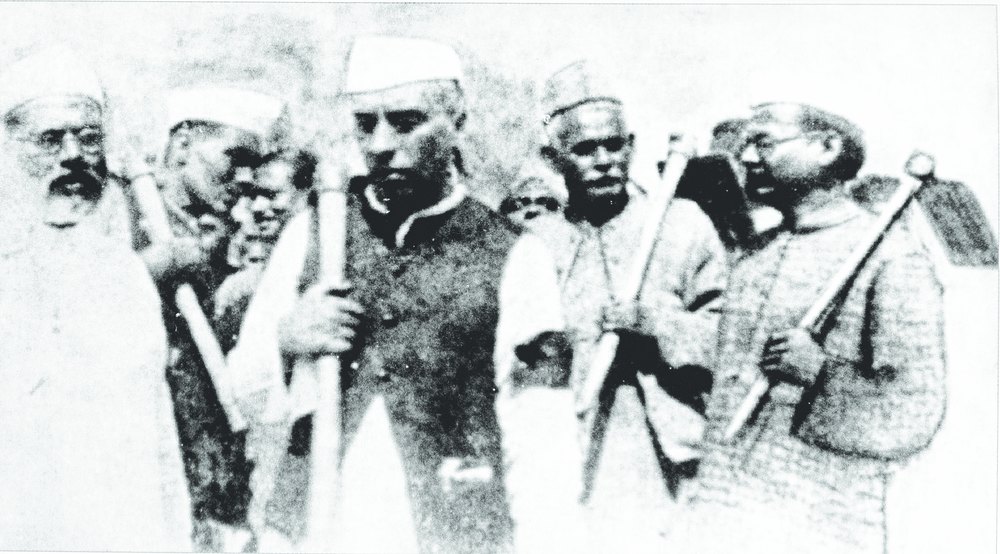
Shahi said kudals (spades) were used to clear debris. "I have a rare photograph of Jawaharlal Nehru and many other Congressmen, including Sri Krishna Singh, visiting Munger to clear the debris. They, too, had spades on their shoulders. This photo is not even available in Nehru Museum," said Shahi.
He was fortunate enough to see Mahatma Gandhi at Ghorghat railway station in Munger. Bapuji was there just after the quake.
Shahi, who became a minister in the Bihar government in 1957 for the first time, said the poor were given preference during rehabilitation. He recalled how big industrialists helped in the relief work by giving monetary help to the affected districts of Bihar.
"The Tata family, the Wadias of the Bombay Dyeing, Ambalal Sarabhai and many other mill owners gave monetary help to those affected by the quake," said Shahi.