
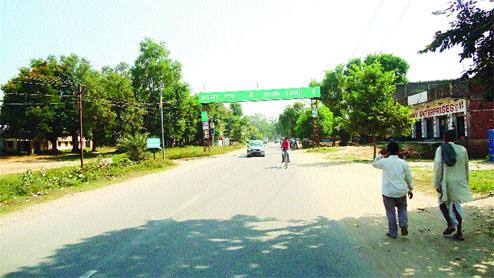

One look at the condition of villages in neighbouring Jharkhand is all it takes to understand the voting preference in Bihar's Aurangabad district.
East of where it says "Jharkhand rajya mein aapka swagat hai (Welcome to the state of Jharkhand)" is the dilapidated Hariharganj block office building.
On the Bihar side is a newly built middle school - dazzling with a newly applied coat of pink. The block office - the highest seat of civil authority at the local level - reflects the Jharkhand government's neglect while the spanking school building is evidence of how Bihar "cares" for its schools even in its last village of Sanda, which leads to Hariharganj in Jharkhand's Palamu district.
The contrast reflects also in the people's reaction.
"We were on cloud nine when we got our separate state of Jharkhand in 2000," said Umesh Shaw, a BJP mukhiya at Hariharganj panchayat.
"We thought our mineral and industry-rich new state would prosper after its bifurcation from Bihar. Fifteen years down the line, we are a sad lot. We get envious when we see electric bulbs light up in our neighbourhood after the sun goes down. Also, new school buildings are coming up and roads being smoothened in neighbouring Sanda and Maharajgan villages of Bihar," he further said.

Hariharganj residents get barely three to four hours of power every day while neighbouring villages on the Bihar side have been getting power for at least 16 to 18 hours in the past six months.
Umesh's wife, Neelam Devi, is the mukhiya of Maharajganj in Bihar. She said: "Our village is better off in terms of roads, schools, power supply and other development parameters."
Neelam, from Aurangabad in Bihar, married Umesh of Hariharganj in the late-1980s when Bihar and Jharkhand were one state. But she decided to continue doing her politics in Bihar. She sounded happier than her husband. While her spouse has a soft corner for the BJP, Neelam was clear about her political preference for Nitish.
"I prefer Nitish and his Grand Alliance. It was his decision to reserve seats for women in panchayats that enabled a woman like me to become a mukhiya. I have no reason to change my political preference, though I don't interfere with my husband's choices," she said.
Unlike Neelam, traders running dhabas and restaurants or selling paan, cigarette and liquor on the Hariharganj-Amba-Aurangabad highway favoured former chief minister Jitan Ram Manjhi's son Santosh Kumar Suman, who is the NDA candidate from Kutumba Assembly constituency. But they all had something good to say about the development work undertaken by Nitish.
Mohammad Karar Ansari, a Muslim at a restaurant on the highway, said: "Kuchh bhi ho jaye (no matter what happens), we'll vote for Congress candidate Rajesh Ram. Yadavs, Bhuinyas, Kushwahas and all we Muslims will vote for him."
Karar was bantering with Rajputs and members of other upper castes - traditionally BJP supporters - at the Tripti dhaba, evidence that there was complete harmony between Hindus and Muslims here, despite BJP supporters injecting the sensitive B-word in the air. In fact, both Karar and Rajesh Singh, a BJP supporter, restrained this reporter from broaching the beef topic.
Pradip Singh, a Rajput in Amba, said: "All of us admired Nitish and would have voted for him had he not sided with Lalu Prasad - a symbol of anarchy. We have decided to support the BJP-led NDA only because Nitish has joined hands with Lalu." Rajesh, a backward caste Kushwaha, said: "We have nothing against Nitishji joining hands with Laluji. These towering leaders have invested their life to uplift the poor, backward classes and Dalits. We are all praise for their unity at the right time."
A journey through Aurangabad, Kutumba, Nabi-Nagar, Obra, Rafiganj and Goh - all in south Bihar's Aurangabad district on the Bihar-Jharkhand border - brings to the fore three broad things. The difference in political preference between Hindus and Muslims has hardly unsettled the bonhomie that exists among communities in the region. The two Assembly seats here - Nabinagar and Rafiganj - have a sizeable presence of Muslims and upper caste Rajputs.
Second, the consolidation of backward castes against the Rajputs, who are numerically powerful in the Aurangabad region, which is also known as the "Chittaurgarh" of Bihar because of the traditional dominance of Maharana Pratap's castemen. Koiris or Kushwahas - the caste that NDA Union minister Upendra Kushwaha belongs to - prefer the JDU-led Grand Alliance to the BJP-led NDA in the region.
Third, few voters are openly critical of Nitish. "He (Nitish) has done a lot in terms of roads, bridges, school buildings and public health centres. His work is praiseworthy. But a lot more needs to be done. Block officials still seek bribes to give caste certificates. Doctors don't attend PHCs regularly. The quality of teachers in school is bad," Sanjay Singh of Aurangabad said, adding: "But it is unjustified to criticise Nitish. He has changed the face of Bihar's hinterlands."
• Aurangabad votes on October 16