
Just before six in the morning, one corner of Pycrofts Road in Triplicane, central Chennai, wakes to the bustle of traffic and the tea stalls. But to one man waiting on the terrace of a two-storey building, it’s already breakfast time for his 3,000 friends.
For the past hour, C. Sekar had been placing clumps of boiled rice, washed in water, on a dozen wooden planks. He inspects his work, washes his hands and steps back into the narrow staircase.
“Don’t worry, they’ll be here any minute,” the 62-year-old says. As if on cue, a flurry of green wings arrives, screeching.
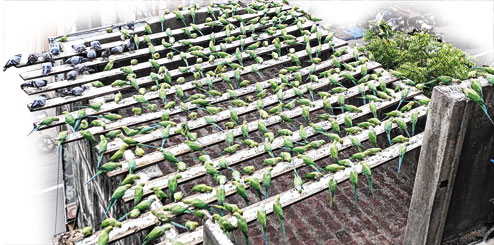
A few at first, then a dozen more, till there are hundreds of them, as though Chennai’s entire parrot population has invaded Sekar’s home. For the next one hour, it’s a wavy sea of green on the terrace, broken at the edges by the black of a few pigeons, outnumbered in their own backyard.
The parrots line up on the mesh of TV cables and eye the terrace gingerly before dropping onto the planks.
As one batch finishes, another flies in amid an incessant cacophony of parrot talk. The occasional bus horn or vroom of a motorbike sends them into a brief tizzy before they land back on the planks.
One hour later, the last of the parrots flies out, leaving behind the handful of local pigeons.
“They’ll be back at five in the evening for dinner,” Sekar says. “I tried counting them along with a few college students, and our estimate is that we get about 3,000 parrots a day.”
The love affair began in December 2004, a few days after the tsunami, when Sekar spotted a few parrots on his terrace. He threw a handful of grains at them and found they were only too happy to polish them off.
“I realised they were unable to find food, so I kept some rice ready next evening only to see more birds arriving. Their numbers kept increasing and they began arriving in the morning as well, expecting me to feed them twice a day.”
Sekar, who repairs cameras and has a collection of over 4,000 vintage cameras and accessories, some as old as 200 years, uses up 60kg of boiled rice every day, which comes to Rs 600 a day.
“Initially, all the money came out of my own pocket but seeing my dedication, several nature lovers now contribute every month. So my personal expense is only
Rs 12,000 a month. A local trader supplies the rice at wholesale rates,” Sekar says.
A wildlife official who visited him after hearing about the parrots has told him the birds come from a national park near the IIT, from the Theosophical Society’s large gardens and from a few cemeteries.
“He said the parrots do not fly more than 10km for food and are happy to find a regular feeding spot on my terrace.”
The routine means Sekar has rarely stepped out of Chennai these last 11 years. He left on his latest outstation visit, to a relative’s wedding, after laying the breakfast spread in the night and returned before evening.
A few of his neighbours tried to copy Sekar by laying out the same rice breakfast but the parrots simply ignored them.
“I gave up after a few days as the parrots preferred Sekar’s food to mine,” said Shyam Das, who sells automobile spares and lives two streets away. Still, Sekar has to watch his friends eat from the staircase: “They are wild creatures, you see — they’d fly away as soon as they see anyone on the terrace.”
The pictures had to be taken with a remote camera or from another terrace, hiding behind a cloak.
During the recent floods, the number of parrots nearly doubled to 5,000 as they couldn’t find food elsewhere, says Sekar.
Every shower washed the rice away and Sekar, wearing a raincoat, kept replenishing the planks. “This went on for almost 10 hours during non-stop rain on December 1.”
Sekar can’t think of life without the parrots. “I’m willing to give away my camera collection to a museum; I’ll be happy to spend the rest of my life feeding the parrots.”
What will happen to the birds after him? “They found me, I’m sure they’ll find another like me.”