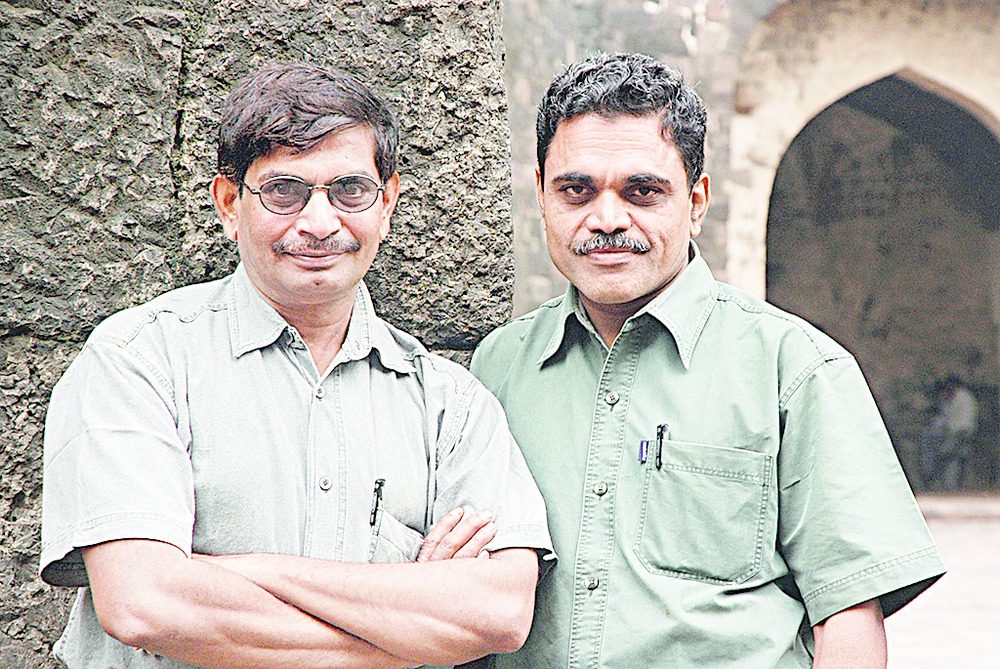

The year was 1972. In Presidency College, in what was then Madras, the teacher announced that A.N. Balakrishnan, a freshman, had topped the class with 80 per cent marks in a Tamil exam. But hold it, the teacher added - there was a tie there. D. Suresh, his classmate, had got identical marks.
"I was so envious at first, but when our eyes met, a bond was formed - a bond that only grew with time," Suresh says. "When he (Bala) was absent, I missed him so much. I wanted to talk to him every day. We had so many common interests."
The bond endures - and in the form of literature. The two write together under the nom-de-plume of Suba. "We thought of the pen name Basu, but Siddhartha Basu was already a well-known quiz master then," Suresh recalls. So Suba it was, and Suba it is.
Strange as it may seem, quite a few people seem to enjoy writing in pairs. And while that is understandable in non-fiction - think Bernstein and Woodward - how do such partnerships work when the pairs are writing novels and poetry? Clearly, they have to be in sync with each other. But is it really that idyllic?
"It's something that works for us, joyously and adventurously," says Kalpish Ratna, the surgeon-writer pair, Kalpana Swaminathan, based in Mumbai, and Ishrat Syed, who shuttles between Mumbai and Mississippi. "Besides, two brains that think as one, what's not to like?"
Kalpish Ratna has written three non-fiction volumes, two novels and two children's books. Their first book, Dr Wrasse of Crystal Rock, was published in 2003 and the latest, Room 000: Narratives of the Bombay Plague, was published in 2015.
One of the big challenges for two people writing a single book, especially fiction, is about how to cover the cracks. The American mystery writer, Joyce Yarrow, who authored Rivers Run Back with Allahabad-based journalist Arindam Roy, says, "We often changed roles, since the goal was to blend our two voices to the point where they became one in the reader's mind. We both played to our strengths and the 'car' reached the last page with some gas in the tank to spare."
Rivers Run Back meanders through Allahabad of the Sixties, where Roy grew up in a railway colony bungalow, and flows all the way up to the US. It spans across three decades.

While Yarrow took her place in the driver's seat - she's the more experienced writer - Roy navigated the plot, erecting the scaffolding and crafting characters. Two of these were his overseas Bengali women friends who lent body and a piece of their mind to the book.
"As these characters gathered their own momentum within the novel, they reacted to the situations in which they found themselves, and often surprised us both," says Yarrow, who met and ate at local food markets with writers, musicians, and artists on her three trips to India.
Roy and Yarrow were friends on Facebook, and one day while chatting on FB, Roy suggested that Yarrow write a book on India. While he began describing the country to her, she realised that he had quite a story in him. That was the beginning of their collaboration.
Suba started out with Kalki, a Tamil magazine. When the two friends heard of a short story-writing competition in the journal, they decided to enter as a pair. "We didn't want to get envious of each other in case one of us had won," Balakrishan remembers. "Our friendship made this decision."
Close to five decades later, Suba has co-authored 500 short stories compiled in three weighty volumes. In the late Nineties, they left their bank jobs to become full-time screenplay and dialogue writers for Tamil cinema.
In 2014, author Ashwin Sanghi wrote a thriller with the American best-selling author, James Patterson. Private India was about a detective agency based in Mumbai and the search for a killer.
Patterson had been writing in collaboration with other authors, and Sanghi's name was suggested to the publisher by a friend. Sanghi told The Telegraph in a 2014 interview that he had conceived the plot based on Patterson's suggestions. The two authors worked on multiple drafts that went to and fro. "We never got on each other's nerves - it was so methodical," Sanghi said.

Author pairs have their own ways of functioning. Some, like Sanghi and Patterson, worked on their own and others, like Suba, do much of their research together.
So while writing the screenplay for the Tamil film 180, Balakrishnan and Suresh went and met cancer specialists to understand the agony and fear of a cancer patient close to death. They met customs officers and small-time smugglers in Chennai's Burma Bazar for Ayan, which deals with smuggling, hypnotists for Anegan (on multiple personalities) and Mumbai cops for Aarambam ( Beginning), based on the 26/11 terrorist attack in Mumbai.
For Kalpish, the focus is on exchanging thoughts. "Our writing is a conversation. That's when ideas begin. To a writer, everything matters," they say in an email interview. "I never know where the next sentence might take me. I want to be footloose and fancy-free for the ride, and how can I do that if I bring an agenda to the blank page?"
Over time, writing styles fuse and only a discerning eye can catch telltale signs. "Sometimes, even we can't tell the writer of some of our stories," says Bala, who has a handle on feelings, while Suresh is more the news man.
But to keep too many cooks from spoiling the alphabet soup, some unwritten rules get written. Mumbai-based former journalists, Rajlakshmi Iyengar and Supriya - two close friends who decided during one of their many phone conversations to put their fertile imagination down in black and white - have their own system. They are now writing a murder mystery called The Blue Corpse.
They let their characters ramble around the Kerala countryside, share gossip or enjoy a good fight at the tea shop - but they periodically touch base to ensure that they don't lose the plot. One picks up where the other has left off, and introduces or develops characters. Editing and rewriting is for another day.
But it's not always the nitty-gritty of the craft that is the dampener, especially when authors write across continents. "One cannot go on flights of fancy when writing about another's culture," says the poetess duo, Shernaz Wadia, a retired teacher in Pune, and Avril Melleam, a retired physiotherapist in Jerusalem, who write tapestry poetry by merging their individual (nine-line) poems about nature and emotions, with a spiritual thread and feminist undercurrent running through.
Roy and Yarrow would know. "In the West, conflict is king. In the East, there is the ever-present search for unity," says Yarrow. "Surprisingly, as we compromised on this and other cultural issues regarding the sexual and social mores of our characters, the through-line of our plot grew stronger, as did the realism of the characters, who became more universal in nature."
Looking back, is there anything they could have done differently? "Look back? Whatever for, when there's so much ahead," asks the spunky Kalpish Ratna.