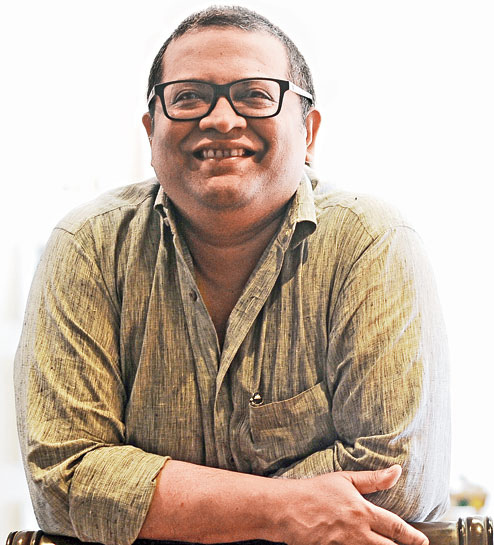

The jury is in. Everyone — young and old, man and woman — has been suitably shaken and stirred by Pink.
But a question that comes to mind is why the director found it necessary to zero in on a man with a mental disorder for the role of the lawyer who takes up cudgels on behalf of three wronged women. Why did Deepak Sehgal have to be different?
Ask that of director Aniruddha Roy Chowdhury, better known as Tony in the film industry, and pat comes the reply: “That was simply to impart a dimension to the character... There are those kind of people I have met in life, people who suffer from obsessive compulsive disorders, like those who invariably go suited-booted for breakfast. Deepak Sehgal, if you noticed, went for his morning walk in a tie, and he was also on medication.”
I buy that argument. Following his initial fumbling in court, Sehgal, played by Amitabh Bachchan, does seem to not only come into his own, but also regain a purpose in life. Pink, labelled a “masterpiece” and a “movement” by Bachchan, carries the conviction to steer a “No means no” course against sexual abuse. It has also kept the box office ringing.
Seated casually in a grey tee and track pants in his plush living room on the 13th floor of a highrise in south Calcutta, Roy Chowdhury is slowly rubbing his forehead. Paintings by Jamini Roy, Paritosh Sen, Shakila, Shahid Kabir adorn the white walls; they jostle for attention with striking sculptures littered about the room. The balcony overlooks manicured gardens, a tinkling wind chime intervenes the silence.
Roy Chowdhury appears content, relieved and happy, although his head is spinning, and he is feeling nauseous. That is not because he is euphoric over the resounding success of Pink. It is because he has had an attack of vertigo — he is, after all, at a new pinnacle of success with his very first directorial venture in Bollywood turning blockbuster.
“This vertigo attack had happened four years ago soon after the release of my Bangla film Aparajita Tumi. That too had been produced by Shoojit,” he says with a cherubic smile.
“What do you do when your head spins like this,” he wonders aloud, sipping as we do the refreshing Darjeeling tea his wife Indrani has just brewed. It is evident that he would rather lie down than sit here and talk. But he is too polite to do that.
And that perhaps makes Roy Chowdhury the man he is — sensitive and empathetic. Those traits are reflected in all his flicks.
His journey began a decade ago with Anuranan (Resonance), which won the National Award for Best Bengali Film followed by Antaheen (The Endless Wait) in 2009. That bagged the Golden Lotus Award (Swarna Kamal) for the Best Feature Film, and the National Film Award for Best Cinematography. Aparajita Tumi (You, Undefeated) in 2012 and Buno Haansh (Wild Goose) in 2014 were based on Sunil Gangopadhyay’s Dui Naari Haate Torobari and Samaresh Majumdar’s eponymous novel.
He even gave acting a shot — as a real estate broker in Sircar’s Piku. “He asked me to. I am too shy and nervous in front of the camera,” he laughs.
Last year, the former corporate and ad filmmaker experimented with the digital format, creating a 14-minute film, Debi.
The journey from Debi, up on YouTube , to Pink’s teen deviyan — Meenal, Falak and Andrea — has almost marked a peaking in his career. “I sounded this story for a Bangla film to Shoojit, who immediately lapped it up and suggested
we do it in Hindi — the theme and message were relevant for a national audience. For me, initially the language was a bit of a barrier, but then one gradually develops an understanding; and Shoojit as creative producer was the guiding force,” he says.
Roy Chowdhury’s biggest learning, however, was not about transcending regional boundaries. It was about understanding why filmmaking is defined as a collaborative effort.
“For the first time, I felt the essence of collaboration in practice... In Tollywood, I’ve usually worked alone. But this was a true team effort where everyone contributed... Everything was meticulously planned and shooting was over in 30-35 days,” he says. From the producers Sircar and Ronnie Lahiri to cinematographer Avik Mukhopadhyay to music director Shantanu Moitra to dialogue writer Ritesh Shah to all the actors, Pink is apparently everyone’s baby. “No one individual can take credit for its success,” he underlines.
It is perhaps this collaboration between head and heart, sensibility and sensitivity that has made Pink a talking point. “We wanted to document a slice of life with real characters, real situations, real experiences,” says Roy Chowdhury. He did that — and a woman’s right to say No won a resounding Yes.