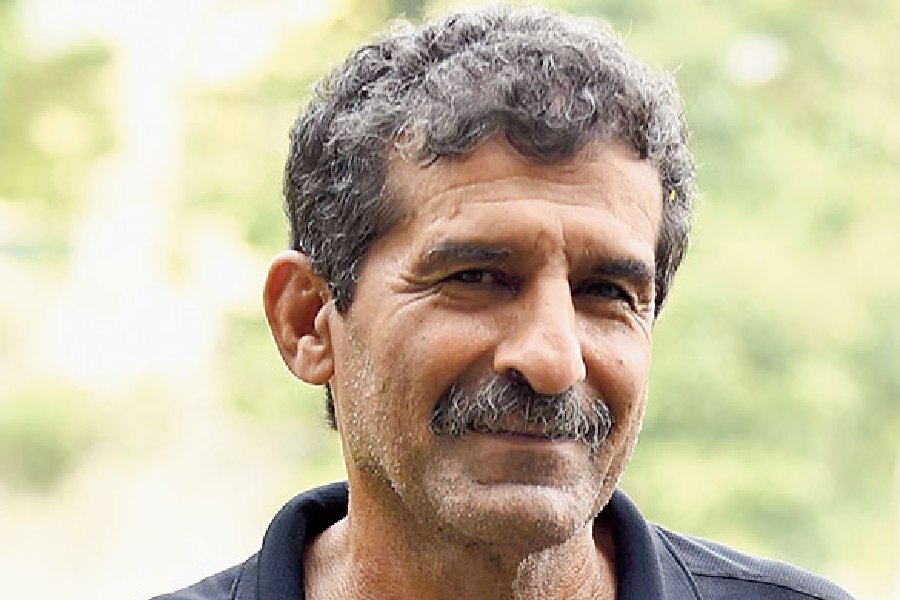

I am expecting a man with great legs, in clingy, ankle-length crepe-silk harem pants. That's what his autobiography promises on his site - the Kiran Nagarkar Unofficial Website. But the man is in a staid kurta and his legs are covered in loose white pyjamas. I should have known better.
Kiran Nagarkar grins when I bring this up. Indian authors, he says, take themselves much too seriously. And it's for those lacking a sense of the absurd that there's a little disclaimer at the end of the self notes on the site. "These are not the real facts about Kiran Nagarkar. That you should have known already," it says with three exclamation marks.
Well, I did suspect something when the site described Nagarkar as the most prolific author the world has seen, writing under the pseudonyms of William Shakespeare, Barbara Cartland and Goethe, as well as Jackie and Joan Collins.
Okay, he is not the most prolific - but he certainly never fails to make a splash. Often described as one of the most powerful writers of independent India, the author of Cuckold and Ravan and Eddie has a narrative that merges history with the contemporary. Gods are not just gods - sometimes they are just like the reader. And, of course, the books evoke loud squawking from some angry corners.
His new volume may ruffle some feathers, too. Published by HarperCollins, it consists of a play and a screenplay. The first, Bedtime Story, was written in 1978 but never published. He wrote the second, Black Tulip, in 2000, but forgot all about it till somebody asked him a couple of years ago, " Kuch hai kya, bhai?"
Every now and then, Nagarkar speaks a sentence or two in his Bambaiya Hindi. He doesn't speak it well, he says, but loves it. Languages, indeed, are a passion for the man who first wrote in Marathi and then turned to English, drawing criticism from some who thought he'd abandoned Marathi.
"Languages are terrific," he exults. "I have said this earlier, and I'll say it again to those who ask me why I turned to English - why do you not ask me, why only two languages?"
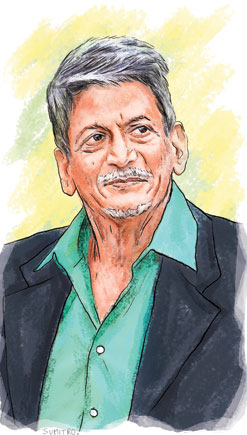
The Mumbai-based Nagarkar, 72, is in Delhi for the launch of his book, and for a literary festival. With his peppered hair and moustache, and eyes that smile, he speaks softly - but has a way of pronouncing some words in capital letters. "How DARE they?" figures often in his conversation - referring often to the US, occasionally to Israel.
He moves from one topic to another seamlessly, touching on subjects as varied as Tom Lehrer and Tabu, and Vishal Bhardwaj and Ravi Shankar. He thinks highly of Lehrer's humorous political songs, loved Tabu in Maqbool, thinks Bhardwaj's Haider missed out on the nuances ("It does try," he says kindly) and blames Shankar for the "ruination" of classical music with his jugalbandis.
But he played so well, I demur. "Oh, but that's the tragedy," he replies, almost jumping out of his chair.
He is passionate about a number of issues but most animated when we talk about his works. Bedtime Story, he says, was written soon after the Emergency.
What was Nagarkar doing during the Emergency, I ask.
"I was trying to make ends meet," he replies. "It was a very bad time for us."
He and his friend, the poet Arun Kolatkar, were both jobless. The advertising agency that they worked for had folded up.
"I had completely forgotten how difficult times were," he says. "But I at least was used to poverty."
Nagarkar grew up - "poor but westernised" - in a Mumbai chawl. His grandfather, a professor of English at Elphinstone College, was a Brahmo who went with Vivekananda to Chicago for the world conference on religion ("Vivekananda, of course, stole the show entirely; good for him, yaar"). But he died young, which meant his eldest son - Nagarkar's father - could not finish school.
Instead, he joined the railways as a clerk and took care of the family of nine, educating each of his siblings. Later, he borrowed money to ensure that his two sons had a sound education.
<,>N<,>agarkar studied English in Pune and Mumbai, faring poorly in his MA, thanks to "sheer arrogance". He joined advertising, but started writing as well - which helped him when he lost his job.
Bedtime Story was finished some time then. The play has four stories from the Mahabharata, related by a grandmother. A chorus cruelly mocks the audience, while members of Hell's Angels beat up spectators trying to move out. In the end - and here's a spoiler alert for those who are still to read it - the chorus, a former Nazi man, gases the audience.
One of the stories is on what transpires after Kunti asks Arjun to share his bride with his four brothers. "I'm off," Draupadi says. "If I have to prostitute myself, why stop at five men?" She walks up to Karna, urging him to take her away from the Pandavas. Karna says, not looking at her, "All you can give me now is what any two-bit slut off Foras Road could give."
In the hall, the dramatist writes, a man screams, "Stop this vile blasphemous play." The Hell's Angels catch hold of him. You hear shots ring out. "Okay, okay. Easy, everybody. Relax," says the chorus, as a bloodied body is carried out.
Actor-director Shreeram Lagoo wanted to stage the play, but couldn't do so in the midst of Shiv Sainik protests. The Maharashtra censor board - without whose approval, Nagarkar explains, you cannot even rehearse a play - first suggested 78 cuts, and then 24. The censors wanted to delete all references to Gandhi and Buddha. And they asked, clearly puzzled, why he wanted to change the epic.
But epics, Nagarkar stresses, have scores of interpretations. "And the great epic stories are in your bloodstream," he says. "I have always held that the first library in the world is the grandmother." Yet no one, he laments, is telling stories anymore.
"Tell me stories; don't tell me that I must love my language," he says. "Bugger off. Just give me the enchantment."
He then goes on to narrate a tale about Odysseus. The god of winds gifts him a sealed bag containing winds to help him sail back home. Odysseus's assistant steals it, thinking that it carries wealth. He and the crew open it, letting loose a storm.
"You never know what you are letting loose," Nagarkar says. "Isn't that an enchanting story?"
Yet, despite his love for words and stories, after Bedtime Story Nagarkar stopped writing for 14 long years - it was almost like his own exile.
"Looking back, I realise it was very wrong on my part. But I just thought that I am from Mumbai - and Maharashtra has seen some of the finest reformists ever. And here was the Sena," he says. "I thought, do I want to even hear these people? Whatever I did seemed to provoke a lot of anger. So without thinking things, I left writing."
<,>H<,>e picked up the pen again in the early Nineties - years after he wrote his first novel Saat Sakkam Trechalis in Marathi, published in English as Seven Sixes Are Forty Three in 1974. In 1994, Ravan and Eddie was published, followed by a sequel The Extras in 2012. In between came Cuckold, which won him 2001 Sahitya Akademi Award, and God's Little Soldier in 2006. Now he's finishing the final volume in the Ravan-Eddie trilogy. "For me there will be closure."
Nagarkar believes that the situation is "worse" today than the time when his play was attacked. "When a prime minister talks about transplanting an elephant's head, then the future doesn't look too good," he mutters, almost to himself.
The mix of apathy and baying for blood across the country troubles him. "You sit down, you scream for murder, you get up, you scream for murder. Are we BONKERS?"
Nagarkar has been critical of the intelligentsia, too, accusing it of slipping into a state of coma.
"My point is larger - when you deal with history, mythology, science with such scant respect, you shrink the horizons of imagination. Of doctors, engineers, others. Minds get used to shrinking - 'Oh, this is the border, we can't cross it; Oh, I don't think I am going to take this risk'."
But he doesn't despair - for the great thing about India, he believes, is the desire for education. "Everyone wants their child to be educated. This want - I want, I want, I want - for once, should be our capital. Not so-called development."
The interview's done, and we chat about music a bit. His mother, he points out, was a BA in English and music. "I am old fashioned - I want my alaap. That's where the quality of the musician - his introspection and vision - comes in," he says.
"I am totally anachronistic," he adds, and then points to his smartphone. "I don't know which key to press."
Nagarkar used to write by hand till recently - he now types, and doesn't like it. His companion, Tulsi - they have been living together for years - is a "great editor", he says. "And she never uses a foul word except in the context of Mr Nagarkar. 'What is this SHIT?' is one of her most favourite sentences," he laughs.
He lopes off - he has to attend the literary festival. I realise too late that I've forgotten to ask him something. His website says that he writes books on how to manufacture WMD in your backyard or kitchen. DRAT!!!