-

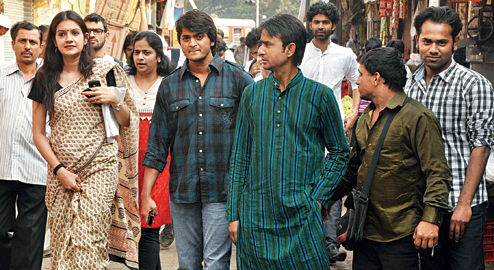
Young guns: AICC spokesperson Priyanka Chaturvedi
Madhuri Subbarao is not in a plush office — she's spending time in a slum. The Bangalore psychologist wants to discuss the 2014 elections with the slum dwellers. Her friends are surprised, but Subbarao couldn't be bothered. Right now, she is drawing up a list of candidates who seek to represent the Vidyaranyapura constituency, and the work they have done.
'It is just an awareness drive to educate people so that they vote judiciously,' Subbarao says. It is also a part of a course in politics that she has joined. And if all goes well, it may be the stepping stone for her own political career.
As 814.5 million people get ready to cast their vote, many youngsters are gearing up for politics. They are not from political families and don't see politics as a last refuge. Young men and women are willingly entering what was once called the big bad world of politics.
'Today, it is a promising career option,' says Devendra Pai, a 26-year-old Mumbai resident. After graduation and a year's study at the Greenville Technical College, South Carolina, US, Pai returned home to join the MIT School of Government (MSG) in Pune. 'That was in 2009, a period of political disillusionment for many like me,' Pai says. 'I wanted to do something for the country. And I decided to do it the professional way,' he says.
Pai now works closely with MLAs in imparting career counselling to government school students. He has counselled children from Yavatmal, a Naxalite-hit region in Maharashtra, and worked on the Bharatiya Janata Party's (BJP) 2020 vision document. The next obvious step would be to join politics. 'But I am yet to decide at what level I will pick up politics,' Pai says.
Indeed, politics — till very recently an area that youngsters from professional families looked at with a jaundiced eye — is now an attractive career choice. 'Earlier politics was meant for people who were rich or from political families. But that perception has changed because of the political uprising that the country saw in the last two years,' holds Aam Aadmi Party (AAP) spokesperson Aswathi Murlidharan. Almost 60 per cent of the 98-odd lakh people who joined the party in a 17-day drive in January were in the 18-35 age group.
-


Devendra Pai; Shivani Dani and Madhuri Subbarao
A snap The Telegraph poll of 200 readers (110 of whom will be first-time voters) of YOU, the fortnightly youth supplement, largely backs the point that the young are cocking an eye at politics. Some 44 per cent of the respondents want students to actively participate in politics after they complete their basic education. However, they want student leaders to become change-makers — unlike conventional politicians. What's more, 52 per cent of those polled want only highly educated people as MPs.
Clearly, the world of politics has opened a new window. If it was ideology that drove people to politics in newly independent India, it was — in some sections — the lure of money and power that steered many to the sphere in the last three decades or so. Corruption scams, rising prices and the threat of communalism — seen by many voters as the handiwork of political parties — are now forcing the young to pick up the political gauntlet.
'The trend became visible with the formation of AAP,' says former Lok Sabha secretary-general Subhash Kashyap. 'For the angry young Indian who was facing a tremendous disconnect with the government, AAP was an outlet to channel his or her anger.'
With the youth openly displaying their discontent, traditional political parties have also begun to focus on them. The Congress, for instance, seeks to sell the slogan 'Kattar soch nahin, yuva josh' (Youthful verve, not hardline thought) in its ad campaigns. In its first list of candidates, 35 per cent was below 50, a relatively young age in politics. The second list consists of nine Youth Congress office bearers.
'Earlier young people were given a raw deal because leaders thought their positions were threatened,' P.C. Chacko, a key member of the Congress central election committee, holds. 'But things are changing now.'
Congress spokesperson Priyanka Chaturvedi is a face of this change. The 2008 terror attacks in Mumbai propelled the media recruitment consultant towards politics. 'I realised then I needed to do more than just sit and crib,' Chaturvedi, 34, says. The alumna of the Indian School of Business, Hyderabad, started with social work and finally joined the Congress. 'My family and friends thought I was joining a filthy world. But today they value politics as my career choice.'
Ten years ago, she adds, she would have laughed if somebody said she was going to join politics. 'But today even winning a ticket is a possibility for people like us who come from non-political backgrounds,' says the mother of two.
In fact, today there are also organised courses to help people hone politics. Subbarao, for instance, has joined a nine-month Civic Leadership Incubator Programme created by the Bangalore Political Action Committee (BPac) in partnership with public policy think-tank, The Takshashila Institution. The programme, launched last year, seeks to groom students for the 2015 municipal elections in Bangalore.
BPac is headed by Biocon chief Kiran Mazumadar Shaw and The Takshashila Institution by Nitin Pai. The 66 students in the course are all in the 30-35 age group.
Many other institutes offer courses in governance. Last month the Sri Sri University in Odisha launched a postgraduate programme in good governance and public policy for future politicians. The Swaniti Initiative in Delhi, started in 2009 by Rwitwika Bhattacharya, a 27-year-old Harvard fellow, gives fellowships to young people keen on joining politics by making them work with legislators.
'Political parties are keen on bringing in young people. The most prominent move was (Congress vice-president) Rahul Gandhi's attempt to reform the Youth Congress. (Narendra) Modi was able to mobilise the youth as he gave them an active role in running his social media and outreach processes,' Bhattacharya says.
Clearly, in some sections, there is a growing belief that politicians have to be trained. 'Integrity is essential in political life but competence in tackling public challenges is required too. There is a need for training and conceptual learning in addition to what only experience can teach,' maintains Pavan Srinath, manager, policy research, The Takshashila Institution.
The six-month residential programme at the Mumbai-based Chanakya Institute of Public Leadership (CIPL) relies on the political craft espoused by Kautilya's Arthashastra. 'We learn modern and ancient governing styles and apply them to the modern system. It is an ideal learning platform for a career in politics,' says Arvind Meghwal, a Mumbai management graduate and CIPL student. The programme is open to graduate students below 30 years.
Sanjay Kumar, fellow at the Centre for the Study of Developing Societies, Delhi, believes that the focus on the youth is the need of the hour. 'A sizeable population of our country consists of young voters. Political parties believe that they need young candidates to attract young voters,' Kumar says. According to the Election Commission of India, 51.8 per cent of voters are in the 18-35 age group. 'So parties are under pressure to open up for young candidates,' Kumar says.
Shivani Dani is among the young looking at politics as a career. Her banker father was aghast when he heard about her decision, says Dani, a national executive committee member of the BJP's Yuva Morcha, who joined the party in 2004 when she was 18. 'This year there has been a 200 per cent increase in youngsters joining our party as compared to previous elections,' Dani says.
Regional parties such as the Telugu Desam Party (TDP), Chiranjeevi's Praja Rajyam Party and the AIADMK are also wooing the young. The TDP recently held a 'Yuva Garjana' programme to enrol youngsters as voters and promised that 40 per cent of tickets would be given to the youth. Politician Srikanth Reddy, who quit the TDP earlier this year, has launched Jana Palana, which will soon be registered as a party. 'I have allocated 50 per cent seats in my party to the youth,' Reddy says.
The interest in politics has been triggered by the role played by the social media too. 'Earlier when I visited colleges, young people weren't keen on talking about politics. It was a domain meant for the oldies. But now, because of the influence of the social media, politics is for urban youngsters too,' says BJP spokesperson Shahnawaz Hussain.
Hussain, who was India's youngest Cabinet minister at the age of 32 in the National Democratic Alliance government, believes Modi's 'Mission 272 plus' campaign is reaching out to the young. 'As a result 30 per cent of our candidates will be below 45, as opposed to 20 per cent in 2009,' he says.
The trend of the young climbing the political bandwagon was first noticed in the 2004 elections, says Rahul V. Karad, founder and dean, MSG. The interest shown by them led him to set MSG up in 2005, offering a one-year masters programme in alliance with the Tata Institute of Social Sciences, Mumbai. 'MSG was conceptualised to transform the outlook of the youth towards politics,' Karad adds.
And the outlook, indeed, is changing. Make way for the young is the new mantra: You have nothing to lose but the baggage of age.
Courses Galore
Bangalore: A nine-month programme for would-be municipal corporators
Pune: A year-long masters programme for future politicians
Mumbai: A six-month programme in politics
Delhi: Fellowships for young people keen on politics
Odisha: A postgraduate programme in good governance and public policy