From Lyallpur with love

It's August 1947 and two lovers, Firoze, in the new Pakistan, and Asha, who has to flee across the border into India, are separated by Partition.
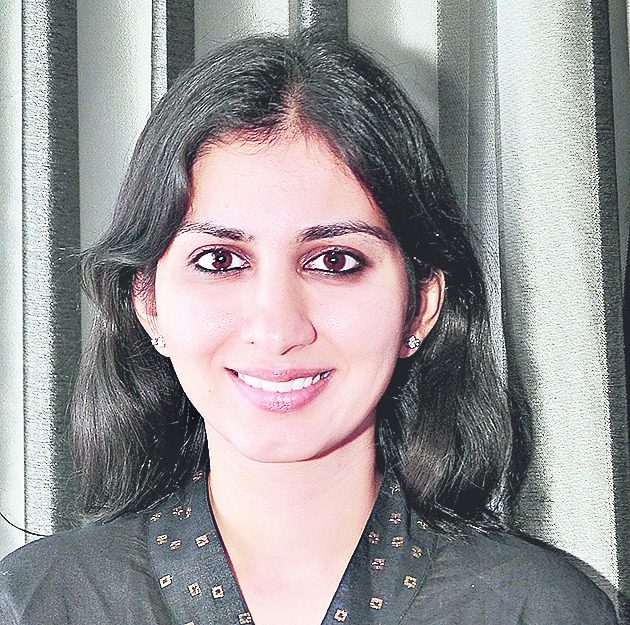
Radhika Swarup's debut novel, Where the River Parts (Sandstone Press; £8.99), which was launched in London last Friday, comes to a climax 50 years later in New York, where "Asha's Indian granddaughter falls in love with a Pakistani, and Asha and Firoze, meeting again at last, are faced with one more - final - choice".
Radhika, who is celebrating her 36th birthday today, lives in London with her husband, Amarendra Swarup, a Bengali - the couple met in Cambridge - and their children, Maanas, five, and Anaia, two.
She has woven family folklore into her novel - she is the daughter of former diplomat-turned-TV pundit and author, Rajiv Dogra, 67, who was Indian consul-general in Karachi up to 1994 before coming to London for three years to be minister (press) at the Indian High Commission.
Rajiv's father had land on both sides of the border, in Gurdaspur and in Shakargarh, while his mother's family belonged to Lyallpur.
Radhika spent her childhood in Delhi, Rome, Doha, Karachi, London and Bucharest before getting five grade 'A's at St. Marylebone School in London, reading economics at Newnham College, Cambridge, working for a bank and then chucking a good salary to become a writer.
"The novel allowed me to chronicle something of what Partition meant to our family," she says.
"And yes," she goes on, "my father did undoubtedly influence my writing. From my earliest days I would remember him coming across a passage he enjoyed, telling me to note the craft in any one sentence or dialogue. I remember him always walking through that wonderful square in Bloomsbury with the plaque dedicated to George Bernard Shaw - 'from the coffers of his genius he enriched the world'."
Radhika's five novels she would want if she were marooned on a desert island would be: A Room With a View (E.M. Forster), The Old Man and the Sea (Ernest Hemingway), Beloved (Toni Morrison), Catalina (W. Somerset Maugham) and A Fine Balance (Rohinton Mistry).
Relative value

Rajiv Dogra has tweeted that Where the River Parts is "a brilliant book", causing Radhika to laugh: "There's nothing like an impartial endorsement from one's father!"
The five books Rajiv would take to his desert island would be: The Old Man and the Sea (Ernest Hemingway), Samarkand (Amin Maalouf), The File on H. (Ismail Kadare), Forever England: The Life of Rupert Brooke (Mike Read) and Almost an Ambassador by Rajiv Dogra (to "keep me amused").
Since Rajiv's latest book is Where Borders Bleed: An Insider's Account of Indo-Pak Relations, he points out: "A father and his daughter have written on the same broad theme around the same time - one in non-fiction, the other in fiction format."
Radhika was three when he was posted to Rome. When other children at school taunted her by stating, "We are white," his daughter "established her skills at repartee by pointing to her arms and saying, 'But I am golden'."
He admits he "didn't take her writing forays seriously till 1995" when author Josephine Pullein-Thomson, the very perceptive president of the English chapter of PEN, read something that Radhika, then 15, had written.
She wrote to her parents saying: "I think she shows great promise and I hope that she will continue with her writing..."
India decoded

With Indian journalists being beaten up simply for trying to do their work, sometimes even by lawyers, "the world's largest democracy" needs a bit of deciphering - and who better to do it than Sunil Khilnani, Avantha professor and director of the India Institute, King's College London.
Rabindranath Tagore, Swami Vivekananda, Raja Rammohan Roy, Subhas Chandra Bose and Satyajit Ray are the boys who bat for Bengal. Jinnah is included; Nehru is not.
Last year Sunil did the first batch of 25 in 15-minute slots for BBC Radio 4, and from tomorrow he starts dealing with the second lot, beginning with the pioneering photographer Lala Deen Dayal.
"Each life had to tell us something more general about the deep themes of India's past," said Sunil, explaining his criterion for selection. "Each had to have some sort of 'after-life' - in other words, be invoked and used in India today for some purpose. Each had to be dead. And finally, each had to be of some interest to me, since the way I tell their story is my own 'incarnation' of their life."
I have been enjoying dipping into Sunil's new book, Incarnations: India in 50 Lives (Allen Lane; £30), which has been published to go with the BBC series, and especially in looking at the black-and-white photographs.
The book launch is at King's College on March 1.
Had his "idea of India" - his best known book is, of course, The Idea of India - changed because of all the "intolerance" debate?
"Today, we are seeing some Indians who want India to be more like a 19th century European nation - with a single religion, language, culture," he said. "And the great irony is that they describe themselves as 'Indian nationalists' - yet they want to undermine the very thing that has made India so distinctive. They want to make India more like a parochial 19th century European nation."
Neelam's tour

The girl of the moment, Neelam Gill, could consider a second career as a TV presenter if she gave up modelling - she is a natural.
The 20-year-old model has just done a faultless 17-minute film for the BBC, taking viewers on an engaging "private tour" of Vogue 100: A Century of Style at the National Portrait Gallery.
She commented on the images that she liked, especially that of her favourite - black model Naomi Campbell's first Vogue cover taken when she was 17 in 1980.
"She speaks about issues close to my heart - like diversity in fashion," she said.
Neelam, who has walked for Burberry, was revealed last week as the new face of American brand Abercrombie & Fitch.
Alice in India
Alice Prochaska, the principal of Somerville College, Oxford - this produced both Indira Gandhi and Margaret Thatcher - tells me she is off to India at the end of March.
This will be for "the launch of our Section 8 company, the Oxonian India Foundation, which we have set up jointly with the Rhodes trust to receive rupee donations. We will be announcing a gift at the launch party in Mumbai that will support a couple of new scholarships."
Alice's big dream is to raise £15m to set up an Indian Centre at Oxford - an excellent idea which Indians should support.
Tittle tattle
My late father would hold up as an example of freedom of expression the debate, "That this house will in no circumstances fight for its King and Country", which took place at the Oxford Union debating society on February 9, 1933.
A section of British opinion was shocked after the motion was carried by 275 votes to 153 as it was seen as providing succour to the Germans.
Curiously, not a single student was assaulted by patriotic lawyers singing "God Save the King".