
Pic: Kunj Teraiya
Kirti Shah is known as a bit of a maverick in Surat. A little over a year ago, when the city's Rs 90,000-crore diamond industry was basking in the glory of high revenues and growth, Shah, 62, urged diamond merchants at a meeting at the Surat Diamond Association (SDA) office, a gleaming four-storey building, to be prepared for a slump.
The warning came when spirits were particularly high. The demand for polished diamonds from Surat was skyrocketing; the market was awash with rough and cut diamonds; diamonds were in great demand despite historically high prices; and they were fetching more money than ever before. A diamond merchant had even given flats and cars to his employees as a Diwali bonus.
"Everybody was in a great mood but the temperature in the room suddenly dropped after I said this. Some laughed, the others simply ignored me," says Shah, the founder of Necklace Diamond, a Rs 50 crore company.
Around April 2015, Shah would fire around 70 employees in phases. Within two months, he had completely wound up his diamond polishing business. "By July everybody realised that the industry was in trouble," he says.
Many small and big firms such as Godhani Gems that had amassed huge debts simply shut shop, leaving thousands of workers jobless. Other small and medium units closed too.
Several factors were together responsible for the situation. The demand for polished diamonds fell because of an economic slowdown in China, Europe and the US. Getting rough diamonds on credit became very difficult. In an industry based on trust, Surat diamond merchants started demanding guarantees for giving credit to each other. Many defaulted on their loans.
The slump came riding on a high. The polished diamond industry had seen a growth of almost 200 per cent in the last decade, from $10 billion in 2003-2004 to $29 billion in 2012-2013. Today, it is likely to be at around $15 billion, as low as it was during the 2008 post-recession period.
Rough diamond imports in Surat have fallen by 30 per cent in dollar terms and 20 per cent in carat terms. According to some estimates, $6-10 billion worth of polished diamonds are still lying with merchants with no buyers.
"Each one of these persons has polished diamonds which they are ready to sell at the price that you would get a rough diamond for," says Raju Gelani, 35, a small diamond trader, pointing to the hundreds of traders on a sidewalk off the Mini Bazaar area of Varachha in Surat. "But there are no buyers."
Few were prepared for the slump, rues diamond merchant Pravin Nanavati. "We had produced far more than the demand in the hope that market would be hungry forever. That was not the case," he says.
The Diwali of 2014 was particularly glittery. That was when diamantaire Savji Dholakia's Rs 45 crore worth Diwali gifts to his employees - Fiat Punto cars, two-bedroom flats and jewellery - hit the headlines. Within a year, there was gloom. Last Diwali, he gave his employees meagre bonuses and small gifts.

"Our employees understand that we are going through tough times," Dholakia says.
Other leading firms also cut down on their bonuses. In fact, at the end of the Diwali vacations, hanging on to one's diamond polishing job was in itself an achievement for many. In places such as Katagram, Mahidharpur and Varachha, jobless workers can be seen milling around in groups on the roadside.
Chetan Kumar Kathtrotiya, 22, who had been working with a Surat company for two years, was sacked without any notice. "My supervisor called me at around 4pm, two hours before my shift ended, to inform me that I and 13 others didn't need to come to work from the next day," he says, waiting in the office of an organisation that takes up workers' issues.
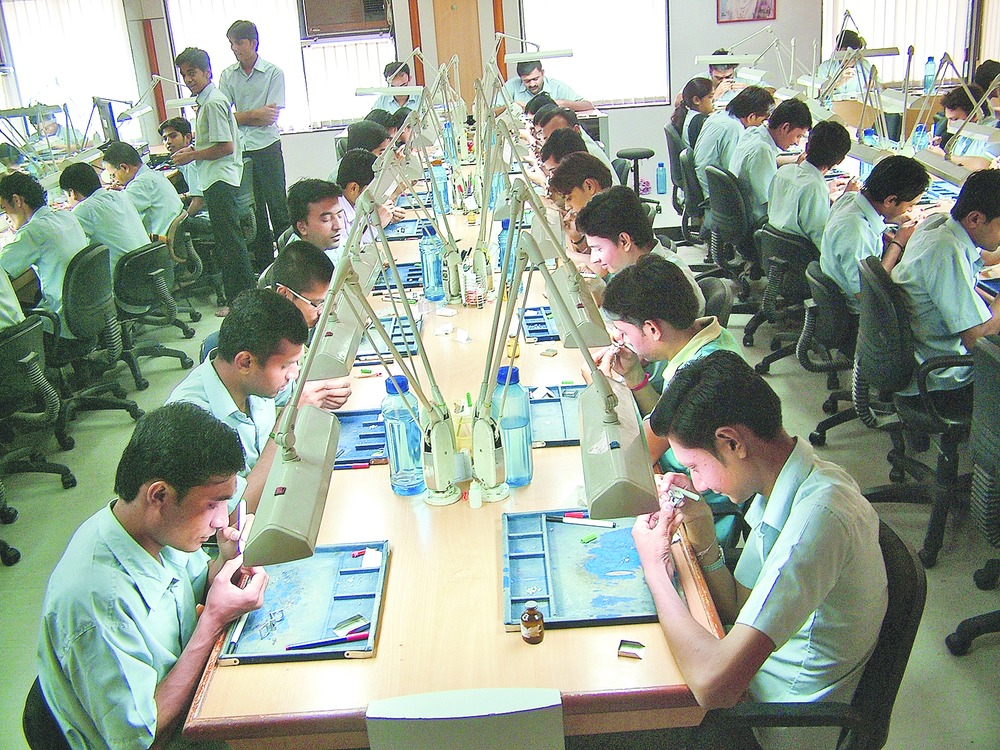
Surat has an estimated 5,000 units employing around six lakh workers. Nine out of every 10 diamonds in the world are polished in Surat. But Jaysukh Gajera, founder of Ratnakalakar Vikas Sangh, who works with diamond workers, says that around 30 per cent of units have closed in roughly a year. Those who still have a job are being paid according to the number of hours they work instead of on a monthly basis, he says.
"About 90 per cent of the companies don't follow any rules and workers don't have any rights. Suicide rates have gone up among workers. This was unheard of previously," he says.
Apart from the global slump, the increasing price of rough diamonds, over-production and an increase in the availability of synthetic diamonds have contributed to the crisis.
"We have been buying rough diamonds at very high prices. There has been almost cut-throat competition to acquire rough diamonds. With the slump, banks have not extended credit," says Chandrakant Sanghavi, chairman, Sanghavi Exports, one of the largest diamond polishing companies in the world.
But not everybody is gloomy about the future. Praveen Shanker Pandya, chairperson, Gems and Jewellery Export Promotion Council, believes that this is a temporary phase and the industry will "self-correct" in the coming months. The SDA in a meeting a few weeks ago asked members to tighten their purse strings and not buy rough diamonds beyond a reasonable stock. The industry seems to have fallen in line.
"The industry will be back on its feet very soon. I only hope that the world economy picks up," he says.
The government may have to roll back its duty structure on imported gold to encourage Indians to make diamond jewellery, Pandya says. "Currently we are only exporting polished diamonds which are used by jewellers around the world. We have to encourage people within India to polish and also make high quality diamond jewellery."
Meanwhile, global rough diamond sellers - realising the importance of the Indian diamond industry and the falling demand - are said to be considering lowering high prices. The Rapaport Group, one of the largest networks of rough diamond trading companies, is in Surat this week to auction rough diamonds at prices lower than those in the international market.
"This is happening for the first time. Instead of our going in search of diamonds, they are coming to us. That is a good sign," SDA president Dinesh Navadiya says.
Nanavati, however, believes that the diamond industry will surprise everybody like it's done in the past. "As long as women are fascinated by sparkling diamonds, nobody can stop us," he says. For now, though, it is the industry that is looking for the sparkle.