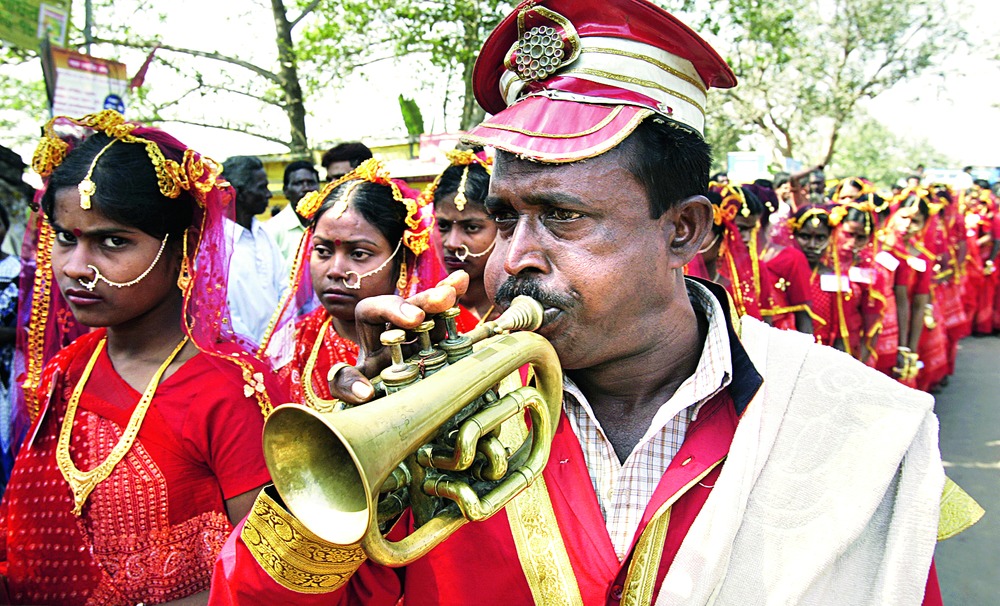

For a place that is supposed to be the den of bandwallahs, M.G. Road is only reasonably noisy. The lane behind north Calcutta's College Street is littered with shops with names like Hindustani Band, Azad Hindustan Band, Punjabi Band, Mehboob Band, India Band, Master band, National Band... More than 20 of them, one after another.
Each shop is barely 4x7 feet. Each has an almirah stacked with trumpets, clarinets, side drums, big drums, flutes. Lying in neat stacks inside them are also caps and uniforms of bandwallahs - royal red or a rich navy blue or a yellowing white with gold trimmings. Usually one man holds fort. But where are the customers?
"What customers?" bristles Shamim Ahmed of Azad Hindustan Band. "DJs have captured the market," he adds. Ahmed's father started Azad Hindustan Band four decades ago, around the same time when Master Sabir's great-grandfather started India Band. "I am the fourth generation and I am still running the shop. But I will not encourage my children to join the business," says Sabir.
Sabir pays Rs 60 as monthly rent for his shop, slightly bigger than the row's regulars. The rent has not gone up in a while. But then neither has his income. Today, a brass band of 12 members makes something between Rs 8,000 and Rs 16,000 per performance, depending on the scale of the event and also the musical hierarchy (based on who plays which instrument). And the number of orders in 365 days - 50 to 60.

The story of the origin of the brass band in India is difficult to trace back to a specific date or place. But in the introduction to Brass Bands of the World: Militarism, Colonial Legacies, and Local Music Making, author Katherine Brucher suggests that brass bands, as we know them in India, grew out of a coming together of the British military bands of colonial India and the royal Indian procession. She mentions Maharajah Ranjit Singh's band, which performed for the Earl of Auckland in 1838.
Post Independence brass bands here changed their tune. Hindi film music now formed the length and breadth of their repertoire. A new tune meant a new audience; but they were still very much in demand - birthdays, weddings, anniversaries. Even restaurants and bars often got a section of the band to play in the evenings.
Today, bands come alive only in winter or during wedding months. "But this January there was only one wedding date - January 24 - for those who went by the almanac. Imagine that!" Shamim Ahmed laments.
According to him, people's tastes have changed. "At least in this city, there are no takers for bandwallahs," says Sabir. The law has also done its bit to hurt them. In old Calcutta, bands are banned. "Band means a procession. It requires blocking the stretch along which the bandwallahs would go marching down," he explains.
So only on rare occasions or holidays or a combination of both, such as Durga Puja, bandwallahs can step out in their splendour. But then, this cannot be their mainstay.
In busy months, band owners source players from Bihar, Odisha, Jharkhand and suburban Bengal. In winter, they work for the band and the rest of the year they are employed in side businesses run by the band owners. Ahmed has a small cycle repair shop adjacent to the band shop. "It is this shop that helps me run my house. I earn very little from the band business otherwise," he says. Some bandwallahs hold day jobs as rickshawallahs or daily wage labourers.
"While we sit here practising, there are many who come and listen and then come back and want to pick up the art gradually. It is an additional thing for them. Additional income or additional enjoyment, whatever you call it," says Ahmed.
In his 1990 paper "Brass Bands: Tradition, Change, and the Mass Media in Indian Wedding Music", Geoffrey Booth wrote: "Brass bands are not a permanent feature of Indian culture. Their heyday is past... but in their decline, and in the phenome-na that eventually replace them, will be additional clues to unravelling the processes of change in Indian, urban, and truly multicultural musics."
And their accidental continuance? What's that a clue of?