Some Chinese online users are calling for a lightning Venezuela-style snatch of Taiwan's leaders in a prelude to taking over the island, but analysts, scholars and security officials say China's modernising military is still far from ready.
In Taiwan, they say, China's military has an adversary which has prepared for years against a "decapitation operation" on its leaders, besides extensive air defences and radar capabilities, as well as likely support from the United States and its allies.
Although China has spent years acquiring advanced weapons, questions remain about the capabilities of its People's Liberation Army in using them effectively, as well as a command structure that must knit them together in combat.
"Once such an operation runs into trouble, it would quickly escalate into a full-scale conflict, with extremely high political and military risk," said Chen Kuan-ting, a lawmaker of Taiwan's ruling Democratic People's Party.
Taiwan's layered air defence and early warning systems meant any air assault or special operations infiltration effort would risk detection as it crossed the Taiwan Strait, foreshadowing escalation, he added.
The United States showcased its forces' battle-tested air dominance with last weekend's operation to extract Venezuelan President Nicolas Maduro and his wife.
Its military controlled the skies with stealth fighters, jets that jammed enemy defences and covert reconnaissance drones and satellites feeding commanders real-time intelligence.
By contrast, the PLA "still has clear gaps in real joint-operations experience, electro-magnetic and electronic-warfare capabilities, and actual combat validation of high-risk missions," said Chen.
China's defence ministry offered no immediate response to faxed questions from Reuters.
China has not ruled out force to take Taiwan
China, which claims Taiwan as its own territory, has not ruled out using force to bring the island under its control. Taiwan rejects China's claims.
"Operationally, while the PLA is in recent times trying to get up to speed with force integration, it is still baby steps compared to what the Americans have for decades been accumulating," said Singapore-based security scholar Collin Koh.
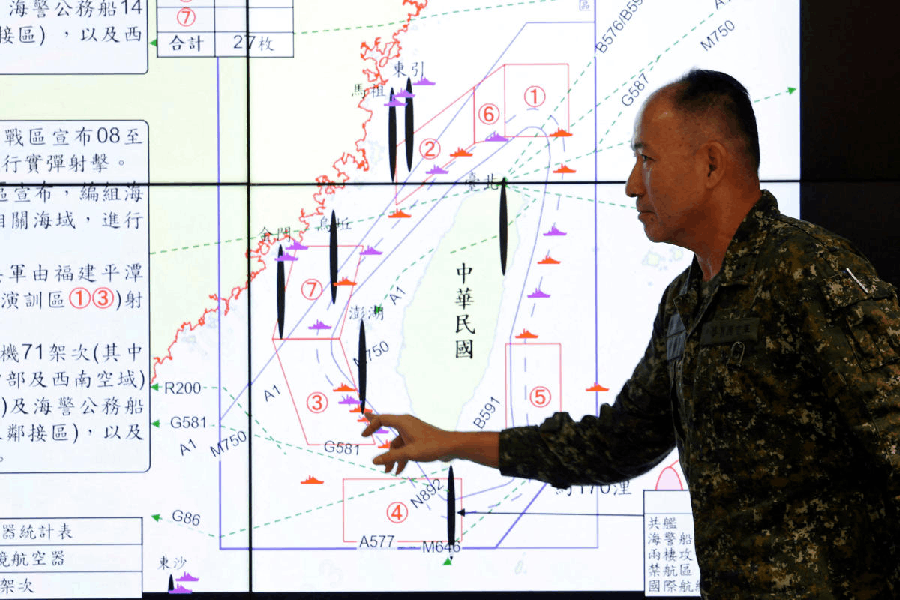
Taiwan is determined to defend its sovereignty and boost its defence, President Lai Ching-te said last month, after Beijing fired rockets towards Taiwan as part of its latest military drills.
The drills surrounding Taiwan - the most extensive to date - were accompanied by strong messaging from Chinese officials and the military.
"Any external forces that attempt to intervene in the Taiwan issue or interfere in China's internal affairs will surely smash their heads bloody against the iron walls of the Chinese People's Liberation Army," China's Taiwan Affairs Office said in a statement.
In October, Lai unveiled a multi-layered air defence system called "T-Dome".
It is intended to be similar to Israel's "Iron Dome", with a more efficient and "sensor-to-shooter" mechanism for a higher kill rate that integrates weaponry from Taiwan-developed Sky Bow missiles to U.S.-supplied HIMARS rocket systems.
In July, Taiwan's military staged a drill to protect the Taipei's main airport from a hostile landing, deploying portable stinger rockets and tanks.
Maduro extraction inspires some
While military attaches say China has war-gamed extraction operations in Taipei in a broad range of military options to take control of Taiwan, some Chinese online users tom-tommed the U.S. action in Venezuela as inspiration.
"The Venezuelan situation has provided us a solution for unifying Taiwan," said one user on the X-like microblogging site Weibo.
"First use special operations to arrest Lai Ching-te, then immediately announce the takeover of Taiwan, issue new identity cards ... and achieve a swift and decisive victory."
Chen, who sits on the foreign affairs and defence committee of Taiwan's parliament, dismissed such remarks as "fantasy" and other analysts said any such attempt would quickly face hard military realities.
China had added aircraft to replicate platforms such as Boeing's EA-18G Growler electronic warfare jet and Northrop Grumman's E-2D Advanced Hawkeye command and early warning aircraft, but their precise capabilities had yet to be delineated, Koh said.
With the ruling Communist Party still playing a role in the PLA's command structure, doubts remain about its effectiveness, added Koh, who is with the S. Rajaratnam School of International Studies.
"A decentralised command-and-control hierarchy is essential; that allows field commanders to exercise necessary initiative to cope with the fluid, evolving and uncertain nature of military operations as events unfold," Koh said.
Despite any perceived PLA shortcomings, Taiwan's leaders are taking no chances, however.
"We have have no capital to take them lightly," said a senior Taiwan security official, who spoke on condition of anonymity as the military issues are sensitive.
"After all, in the wake of this painful and shocking experience, China will also look for all kinds of ways to overcome these problems."