
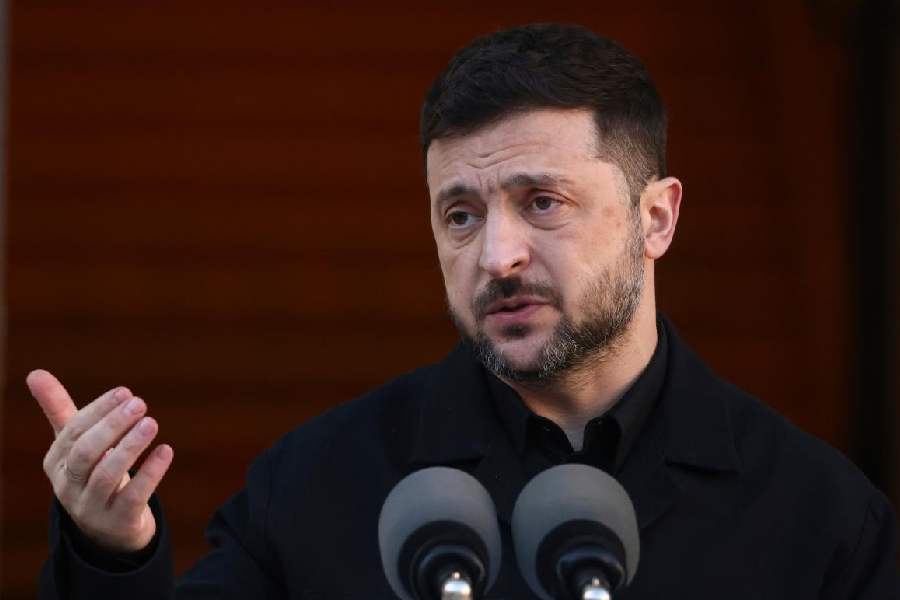
Ukrainian President Volodymyr Zelenskyy has written to US President Donald Trump and Congress asking for more American-made air defence ammunition to counter intensifying Russian ballistic missile attacks, Kyiv said Wednesday.
Meanwhile, Russian lawmakers have backed a draft bill to have bank employees join the fight against Ukraine's long-range drones that strike deep inside Russia - with trained bank staff shooting down the unmanned aircraft.
The steps came after a recent escalation in aerial attacks by both sides in the more than four-year war that followed Russia's all-out invasion of its neighbor. Neither side has been able to make much progress on the 1,250-km front line.
Also on Wednesday, Anne Keast-Butler, head of UK's intelligence agency GCHQ, asserted that Russian President Vladimir Putin is "going backwards on the battlefield".
New data shows that "almost half a million Russian soldiers have now been killed since the conflict began," she added.
Ukraine has pounded Russian targets, especially oil facilities and manufacturing plants, with its domestically produced drones. At the same time, the Russian military has intensified its aerial attacks, firing almost 90 missiles as well as hundreds of drones at Kyiv last weekend in an effort to overwhelm air defences.
The Ukrainian leader urged Trump and Congress in a letter, which was obtained by The Associated Press, to supply more Patriot PAC-3 missiles and other air defence systems, warning that deliveries to Ukraine are falling dangerously short as the Iran war diverts US stocks.
Ukraine has raised its drone interception rate to more than 90%, the letter says, and Ukrainian specialists have helped countries in the Middle East - specifically the Gulf Arab region - strengthen air defences. They have also helped at American military bases in the Mideast, the letter says.
But Ukraine cannot yet produce its own anti-missile defence systems, Zelenskyy said, and for that relies "almost exclusively on the United States".
"For us - for a nation fighting for its survival - there is hardly anything more painful to see than Patriot batteries with no missiles loaded," Zelenskyy wrote.
Deliveries, he says, are "no longer keeping up with the reality of the threat we face."
Washington did not immediately comment on the letter.
The US weapons that European nations and Canada buy to donate to Ukraine are a vital component of the country's air defences, but only a few NATO allies are investing significant sums in the arrangement, alliance officials say.
The ambitious plan approved by the country's lower house of parliament on Tuesday envisages banks installing electronic jamming systems on their premises while selected employees would be trained to shoot down incoming drones.
And with banks in almost every town, their incorporation into Russia's air defences could help expand its cover.
The bill, which state news agency Interfax said was first presented last August and later expanded in scope, must still be approved by the upper house Federation Council and signed by Putin before coming into force.
Russia is finding it hard to protect its large land mass from a growing number of attacks by increasingly sophisticated Ukrainian long-range drones. Smaller drones are also holding back Russian troops along the front line, Western analysts and officials say.
As the intensity and depth of Ukrainian drone attacks have increased, Russian authorities have encouraged businesses to contribute to protective measures against aerial strikes.
Russian banks are not known to have been a prime target for Ukrainian drones in the war that followed Moscow's 2022 invasion. The plan encompasses Russia's central bank and other top institutions, including majority state-owned Sberbank.
With little details included in the bill, it has raised questions about how such a project would work. The widespread installation of equipment and training of staff in how to use it would require a huge organisational effort.
With Putin keen to shield Russians from the war, the plan could work against his efforts by involving regular citizens in it and making the consequences of the invasion more visible.
The proposed measure reflects growing problems for Russia against Ukraine's increasingly sophisticated drones, according to Thomas Withington, an associate fellow at the Royal United Services Institute in London.
The draft bill "seems to indicate that … military-level drone defense capabilities in Russia are failing, because if they were working you wouldn't need to do that," Withington told The Associated Press.
"This situation is not improving for Russia," he said, noting that Moscow is battling to keep up with Ukrainian drone innovations.
The measure seeks to "try and offload some of the burden of drone protection to the non-military, non-law enforcement sectors," which are under strain, he said.
The bill says bank employees may jam or intercept drone control signals, and damage or destroy uncrewed aerial, underwater and ground vehicles threatening their facilities, without waiting for a response from security services.
"Jamming will be used to make it more difficult for (the drones) to target and attack the relevant targets," Anatoly Aksakov, chairman of the State Duma Committee on Financial Markets, told Russian media outlet RBK. "Plus, we'll also use means to shoot down these drones, thereby protecting the relevant targets."
Each organisation would determine which employees would be trained to deploy the measures.